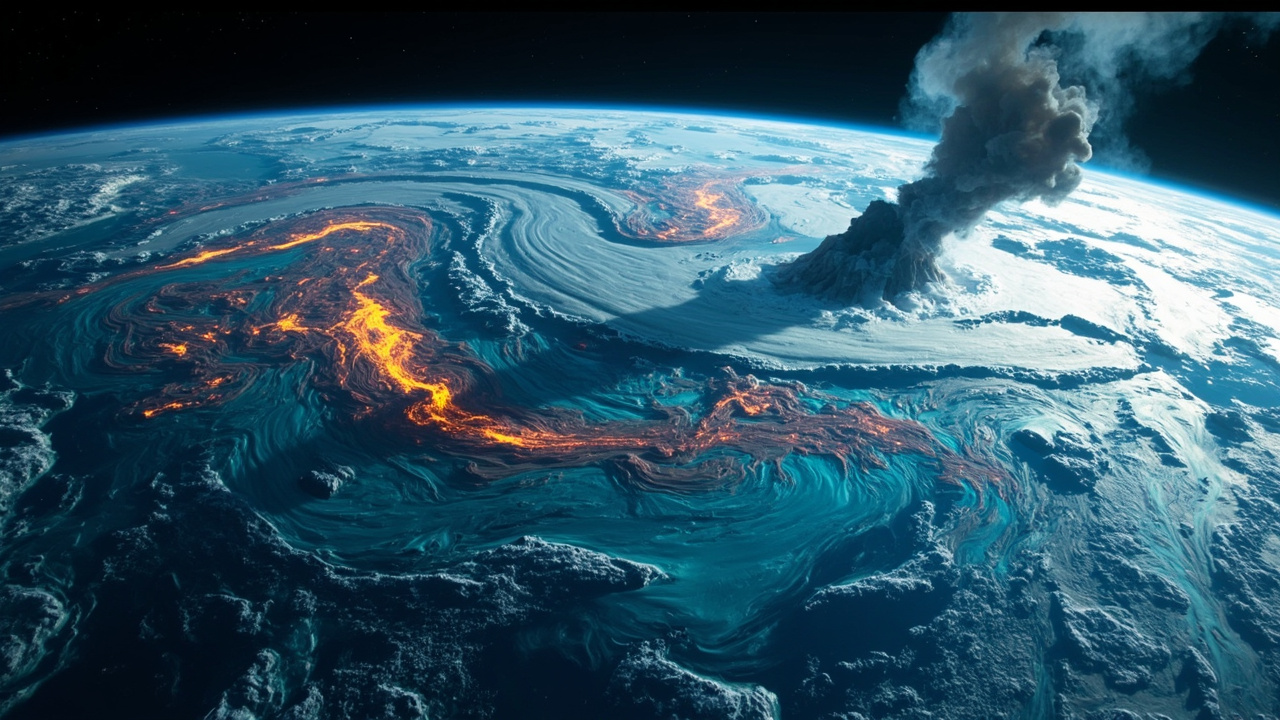
TL;DR: A paper titled "Uneven imprints of major volcanic winters on weakening global marine cold-spells since 1850" was listed as an Article in Press in Ocean-Land-Atmosphere Research, while independent ocean records show marine cold-spells becoming less frequent as major eruptions leave uneven regional signals.
New listing frames volcanoes and fading ocean cold extremes
A study by Jan Kempert and Raven Quilestino-Olario is listed under the title "Uneven imprints of major volcanic winters on weakening global marine cold-spells since 1850" in Ocean-Land-Atmosphere Research, according to the journal page hosted by Science Partner Journals.
The same journal page identifies the venue as Ocean-Land-Atmosphere Research Article in Press, with Article ID 0177 and DOI 10.34133/olar.0177.
The journal page states the work was published online on 7 September 2026.
The journal page lists Kempert with South Westphalia University of Applied Sciences - Hagen in Hagen, Germany.
The same page lists Quilestino-Olario with the Institute of Geology and Mineralogy at the University of Cologne in Köln, Germany.
The title itself signals two themes: a long-term weakening of global marine cold-spells since 1850, and uneven effects associated with major volcanic winters.
The journal page offers a PDF view option but does not display an abstract, results, methods, or figures in the text retrieved for this archive report.
For readers in the United States tracking space-based ocean observation and climate variability, the listing matters because satellites, reanalyses, and paleoclimate archives now provide overlapping views of how short-lived volcanic cooling interacts with a longer warming trend.
What marine cold-spells look like in recent monitoring
Recent monitoring shows a contrast between widespread marine heat and much less widespread marine cold.
The 36th annual State of the Climate report, summarized by Green Left, found that about 87% of the ocean surface experienced at least one marine heat wave last year, while only 26% experienced at least one marine cold spell.
The same summary reported that mean annual global sea surface temperature was the third highest in the 172-year record and stood 0.38°C above the 1991–2020 average.
The State of the Climate summary placed last year's global mean temperature across land and ocean among the three highest years on record, with records extending back to the mid-1800s.
The summary also reported that the past 11 years from 2015–25 were the 11 warmest on record across all five major global temperature datasets used for analysis.
The report was described as published by the American Meteorological Society and based on contributions from 625 scientists in 60 countries.
The summary said data were collected by environmental monitoring stations and instruments located on land, water, ice and in space.
Greenhouse-gas context accompanied the ocean findings, with globally averaged carbon dioxide reported at 425.6±0.1 parts per million, a 53% increase from a preindustrial level of about 278 parts per million.
Fossil-fuel emissions were estimated at 10.3±0.5 petagrams of carbon per year, compared with 3.0±0.2 petagrams per year in the 1960s, according to the same summary.
Global ocean heat content from the surface to 2,000 metres depth reached new record highs, and the oceans were reported to have stored almost 90% of excess energy trapped over the past half-century.
Global mean sea level was reported as a record high for the 14th consecutive year, about 111.2 millimetres above the average for 1993, when satellite altimetry measurements began.
Those basin-to-global indicators provide the background against which a study of post-1850 marine cold-spells can be read: unusually warm seas leave less room for persistent cold extremes.
Gulf of Maine shows the cold-spell decline in one U.S. region
A preprint synthesis focused on the Gulf of Maine quantified opposite trends for hot and cold ocean extremes between 1993 and 2025.
The authors reported a 3% yearly increase in marine heatwave events and a 4% yearly decrease in marine cold-spells over that interval, according to the EcoEvoRxiv preprint record.
The Gulf was described as located at the confluence of the Labrador Current and the Gulf Stream.
The paper argued that ecosystems at the confluence of large global currents are particularly vulnerable because small shifts in currents can trigger rapid local change.
The synthesis noted that the Gulf of Maine experienced rapid warming in recent decades, punctuated by frequent extreme temperature events affecting fisheries and diverse ecosystems.
The authors said synthesis work had not previously quantified changes in extreme temperature events over time or their implications for Gulf of Maine ecosystems.
Trends were reported to vary spatially across the Gulf of Maine, rather than being uniform.
To assess ecological effects, the team conducted a formal literature review, starting from 539 papers and identifying 12 papers that met criteria for extreme temperature events affecting ecosystems in the Gulf of Maine.
Across marine ecosystems, the review noted direct physiological impacts and cascading effects through disease spread, altered food webs, and disrupted fisheries.
The review also addressed effects on coastal human communities and possible future change with emerging stressors and human migration.
The author list is led by Easton R. White of the University of New Hampshire, with collaborators including Camyrn Ragland, Jannine Chamorro, Selina Cheng, Valerie Eddington and others.
The record identifies the work as a preprint version 1 that had not been peer reviewed.
For Morning Space Brief readers, the relevance is observational: the 1993–2025 window coincides with continuous satellite altimetry and increasingly complete satellite sea-surface temperature coverage.
Why volcanic winters would leave uneven marks
A separate line of evidence shows that volcanoes can disturb ocean-climate relationships temporarily and unevenly, rather than cooling every region in the same way.
Researchers at Woods Hole Oceanographic Institution combined paleoclimate evidence with climate-model simulations to examine links between the tropical Indian and Pacific oceans over several centuries, according to ScienceDaily.
The study was published in Nature Communications under the title "Coupling of Pacific and Indian Ocean variability disrupted by 19th century volcanism."
The team used tropical paleoclimate records preserved in corals, tree rings and stalagmites to reconstruct conditions back to the early 1600s.
The paleoclimate evidence showed the Indian and Pacific oceans remained closely connected through most of the past 400 years.
Between 1810 and 1850, that relationship changed significantly, and researchers linked the disruption to a series of major tropical volcanic eruptions, ScienceDaily reported.
Those eruptions appeared to weaken the Pacific Ocean's usual influence over climate conditions in the Indian Ocean.
Computer simulations covering the past thousand years supported that interpretation.
The strength of the disruption depended on both eruption size and background climate conditions at the time.
ScienceDaily quoted co-author Caroline Ummenhofer, a senior scientist at WHOI, as saying the work was among the first to examine the Pacific-Indian connection using past climates, modern observations and climate models.
Lead author Shawn Wang, described as a former WHOI graduate student and postdoctoral researcher now at the University of Colorado Boulder, said paleo-records and models allowed greater confidence that recent changes are exceptional.
Ummenhofer added that global warming and human emissions are now overwhelming the Pacific's natural influence on the Indian Ocean.
Co-author Delia Oppo, an emeritus research scholar at WHOI, described the Indian Ocean as a huge heat reservoir that can decouple from Pacific behavior.
The study was reported as supported by the U.S. National Science Foundation, the WHOI Investment in Science Program and the WHOI Academic Programs Office.
Eurasian winter response shows limits of a simple cooling story
Another peer-reviewed analysis published 7 September 2026 urges caution about assuming that large eruptions produce a uniform winter response.
The paper "No evidence of statistically significant Eurasian winter warming or cooling caused by large eruptions over the last millennium," by Zilu Meng and Lorenzo M. Polvani, appeared in npj Climate and Atmospheric Science.
The authors examined the 20 largest tropical eruptions of the last millennium, each exceeding the magnitude of the 1991 Pinatubo event.
They separately examined the largest extratropical eruptions over the same period.
To address sparse winter proxy data, they used a recently developed online paleo-data assimilation dataset called LMR Seasonal, in which analysis from one season is propagated forward as the prior for the next season.
That approach was described as allowing information from dense summer-sensitive proxies to better constrain winter climate.
Irrespective of latitude, the authors found no evidence of statistically significant wintertime post-eruption warming or cooling over Eurasia and Northern Europe.
Correlation analyses showed no significant relationship between volcanic stratospheric sulfur injection and subsequent winter temperature anomalies.
The findings were corroborated with two additional datasets named WinTEDA and ModE-RA.
Analysis of individual eruptions revealed considerable spread across datasets for many events.
The authors questioned the validity of superposed epoch analysis, saying it can yield erroneous conclusions even on continental scales.
Meng is affiliated with the Department of Atmospheric and Climate Science at the University of Washington in Seattle, while Polvani is affiliated with Columbia University and Lamont-Doherty Earth Observatory.
The work was supported by NSF Awards 2402475 and 2105805, according to the publisher page.
How to read the new OLAR title alongside these records
Taken together, the sources available by the archive cutoff describe a system in which cold extremes are fading in many waters but volcanic interruptions remain regionally specific.
The OLAR title points to weakening global marine cold-spells since 1850, a period that starts near the end of the 1810–1850 volcanically disturbed interval identified in the WHOI study.
The Gulf of Maine preprint gives one concrete regional example of that direction of change, with fewer cold-spells from 1993 to 2025.
The State of the Climate summary gives a global snapshot consistent with reduced opportunity for cold-spells, with far less ocean area affected by cold-spells than by heat waves.
The WHOI results and the Eurasian-winter results both warn against expecting the same signal everywhere after an eruption.
For satellite and mission watchers, the practical implication is that continuous orbit-based sea-surface temperature, sea-level and ocean-heat records are essential for separating brief volcanic cooling from longer declines in cold extremes.
The OLAR article page does not, in the retrieved text, specify which eruptions, ocean basins, datasets or cold-spell metrics Kempert and Quilestino-Olario analyzed.
Any comparison of eruption-by-eruption effects will therefore need the full PDF or subsequent data release, rather than the listing alone.
What is verified now is narrow but useful: a newly listed peer-reviewed venue for the volcano–cold-spell question, and a set of independent U.S.-relevant observations showing why uneven, regional analysis is required.
Sources referenced
- Uneven imprints of major volcanic winters on weakening global marine cold-spells since 1850 | Ocean-Land-Atmosphere Research (https://spj.science.org/doi/10.34133/olar.0177)
- Temperature extremes in the Gulf of Maine: A synthesis of marine heatwaves, cold-spells, and ecological impacts (https://ecoevorxiv.org/repository/view/14657/)