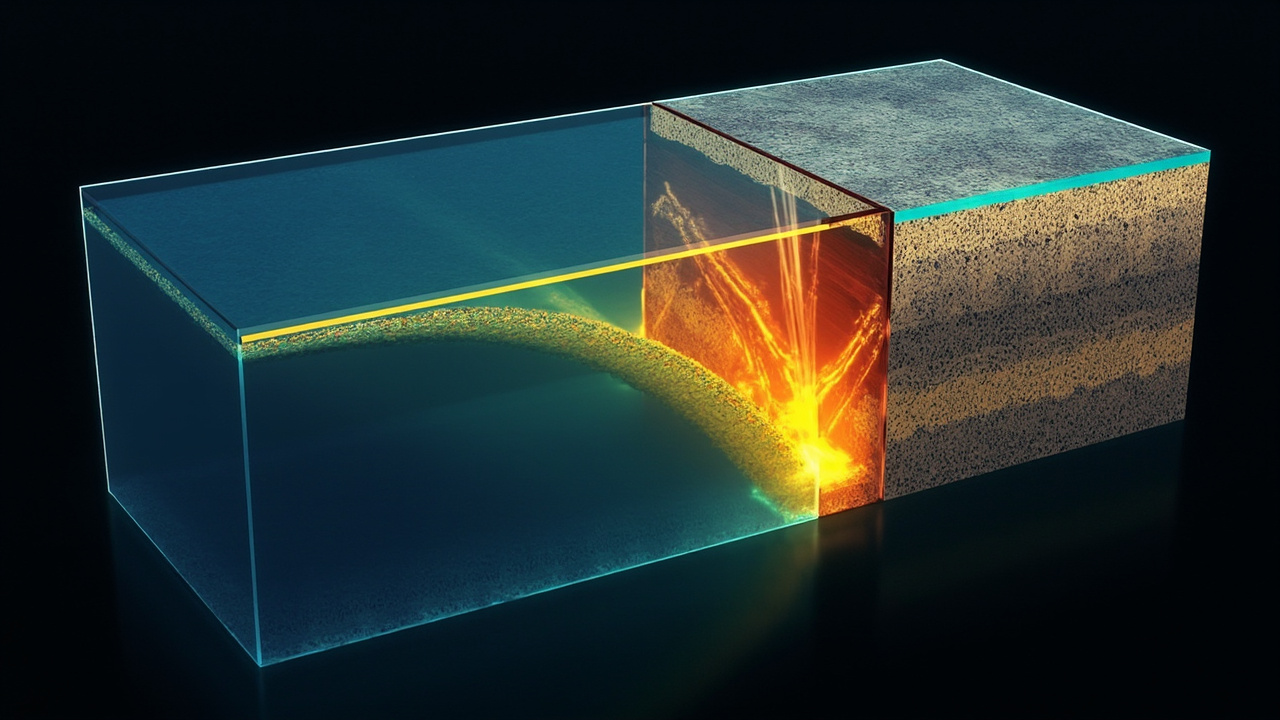
TL;DR: Near-lithostatic pore-fluid pressure lets bending oceanic plates slip backward on old normal faults, erasing up to half their initial offset.
Bending plates break differently at ridges
Elastic flexure of tectonic plates forms broad topographic features and can drive slip on faults that cut the full lithosphere, according to the paper Elevated fluid pressure in compression facilitates flexural reverse faulting | Science Advances. Bending stresses are largest near the upper and lower faces of a flexed plate. When those stresses pass yield, shallow rock fails in brittle faulting that can nucleate or reactivate faults and cause large earthquakes, while deeper rock flows in a ductile manner. Faulting tied to bending is established at convergent margins but was identified at divergent margins only recently. Mid-ocean ridge lithosphere offers a comparatively simple structure and history for testing how such bending faults and earthquakes develop.
A predicted compression signal went missing until 2022
Early plate-tectonic work proposed that unbending beside an axial valley should place the shallow plate in compression and create surface-breaking reverse faults and earthquakes. Flattening beside an axial high was already linked to normal-fault amplitudes at fast-spreading ridges, and unbending away from an axial high was expected to give surface extension. The valley-flank compression forecast lacked observed earthquakes for decades. That gap closed with a sequence on the Mid-Atlantic Ridge near 54°N, documented in work cited by the Science Advances team. The sequence started on 26 September 2022 with normal-faulting earthquakes. Those events shifted about 45 km south along the axis in 3 days. On 29 September 2022 a moment magnitude 5.1 reverse-faulting earthquake occurred about 15 km east of the axis.
Twelve reverse events mark two narrow off-axis zones
Eleven more reverse-faulting events followed the 29 September 2022 shock, with the final detection on 4 January 2023, according to the Science Advances paper. The reverse shocks clustered symmetrically in two narrow bands about 15 km from the spreading axis on both flanks. The paper places the sequence on one Mid-Atlantic Ridge segment near 54°N. Normal faulting opened the episode along the axis before compressional failure began off axis. The spatial pattern provided a direct test for models of valley unbending. Standard treatments reproduced the position of failure but consistently underpredicted how deep compression extended and how large the associated surface offsets became.
Seafloor scarps show half the valley extension is undone
Bathymetric profiles across the 54°N segment show fault-scarp throws compiled by Olive and colleagues, as displayed in the Science Advances figures. Cumulative horizontal fault offset rises steeply near the axis and then flattens farther out. The slope of that cumulative-offset curve, treated as apparent tectonic strain T, falls from T = 0.13 in the near-axis interval to T′ = 0.07 in the far-field interval. The break occurs about 15 km from the axis, the same distance as the reverse-faulting clusters. The authors interpret the drop as reversal of up to 50% of extensional offsets generated inside the axial valley by later compressional slip across the valley flanks. That quantitative strain comparison anchors the modeling that follows.
Global profiles confirm flexure reshapes abyssal hills
A companion analysis reported in Global Evidence for Off‐Axis Flexural Modification of Abyssal Hill Faults at Mid‐Ocean Ridges widened the test beyond one segment. That Geophysical Research Letters study examined 50 across-axis bathymetric profiles from 21 regions covering slow to fast spreading rates. The team picked 1,201 abyssal-hill-bounding fault scarps and tracked cumulative heave across ridge shoulders. After correction for apparent-throw loss from surface processes, axial-valley ridges displayed shortening that grows with axial relief. Fast-spreading axial-high ridges displayed extension that grows with relief. Axial-high ridges spreading at slow-to-intermediate rates displayed little flexural strain, attributed to thicker axial lithosphere gaining limited accretional curvature. A simple flexural calculation with strain proportional to axial relief reproduced the first-order pattern.
Models need near-lithostatic fluids to match the strain
The Science Advances authors used numerical models to test why reverse slip reaches the observed depth and surface expression. Their result is that elevated pore-fluid pressure in the compressional domain permits greater slip on flexure-driven reverse faults. Agreement between modeled reverse-fault bending strain and the strain inferred from bathymetry and seismicity occurs only when pore-fluid pressure in the reverse faults nears lithostatic values. Lower fluid pressures keep effective normal stress higher and limit reactivation. Near-lithostatic fluids lower effective stress enough for inherited structures to move in compression. The finding assigns a central role to inherited structural heterogeneity together with high pore pressure during unbending of the lithosphere.
Old normal faults become young reverse faults
Reactivation geometry matters because many off-axis faults start as ridge-axis normal faults nearly parallel to the bending axis. Outer-rise studies cited in the paper show that preexisting faults close to parallel to the bend axis are preferentially reactivated, with normal-fault offsets of about 50 to 100 m visible in bathymetric and seismic-reflection records. At 54°N the reverse zones sit where cumulative normal offset begins to decline, consistent with reuse of valley-formed structures in the opposite sense. The mechanism therefore does not require creation of entirely new throughgoing thrusts. It calls for compression to exploit suitably oriented inherited faults once fluids reduce frictional resistance. That reuse explains the symmetry of the two bands about 15 km from the axis on opposite flanks.
Why continental forebulges face a related hazard
The authors extend the oceanic result to continental forebulges where bending stresses also load inherited faults. They point to the stress field of the India-Tibet forebulge, described with an approximately 670 km wavelength, as a likely contributor to reactivation of a rift-related normal fault in the 2001 Bhuj reverse-faulting earthquake. That event had moment magnitude 7.6 and caused more than 20,000 deaths. Tomographic work cited in the reference list reports evidence for fluids at the Bhuj hypocenter and discusses implications for rupture nucleation. In the new interpretation, pore-pressure modulation may amplify flexure-induced seismicity in such forebulges. The paper therefore presents pore-pressure level as a fundamental control on global tectonic hazards, not only a local ridge curiosity.
What standard hazard sketches omitted
Convergence-zone bending has long illustrated the hazard from flexural normal faulting at the outer rise. The 2009 Samoa-Tonga sequence combined a moment magnitude 8.1 normal-faulting mainshock with two moment magnitude 7.8 thrust earthquakes, generated run-ups up to 12 m, and caused 192 fatalities, according to the Science Advances introduction. Those events show how bending faults can participate in tsunamigenic sequences. The ridge result adds the complementary case in which unbending drives compressional reactivation off axis. Models that use hydrostatic or modestly elevated pore pressure capture where that reactivation should occur but miss its depth extent and surface offset. Inclusion of near-lithostatic pore pressure in compression closes that mismatch for the 54°N strain values. The work was supported by the European Research Council, with authors Zhonglan Liu of Jilin University, W. Roger Buck of Lamont-Doherty Earth Observatory, and Jean-Arthur Olive of Centre National de la Recherche Scientifique.
What remains a projection rather than an observation
The observed portion is the 2022-2023 Mid-Atlantic Ridge sequence, the T = 0.13 to T′ = 0.07 strain drop, the 1,201 scarps in 50 profiles from 21 regions, and the model match that requires near-lithostatic fluids. The wider hazard statement remains a proposed mechanism rather than a demonstrated forecast for any specific forebulge. The paper frames elevated fluids as a candidate amplifier of events like the 2001 Bhuj earthquake rather than a prediction of timing or size. Future seafloor mapping and microseismic monitoring can test whether other axial valleys show paired reverse bands near 15 km or at distances scaled by relief and lithospheric thickness.