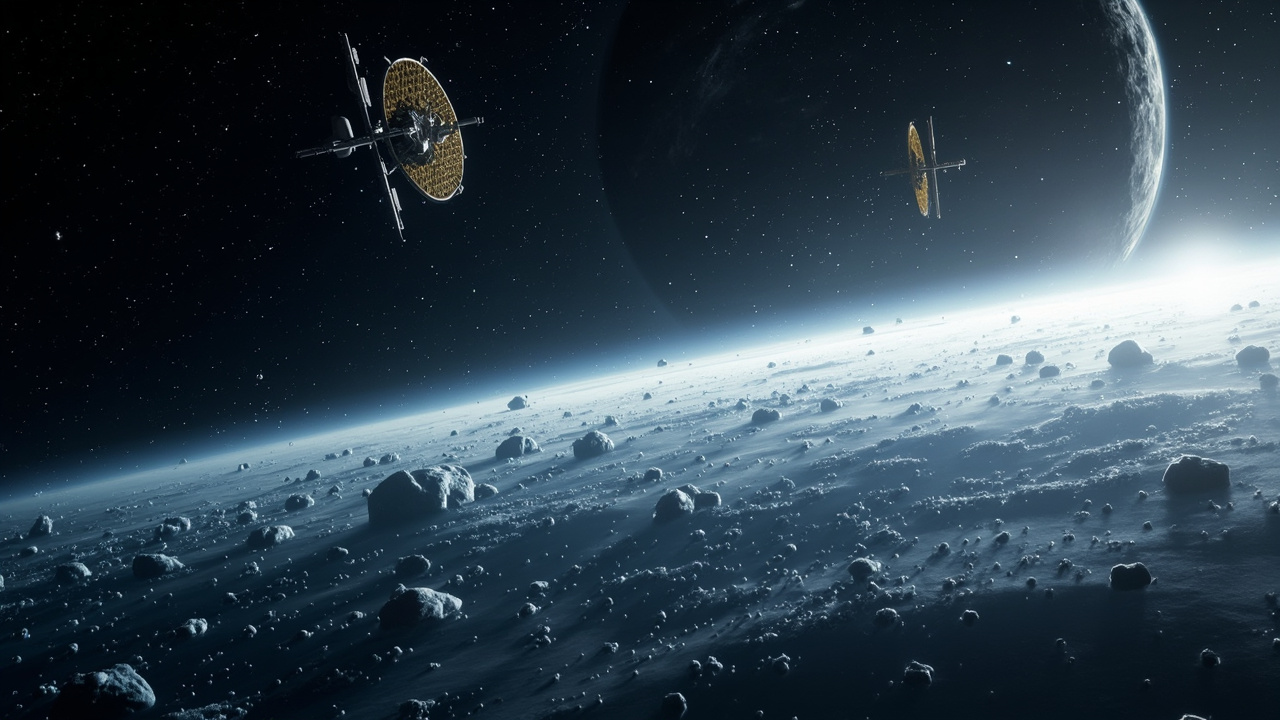
TL;DR: Tiny Ice Worlds Kept Their Birth Colors
For the first time, scientists combined NASA's Hubble and James Webb space telescopes to study Trans-Neptunian Objects, and found that 27 newly discovered tiny bodies share the colors of their larger relatives while appearing in smaller numbers than many formation models predicted.
The joint work is described in two complementary papers published Tuesday in The Astronomical Journal, according to NASA Science in "NASA’s Hubble, Webb Find Far-out Solar System Objects ‘Remember’ Past - NASA Science." The teams analyzed the color, composition, and size distribution of 27 newly discovered tiny, dim Trans-Neptunian Objects, or TNOs. Some are the smallest and faintest ever directly seen. The researchers unexpectedly found fewer small TNOs than they expected, and that the colors of these bodies followed the same relationships as their larger family members.
TNOs are typically small, faint, icy bodies orbiting the Sun beyond the orbit of Neptune, according to NASA Science. Most are more than 100 million times dimmer than objects visible to the unaided eye. The new sample extends that frontier to remarkably dim detections, including one object described as equivalent to standing on Earth and seeing a small swarm of fireflies on the Moon.
Deepest TNO Survey Used Hubble And Webb Together
In the deepest TNO survey to date, teams examined a patch of sky simultaneously with Hubble and Webb, according to NASA Science. Hubble observed the TNOs' visible light, while Webb observed their infrared light. The team of researchers measured the objects' colors, sizes, and determined their orbits.
The effort was led by PhD candidates from the University of Victoria in Canada, under the guidance of the National Research Council of Canada, and Northern Arizona University in Flagstaff, according to NASA Science. One study was led by Northern Arizona University PhD candidate Anastasia Morgan and focused on color and composition. A complementary study was led by University of Victoria PhD candidate Marielle Eduardo and focused on size distribution.
Northern Arizona University's account of the work, in "Far-out space objects ‘remember’ their past - The NAU Review," describes the pair of studies as the first in history to harness the joint power of NASA's Hubble and Webb telescopes. In that account, Morgan and Eduardo's teams studied TNOs in one tiny patch of sky, with Morgan measuring colors and Eduardo measuring size distribution.
This project would not have been possible without Hubble and Webb working together to detect and characterize these TNOs, according to NASA Science. With Hubble's sensitivity in visible light and Webb's in infrared, the space telescopes provide more insights than either can on its own.
The color measurements covered optical to near-infrared wavelengths. The peer-reviewed abstract for "Combined JWST and HST Deep Imaging to Characterize the Smallest Known Trans-Neptunian Objects" reports optical-near-infrared color measurements spanning 0.35-3.2 microns for small TNOs at sizes of 40 kilometers and below, using coordinated and nearly simultaneous observations. In that abstract, Webb's NIRCam data provided detections and near-infrared photometry for faint TNOs, while Hubble's ACS and WFC3 imaging enabled recovery in the optical.
Thirteen Webb-detected TNOs were recovered in the Hubble observations, according to the same abstract. The authors state that trailed point-spread-function photometry was used to derive mean magnitudes, colors, and rotational lightcurves.
Colors Act Like Fingerprints Of Surface Composition
The teams measured the objects' colors, which are like a fingerprint of the surface composition, according to NASA Science. That comparison was central because earlier expectations held that repeated impacts should have resurfaced the smallest bodies.
Prior to these observations, astronomers thought that small TNOs from both hot and cold populations would have undergone many collisions, changing their surfaces compared to larger TNOs, according to NASA Science. The observations did not show that pattern. Instead, the small bodies look like their larger counterparts.
The implication described by NASA Science is that collisions are not changing the surfaces significantly. Two possibilities are noted: perhaps there are fewer collisions than expected, or the TNOs somehow retain their primordial, pre-collision compositions. The teams are still trying to unravel this mystery.
Morgan said the team expected to find variation in colors, shapes, and materials as evidence of prolonged travel and collisions, according to the NAU Review account. What the researchers found instead was very little variation, suggesting much less movement than imagined.
“For these objects to have a lot of the same color and shape, it’s telling us that they have probably sat there and not been very collisionally active,” Morgan said in the NAU Review account. “The models say they should have been altered by collisions, but that’s just not what we’re seeing.”
In NASA Science's account, Morgan added:
“You could imagine a scenario where getting knocked around and fragmented would change the surface composition, and then you would see a different surface color for tiny TNOs compared to their larger siblings. So it's really fascinating to see that the smallest objects are somehow 'remembering' and preserving the history of how they were made.”
Both the hot and cold populations seem to keep the same colors as when they were formed, with little change since the birth of the solar system, according to NASA Science.
Cold And Hot Populations Preserved Different Histories
In the coordinated observations, the teams studied two different types of TNOs, according to NASA Science. The first, dynamically cold TNOs, are on their original, relatively circular orbits around the Sun in the plane of the solar system.
The second type, dynamically hot TNOs, formed between the current locations of Uranus and Neptune but were pushed outward where they are today when the outer gas giants migrated early in the solar system's history, according to NASA Science. Today they reside in highly elliptical orbits and move in and out of the plane of our solar system.
The distinction matters because the hot population was orbitally scrambled after formation, while the cold population remained closer to its original configuration. David Trilling of Northern Arizona University, a co-author, said the dynamically hot TNOs retain a signature of where they were born despite later orbital changes, according to NASA Science.
“These dynamically ‘hot’ TNOs retain a signature of where they were born, even though they’ve been orbitally scrambled since then,” Trilling said.
The NAU Review account similarly quotes Trilling as saying the objects retain a signature of where they were born even though their orbits have been scrambled since then. It also describes Trilling as a professor in the Department of Astronomy and Planetary Sciences at Northern Arizona University and a co-author of the study.
The detailed color results differ by dynamical group but point in the same direction. The journal abstract states that the color distribution of the small cold classical discoveries is narrow and consistent with occupation of a single reflectance sequence previously identified for larger cold classical TNOs. It reports no evidence for a change in that sequence at smaller sizes.
In contrast, the dynamically excited TNOs discovered in the program exhibit a broader range of colors consistent with multiple compositional classes seen at larger sizes, according to the same abstract. Lightcurve amplitudes were generally low for both dynamical groups in the sample.
One previously known object in the field stood out. The abstract identifies 2015 GK56 as a previously known TNO that displays a large-amplitude, structured lightcurve consistent with a contact binary. The authors interpret the overall color result as evidence that the characteristic color distribution extends to smaller sizes than previously studied, suggesting a primordial origin rather than size-dependent collisional processing.
Fewer Small Bodies Than Some Models Predicted
The Webb data also allowed researchers to measure the number of objects of each size, according to NASA Science. They found that the overall size distributions for both populations were surprisingly similar.
Eduardo, who led the study on size distribution, said the similarity was striking because the two populations formed in different regions of the early solar system, according to NASA Science.
“It's very interesting that the process of planetesimal formation ends up producing the same distribution of sizes for both cold and hot populations, despite forming in different regions of the early solar system. The process seems to be insensitive to disk conditions, producing similar planetesimal sizes whether the disk is hot or cold, and dense or fluffy,” Eduardo said.
Researchers also found fewer of these very small bodies than they expected based on some planet formation models, according to NASA Science. Webb discovered 27 new, remarkably dim TNOs. The smallest one observed has a diameter of about 3 miles, or 5 kilometers, which is about five times smaller than what is possible to detect with the most sensitive ground-based telescopes.
The NAU Review account places the faintness in similar terms, describing the studied TNOs as some of the smallest and faintest ever directly seen. It repeats Morgan's comparison of standing on Earth and trying to measure a swarm of fireflies on the Moon without magnification.
The Space Telescope Science Institute release, listed as "NASA’s Hubble, Webb Find Far-out Solar System Objects ‘Remember’ Past | STScI," summarizes the same program as the deepest TNO studies to date. It states that researchers analyzed the color, composition, and size distribution of 27 newly discovered TNOs, some of them the smallest and faintest ever directly seen. It also states that Hubble and Webb, working together to detect and characterize the objects, provided more insight than either could on its own.
A Frozen Record From Planet Building
This class of small bodies offers the best view into an early stage of planet-building, according to NASA Science. At that stage, a disk of dust and pebbles in orbit around the Sun coalesced into city-sized planetesimals, described as the solid building blocks that clump together to form planets, but had not yet merged into full-sized worlds.
Beyond Neptune, this second stage never happened, leaving behind a frozen population of planetesimals, according to NASA Science. That is why the colors and sizes of present-day TNOs can preserve clues about initial conditions.
Morgan said TNOs hold some of the history of the formation and evolution of the outer solar system, according to the NAU Review account. In that account, she said they tell researchers what was present at the beginning and, more broadly, give clues about how other planetary systems are formed.
“TNOs hold some of the history of the formation and evolution of the outer solar system,” Morgan said in the NAU Review account. “They tell us what was here at the beginning, and more broadly, they give us clues into how other planetary systems are formed.”
The Hubble program continues in parallel with newer observatories. NASA Science notes that the Hubble Space Telescope has been operating for over three decades and continues to make discoveries that shape understanding of the universe. It identifies Hubble as a project of international cooperation between NASA and ESA, the European Space Agency, with NASA's Goddard Space Flight Center in Greenbelt, Maryland, managing the telescope and mission operations.
For the new TNO work, the practical result is a tighter link between present-day faint ice bodies and their formation zones. The small cold objects stayed narrowly grouped in color, the small excited objects spanned the broader classes already known at larger sizes, and neither group showed the shift that extensive collisional resurfacing would have produced.