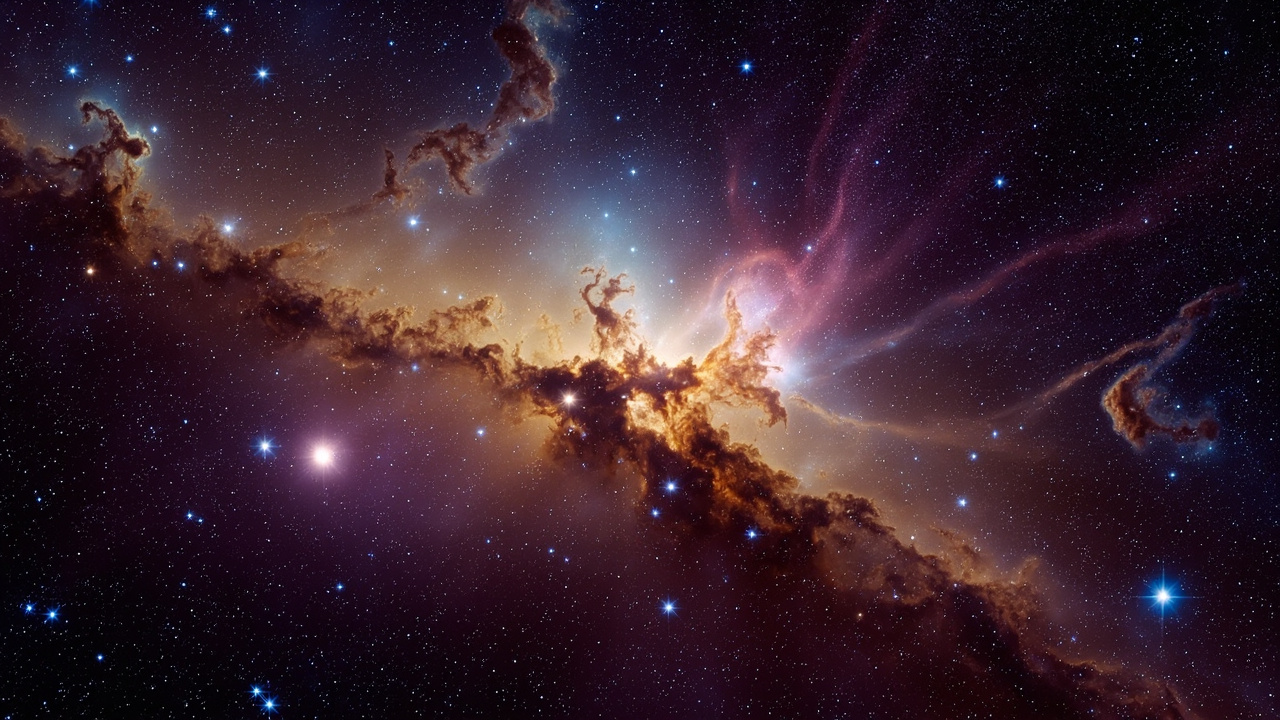
TL;DR: NASA’s James Webb Space Telescope has captured one of its largest images to date of IC 348, finding brown dwarfs as light as twice Jupiter’s mass that challenge star-formation models.
Webb Turns Its Sharp Vision on IC 348
NASA’s James Webb Space Telescope has delivered a sweeping near-infrared view of IC 348, a nearby stellar nursery where astronomers are testing the lower limits of how stars form, according to NASA’s release titled “NASA’s Webb Reveals Dynamic Panorama of Star Formation.”
The region sits just 1,000 light-years from Earth in the constellation Perseus, placing it close enough for Webb to separate faint, cool objects from the glare of brighter young stars. In this field, cold clouds of molecular hydrogen gas collapse to build new stars, producing glowing and sculpted nebulosity across the frame.
The new vista ranks among the largest pictures released from Webb so far to the public. It pairs broad context — filaments, scattered stellar generations, and background galaxies — with fine detail on newborn systems still wrapped in natal material.
Image credit for the panorama is listed as NASA, ESA, CSA, Kevin Luhman (PSU), Catarina Alves de Oliveira (ESA), and Mahdi Zamani (ESA/Webb). The observation is presented as a composite built from separate Webb exposures, with color assigned to different filter bands.
The object listing for the NIRCam image gives a position of right ascension 03:44:34.28 and declination +32:09:43.10, with Perseus as the host constellation. It describes the displayed field as about 19.1 arcminutes high, corresponding to about 5.5 light-years at the distance of IC 348.
Why Astronomers Chase the Smallest Brown Dwarfs
The central science question is direct: how small can an object made by the star-formation process be?
Stars at the low end of the mass scale weigh about 8 percent of the mass of the Sun, as described in both NASA and ESA/Webb accounts. Below that threshold lies a population known as brown dwarfs.
Brown dwarfs arise through the same basic mechanism as stars, through collapse of molecular clouds. Their cores, however, never grow hot enough to fuse ordinary hydrogen into helium, although many briefly fuse deuterium, or heavy hydrogen, early in their histories.
That boundary makes them valuable probes. Massive stars may expire after only a few million years in core-collapse supernova explosions, while the smallest and most common stars are long lived and produce powerful stellar storms. Brown dwarfs extend the sequence further downward, into masses that overlap the planetary regime but form through a star-like path.
Researchers therefore used Webb’s sensitivity to search IC 348 for progressively fainter and cooler substellar members. The goal was not only to count them, but to establish whether star formation has a clear minimum mass and how the resulting mass distribution compares across different clouds.
A Three-Step Hunt From 2022 to 2025
The new result builds on an earlier Webb examination of the same cluster.
The team first studied IC 348 with Webb in 2022 and identified brown dwarfs with masses as low as three to four times the mass of Jupiter, according to NASA’s account. That finding already pushed observations toward planetary masses.
The same research group then looked deeper. It used Webb’s NIRCam, the Near-Infrared Camera, in 2024 to record the warm glow of young brown dwarfs and newborn stars seen in the panorama. Candidates were chosen from their colors and brightness, a standard way to separate cool cluster members from unrelated background stars and galaxies.
Follow-up came in 2025 with NIRSpec, the Near-Infrared Spectrograph, to obtain spectra and assess masses. Spectroscopy spreads the light into fingerprints that reveal temperature, composition, and youth, allowing a more secure classification than imaging alone.
The associated object page lists 30 Aug 2024 as the exposure date for the NIRCam imaging and names filters F162M, F182M, F360M, and F444W. In the released color version, blue is assigned to F162M plus F182M, green to F360M, and red to F444W.
The work was carried out under Webb General Observer Program 4866, led by principal investigators K. Luhman and C. Alves de Oliveira. As summarized by ESA/Webb in “Webb reveals stunning panorama of star formation,” the program aims to study the lowest-mass products of star formation, examine how populations of planetary-mass objects vary among star-forming regions, and investigate the origin of a hydrocarbon signature seen in the lowest-mass dwarfs.
Twice Jupiter’s Mass and Lighter Than Theory Allows
The deep campaign reached a new mark.
The spectra reveal brown dwarfs with masses as low as just twice the mass of Jupiter, or only 0.19 percent of the Sun’s mass, NASA reports. These are described as the least massive brown dwarfs known.
That mass lies well below what many formation calculations had expected to survive as cloud-collapse products. The release therefore describes their existence as a challenge to models of how stars form, a point echoed in the ESA/Webb summary.
The shift from three to four Jupiter masses in 2022 to about two Jupiter masses now may sound incremental, but it opens a new mass range for comparative study. At these extremes, small differences in mass correspond to large differences in temperature, luminosity evolution, atmospheric chemistry, and the likelihood of retaining disks.
The panorama itself helps make that census possible. A wide yet sharp mosaic lets astronomers sample the cluster core, its surroundings, embedded sources, faint outflows, and contaminating background galaxies in one consistent dataset. A companion collage released with the image calls out embedded stars, the central star cluster, faint outflows, Herbig-Haro objects, gravitational lensing, and spiral galaxies as features visible in cutouts.
A Possible Planet Nursery and a Mystery Molecule
Two additional surprises emerged from the faintest targets.
One of the lightest newly found brown dwarfs shows signs of a disk, suggesting that small planets could be forming around an object that itself carries only planetary mass. The ESA/Webb version phrases the implication similarly, noting evidence for a disc around a brown dwarf with planet-like mass.
If confirmed in detail, such a system would show that the disk-building stage is not restricted to true stars. It would also provide a natural laboratory for studying how much solid material can persist around a central mass near two Jupiters and whether planet assembly can proceed there.
The second surprise came from spectra. While examining the brown-dwarf spectra, the team found a feature attributed to an unidentified hydrocarbon, meaning molecules made only of hydrogen and carbon atoms. NASA describes it as unidentified, while ESA/Webb describes it as attributed to hydrocarbons.
This particular signature has only been seen in the atmospheres of the lowest-mass brown dwarfs. That exclusivity leads researchers to suggest that these extreme objects might represent a spectral class of their own, distinct from warmer brown dwarfs and stars.
Program 4866 explicitly includes tracing the origins of that hydrocarbon feature as one of its aims. Understanding whether it reflects temperature, surface gravity, vertical mixing, carbon chemistry, or age will require comparison with other regions and with laboratory and atmospheric models.
Jets, Protostars, and Herbig-Haro Showpieces
Stars and brown dwarfs are not the only subjects in the frame.
A detailed group of protostars occupies the upper-right corner of the image. Several are associated with Herbig-Haro objects, luminous patches that form when jets from growing newborn stars crash into surrounding gas and dust.
The long, narrow horizontal feature in that corner is Herbig-Haro object HH 797. Closer inspection shows it to contain two protostars with nearly parallel outflows, rather than a single driving source.
Just to the right of HH 797 lies HH 211, described as propeller-shaped and as containing both narrow jets and broader outflows. Both HH 797 and HH 211 had been highlighted in earlier Webb releases, and their reappearance here provides wider context for the jets, envelopes, and impacted cloud material.
Together, these outflows record active accretion. Material falls toward a growing protostar, while a fraction is ejected at high speed, sculpting cavities and shocks. The resulting knots and bow shapes preserve a short-term history of episodic ejection.
What This Panorama Changes for Star-Formation Science
For readers in the United States following Webb science, the practical significance lies in calibration. IC 348 is near enough, and now imaged deeply enough, to anchor counts of planetary-mass brown dwarfs against better-studied stellar members.
That census feeds directly into models used across astrophysics. The number of very low-mass objects affects estimates of star-formation efficiency, the distribution of masses emerging from a cloud, and the expected contamination when imaging searches look for directly imaged exoplanets around nearby stars.
The result also sharpens the distinction between formation history and present mass. A two-Jupiter-mass brown dwarf formed by cloud collapse is not the same kind of object as a two-Jupiter-mass planet formed in a disk around a star, even if their masses match. Spectra, disks, chemistry, and environment are needed to tell those pathways apart.
Webb is identified by NASA as the world’s premier space science observatory and by ESA/Webb as the largest and most powerful telescope launched into space. It operates as an international partnership among NASA, ESA, and the Canadian Space Agency. ESA notes that it supplied the launch service on Ariane 5, provided the NIRSpec spectrograph, and contributed half of the mid-infrared instrument MIRI alongside partner institutions.
More detailed study of IC 348’s faintest members is built into the observing plan. The program’s remaining questions — the true minimum mass, regional differences in planetary-mass populations, and the cause of the hydrocarbon band — will require spectra of additional candidates and comparison fields beyond this single panorama.
Sources referenced
- NASA's Webb Reveals Dynamic Panorama of Star Formation (https://science.nasa.gov/missions/webb/nasas-webb-reveals-dynamic-panorama-of-star-formation/)
- Webb reveals stunning panorama of star formation | ESA/Webb (https://esawebb.org/news/weic2619/)