TL;DR: NASA’s James Webb Space Telescope found oxygen-rich silicate dust and, for the first time, water surviving in the dust envelope of the dying star IRS 3 just 0.55 light-years from the Milky Way’s supermassive black hole Sagittarius A*.
What Webb captured on Aug. 11, 2026
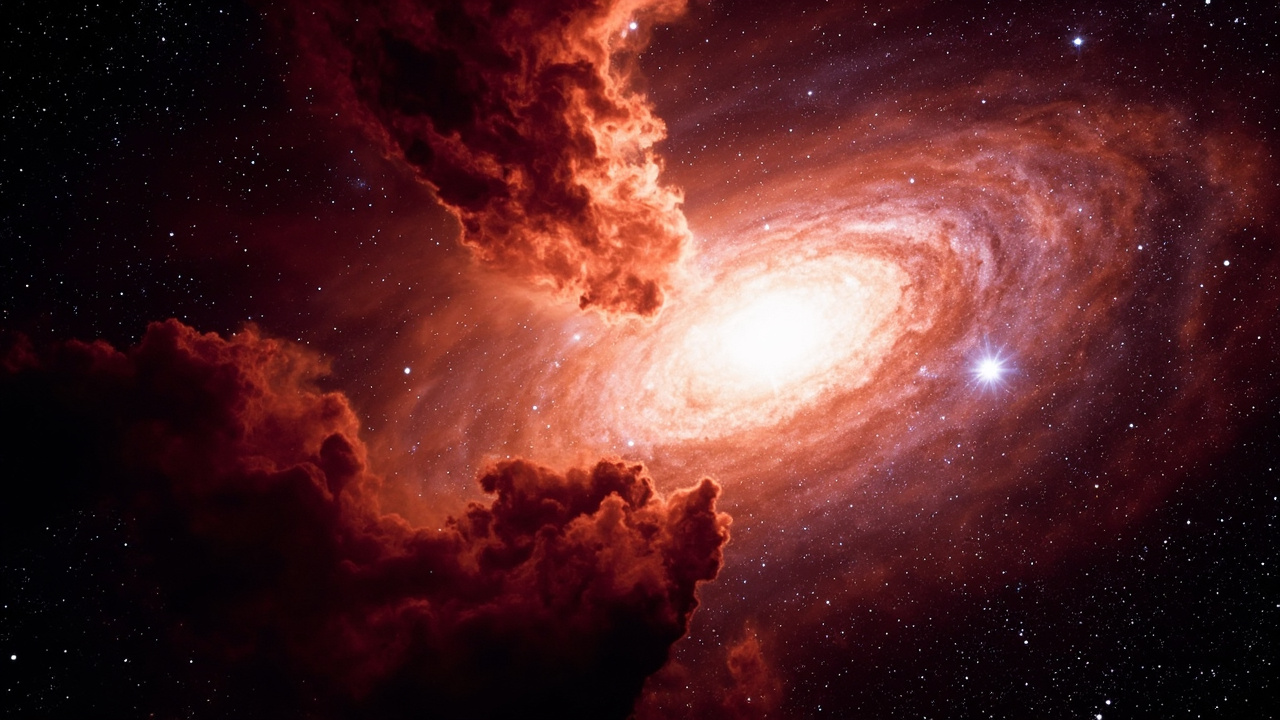
A brilliant concentration of stars takes center stage in an Aug. 11, 2026, image taken by NASA’s James Webb Space Telescope, according to NASA. The starfield centers on IRS 3, a star near the end of its life cycle, according to NASA. Webb’s mid-infrared data revealed the clear signature of oxygen-rich silicate dust in its surrounding dust envelope, according to NASA. The same data revealed, for the first time, water in that envelope, according to NASA.
The image credit lists ESA/Webb, NASA and CSA, F. Peißker, J. Lu, F. Yusef-Zadeh, N. B. Sabha and C. Chan, according to NASA. The frame shows countless stars scattered across glowing clouds, with a bright, almost white core surrounded by filaments and wisps of illuminated gas and dust, according to the Jean-Baptiste Faure image description. Dark, irregular patches of opaque dust interrupt the glowing clouds, particularly toward the left side of the image, according to the Jean-Baptiste Faure image description.
Where IRS 3 sits in the galaxy
IRS 3 is located just 0.55 light-years from Sagittarius A*, the Milky Way galaxy’s central supermassive black hole, according to the Jean-Baptiste Faure image description. Using the James Webb Space Telescope, an international team of astronomers have discovered that dust and water can form and survive surprisingly close to the supermassive black hole at the center of our Milky Way galaxy, according to SpaceWeekly.com.
The observations reveal that the evolved star IRS 3 continues to enrich its surroundings with newly formed material despite the intense radiation environment around Sagittarius A*, according to the Jean-Baptiste Faure image description. The discovery challenges previous assumptions about the survival of stellar envelopes in such extreme environments, according to the report published by Suggeelson.com. It offers new insights into the behavior of asymptotic giant branch stars near supermassive black holes, according to the report published by Suggeelson.com.
Which star Webb studied
The study, published in Astronomy & Astrophysics, focuses on a dying star named IRS 3, located just 0.55 light-years from Sagittarius A*, the supermassive black hole at the heart of the Milky Way, according to the report published by ApolloCT. This star, an asymptotic giant branch star, is in the late stages of its life, losing its outer layers into space due to powerful stellar winds, according to the report published by ApolloCT.
Stars of this type become very large, cool but luminous late in evolution, according to Astronomi News. Old stars of this kind blow gas into space through very strong stellar winds, creating an extensive envelope of material, according to Astronomi News. Gas and dust released in that process are a major source of cosmic dust, material important for forming next-generation stars and planets, according to Astronomi News.
Until now, scientists were uncertain whether that process could still operate so close to a supermassive black hole, according to Astronomi News. The galactic center ranks among the most extreme settings known, which makes continued enrichment there an important question, according to the report published by ApolloCT.
How MIRI exposed the chemistry
The team used Webb’s Mid-Infrared Instrument, known as MIRI, to analyze infrared light from IRS 3, according to Astronomi News. The researchers used the Mid-Infrared Instrument on Webb to observe IRS 3, a dominantly bright dying star, and its surrounding dusty envelope, according to the report published by ApolloCT.
This image features data from Webb’s NIRCam and MIRI to capture the most detailed mid-infrared view yet of the field that hosts the highly evolved star IRS 3, according to the Jean-Baptiste Faure image description. MIRI operates at mid-infrared wavelengths inaccessible to ground-based telescopes because of absorption by Earth’s atmosphere, according to Radiome. MIRI was built with contributions from European research institutions coordinated by ESA and is considered Webb’s most suitable tool for studying cold dust and molecular material in extreme settings, according to Radiome.
The Webb observations revealed an oxygen-rich star with silicate dust, multiple shells of expelled material and clear water signatures, according to the report published by Suggeelson.com. Data from Webb revealed two strong infrared signatures associated with silicate dust, a mineral composed of silicon and oxygen, according to Astronomi News.
Why the oxygen-rich finding matters
The findings show oxygen-rich silicate dust rather than carbon-rich chemistry for IRS 3, according to NASA and Astronomi News. That result differs from an earlier interpretation that treated IRS 3 as potentially carbon-rich, according to Astronomi News and OKDiario. The MIRI analysis detected signals compatible with oxygen-rich dust and silicates, according to OKDiario.
This is the first time a continuous mid-infrared spectrum has been collected for this star, allowing detection of silicate dust features and the star’s true chemical identity, according to the report published by SCS Enviro, quoting ESA MIRI scientist Macarena Garcia Marin. The discovery of water in such an inhospitable environment is particularly exciting because it suggests molecular material can survive intense radiation, according to the report published by ApolloCT, quoting Garcia Marin.
Detection of water indicates the potential for formation of other complex molecules through interaction of star-borne water and radiation, according to the report published by ApolloCT, quoting Garcia Marin. That prospect matters because molecules near a galactic nucleus were thought vulnerable to destruction before they could stabilize, according to Radiome.
How large and hot the envelope is
IRS 3’s dusty envelope extends about 10,000 astronomical units and remains remarkably large and well preserved despite proximity to Sagittarius A*, according to the report published by Suggeelson.com. One astronomical unit equals the Earth-Sun distance, according to Astronomi News. By combining Webb observations with computer simulations, scientists reconstructed a layered, onion-like distribution of dust extending about 10,000 astronomical units from the star, according to Astronomi News.
Temperature falls from about 1,200 Kelvin near the star to about 100 Kelvin in the outer part, according to Astronomi News. In regions closest to the star, aluminum oxide concentrates at very elevated temperatures, according to OKDiario. Farther out appear considerably colder silicate grains, with a thermal difference of about 1,000 K, according to OKDiario.
The envelope is not a simple cloud but consists of multiple shells at different temperatures and distances, according to the report published by Suggeelson.com. Those shells may record thousands of years of mass-loss history, according to the report published by Suggeelson.com. The star’s bloated outer layers pulse outward in a nesting-doll-like set of shells at intervals of hundreds of years, according to the report published by SCS Enviro. That process has potentially been ongoing for 5,000 years, according to previous studies cited by SCS Enviro.
How fast IRS 3 is shedding mass
The mass-loss rate is estimated at 6 × 10^-5 solar masses per year, according to the report published by Suggeelson.com. That rate is equivalent to the mass of Earth every 18 days, according to the report published by Suggeelson.com. Such rapid shedding has allowed IRS 3 to maintain its dense, expanding envelope even in the harsh conditions of the galactic center, according to the report published by Suggeelson.com.
Researchers estimated the density of surrounding material and found evidence of highly uneven conditions in the inner galactic center, according to the report published by Suggeelson.com. Its high mass-loss rate could replenish material in the immediate surroundings of Sagittarius A*, according to the report published by Suggeelson.com. Detection of water suggests molecules can persist inside a sufficiently dense stellar envelope even in the challenging environment of the galactic center, according to the report published by Suggeelson.com.
What modeling says about the star itself
Researchers ran simulations to reconcile Webb observations with stellar models, considering various temperatures, luminosities and chemical compositions, according to the report published by ApolloCT. Investigators used the Hyperion radiative-transfer model to study characteristics of the envelope, according to OKDiario. After about 100,000 numerical simulations, they calculated that IRS 3 has a luminosity of about 60,000 times the Sun, according to OKDiario.
The analysis suggests IRS 3 may have been born far from the galactic center and migrated inward, with a mass of around six times that of the Sun and an age of approximately 72 million years, according to the report published by ApolloCT. Astronomi News also estimates mass at about six times the Sun and age at about 72 million years, according to Astronomi News. The researchers inferred IRS 3 may have been born as far away as 16 light-years from the galactic center and migrated inward, according to the report published by SCS Enviro. It is estimated to be about six times as massive as the Sun and approximately 72 million years old, a relatively young star compared with the Sun’s expected 10-billion-year lifespan, according to the report published by SCS Enviro.
Florian Peißker, an astrophysicist at the University of Cologne and lead author of the study, emphasizes the importance of understanding stellar behavior in galactic centers, according to the report published by ApolloCT. Peißker notes that Webb’s ability to directly observe extreme environments is crucial for studying resilience of dust production, according to the report published by ApolloCT. Galactic centers are among the most extreme environments, making it crucial to understand whether stars can continue enriching their surroundings there, according to the report published by SCS Enviro, quoting Peißker.
Why survival near Sagittarius A* surprises astronomers
Radiation, tidal effects and strong magnetic forces near Sagittarius A* were considered destructive enough to break apart dust and molecules before they could stabilize, according to Radiome. The new observation shows that, at least in some cases, dying stars can shield emitted material enough for it to survive in the immediate surroundings of the black hole, according to Radiome.
The dense dust shell itself may supply needed protection, according to OKDiario. That very dense structure acts as a kind of barrier against radiation and allows water vapor to survive in certain zones, according to OKDiario. The detection is significant because it suggests molecular material can survive in intense radiation and interactions near Sagittarius A*, according to the report published by Suggeelson.com. It challenges the notion that stellar envelopes are completely destroyed in such environments, according to the report published by Suggeelson.com.
The research demonstrates that stars can continue to enrich surroundings with chemically rich space dust and water even near supermassive black holes, according to the report published by ApolloCT. Evolved stars expel material and elements that later can be incorporated into new generations of stars, planets and other bodies, according to OKDiario. Observing that process under such extreme conditions tests how far stars can keep enriching their environment despite a supermassive black hole’s influence, according to OKDiario, quoting Peißker via SciNews.
What observations come next
The work belongs to the MICONIC program, devoted to mid-infrared characterization of nearby iconic galaxy centers using Webb guaranteed observing time, according to Radiome. Co-author Macarena Garcia Marin is affiliated with ESA, which operates the telescope with NASA and the Canadian Space Agency, according to Radiome. Webb is a mission developed jointly by NASA, ESA and the Canadian Space Agency, according to OKDiario.
Future observations, such as those planned for the Extremely Large Telescope with METIS, will further improve understanding of IRS 3 and asymptotic giant branch stars in the galactic center, according to the report published by Suggeelson.com. Those studies will probe the star’s structure in greater detail and help distinguish among stellar outflows, interactions with surrounding gas and gravitational effects from Sagittarius A*, according to the report published by Suggeelson.com. The University of Cologne team plans to compare IRS 3 data with other evolved stars in the same region to determine whether it is an isolated anomaly or evidence of a broader phenomenon, according to Radiome.
Sources referenced
- Dust and Water in Sagittarius A* - NASA (https://www.nasa.gov/image-article/dust-and-water-in-sagittarius-a/)
- Dust and Water in Sagittarius A* – SpaceWeekly.com (https://spaceweekly.com/?p=803632)