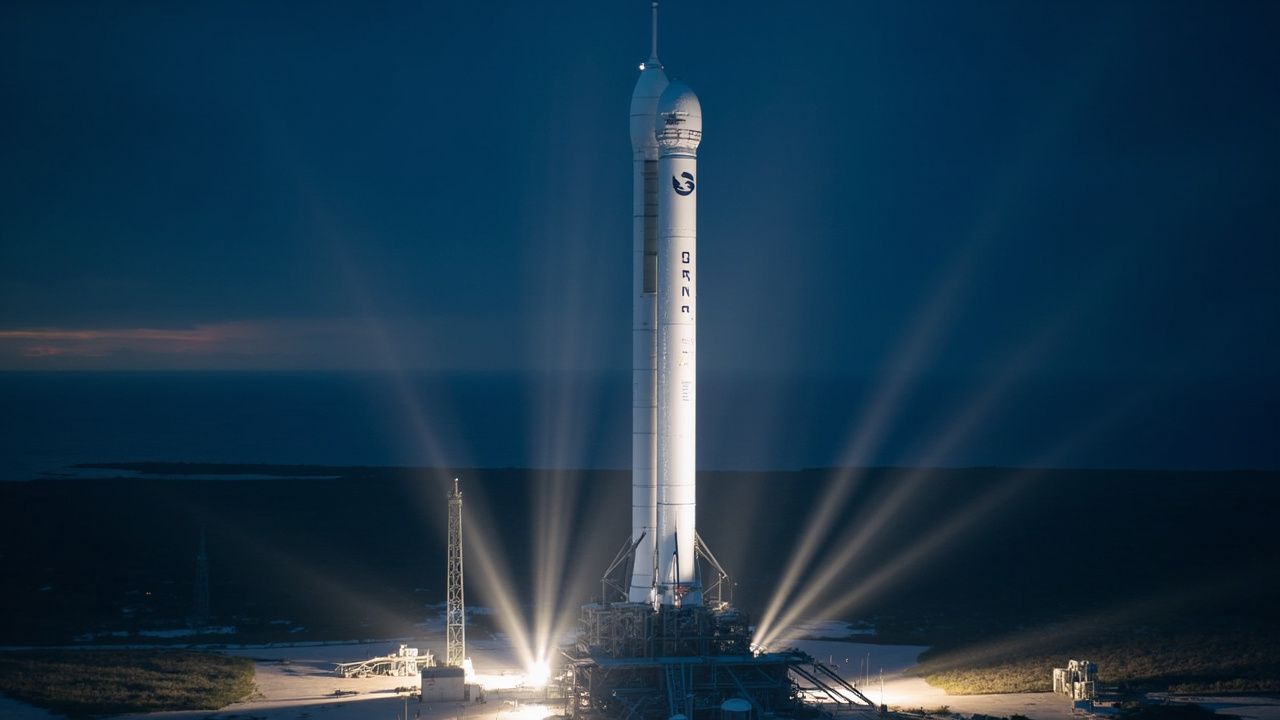
TL;DR: SpaceX plans to fly Falcon booster B1067 for a record 37th time on the Starlink 10-49 mission, lifting 29 satellites from Cape Canaveral at 5:33 a.m. EDT on Aug. 25.
SpaceX is counting down to a new reusability milestone from Florida's Space Coast, with a flight-proven Falcon 9 first stage assigned to make its 37th trip to space and back. The mission will add more relay spacecraft to the company's expansive broadband network in low Earth orbit and may close out a chapter of East Coast Starlink operations for the near term.
According to Spaceflight Now, the Starlink 10-49 flight is scheduled to lift off from Space Launch Complex 40 at Cape Canaveral Space Force Station at 5:33 a.m. EDT (0933 UTC) on Tuesday, Aug. 25. The trajectory is planned toward the northeast, with the 45th Weather Squadron forecasting favorable conditions for the early-morning window.
The payload for the flight is 29 Starlink broadband internet satellites bound for low Earth orbit. Once deployed, they would join a constellation described as consisting of more than 11,000 spacecraft, continuing a rapid deployment cadence that has made Starlink the largest commercial satellite system in operation.
A record 37th flight for booster B1067
The centerpiece of the mission is the first stage, tail number B1067. The booster entered service in June 2021 and, if the flight proceeds as planned, will break its own record for Falcon reuse with a 37th launch.
No other Falcon first stage has reached that total. The assignment reflects SpaceX's strategy of flying its most experienced hardware repeatedly, with inspection and refurbishment between missions, rather than retiring boosters after a small number of uses.
According to SpaceBytes, six Falcon 9 boosters now have at least 30 flights each, with B1067 leading the fleet before Tuesday's planned liftoff. That depth of experienced hardware gives SpaceX flexibility to match specific boosters to Starlink, crew, cargo, and commercial missions while keeping newer stages available where needed.
B1067's career illustrates that approach. The same first stage previously supported a mix of high-profile government, crew, and commercial flights alongside routine Starlink deployments. Its manifest before the planned record flight included CRS-22, Crew-3, Turksat 5B, Crew-4, and 25 Starlink deployments, showing a progression from Dragon resupply and astronaut missions to sustained service as a workhorse for constellation construction.
Launch site, time, and flight profile
The launch is planned from Space Launch Complex 40 at Cape Canaveral Space Force Station in Florida. Liftoff is targeted for 5:33 a.m. EDT on Aug. 25, placing the ascent in the pre-dawn hours when clear skies can make the exhaust plume visible well beyond the immediate Cape area.
After leaving the pad, the Falcon 9 is expected to head on a north-easterly trajectory. That direction aligns the Starlink insertion with the intended orbital plane for the 10-49 group while keeping the ascent track over open ocean for much of powered flight.
The booster recovery plan calls for a droneship landing at sea. B1067 is targeting touchdown on A Shortfall of Gravitas, stationed in the Atlantic Ocean, approximately 8.5 minutes after liftoff. If successful, the landing would mark the 165th booster recovery on that vessel and the 654th Falcon first-stage landing to date.
SpaceX planned to provide live coverage starting roughly 10 minutes before launch, giving viewers a short window to follow final countdown milestones, engine ignition, liftoff, and the early phases of ascent and booster return.
A separate preview outlined a four-hour window opening at 1:49 a.m. EDT (0549 GMT) on Aug. 25, with upper-stage deployment of the satellite payload expected 61.5 minutes into flight. The 5:33 a.m. time represents the targeted liftoff opportunity within the available window for the operational mission.
Weather outlook for the early-morning window
Forecasters see favorable conditions for the attempt. The 45th Weather Squadron forecast a 90 percent chance for favorable weather during the launch window, a high confidence level for an August morning in Florida.
Launch weather officers said they are watching for a small possibility of interference from cumulus and anvil clouds. Those cloud types are standard concerns for Falcon 9 countdowns because of flight rules governing lightning, thick clouds, and upper-level conditions.
The early-morning timing can help with daytime heating issues but does not eliminate overnight cloud development or distant thunderstorm debris. Teams will monitor radar, satellite imagery, and electric-field mills through the final hour of the count, with a decision to proceed or hold based on observed conditions at liftoff time.
What the 29 satellites will do
The 29 spacecraft on Starlink 10-49 are broadband internet satellites designed to operate in low Earth orbit as part of a networked constellation. Together with more than 11,000 spacecraft already in the system, they would help maintain coverage, add capacity, and replace older satellites as the network evolves.
SpaceX builds and launches Starlink satellites at a high rate, using dedicated Falcon 9 missions to place groups of spacecraft into initial orbits before they maneuver to operational altitude. The new satellites from this flight were expected to appear initially as a fresh train in low orbit before dispersing, a pattern familiar to skywatchers who have followed previous deployments.
The mission designation, Starlink 10-49, identifies the specific launch group within the broader deployment sequence. The number does not by itself describe the final orbit, but it allows trackers and enthusiasts to associate the satellites from this flight as they are cataloged and drift to their assigned slots.
A possible pause for Starlink from Cape Canaveral
Beyond the reuse record, the mission is notable for what may follow at the Florida range. The flight could be the last Starlink mission from Cape Canaveral for a while, with no further missions for the company's internet service appearing on the near-term schedule.
That potential pause reflects a geographic shift in Starlink operations this year. So far this year, SpaceX has launched 44 out of 76 Starlink missions from its West Coast launch site at Vandenberg Space Force Base in California, according to Spaceflight Now.
The company's Cape Canaveral workforce has been refocused on Starship preparations. That effort is distinct from Falcon operations and involves ground systems, facilities, and personnel needed to support the next-generation vehicle from Florida.
The shift does not mean an end to Falcon launches from Florida overall. Cape Canaveral and the nearby Kennedy Space Center continue to support crew, cargo, national security, and commercial Falcon missions. It would, however, mark a temporary lull in the steady cadence of Starlink-only flights from Space Launch Complex 40 that has defined much of the manifest in recent years.
Falcon 9's 100-flight year
Tuesday's planned liftoff also marks a cadence milestone for the Falcon 9 program. According to SpaceBytes, the mission is scheduled as the rocket's 100th launch of 2026, underscoring its role as the world's busiest orbital rocket.
The program flew 165 missions last year, all successful, exceeding all other orbital rockets combined. That flight rate was enabled by rapid turnaround, refurbishment, and extensive first-stage reuse, which has reduced launch costs and reshaped commercial and government access to space.
Reaching 100 flights before the end of August points to sustained demand from Starlink deployment alongside paid customer missions. It also reflects operational maturity in range coordination, pad turnaround, droneship availability, and second-stage production, all of which must keep pace for such a tempo to continue.
Competing launch providers are pursuing reuse but have yet to achieve multiple reflights on the same vehicle. SpaceX's lead in demonstrated reflights gives it a near-term advantage in cost, schedule assurance, and internal manifest flexibility for large constellations.
Why repeated reuse matters
Flying the same booster 37 times tests engines, structures, thermal protection, landing legs, grid fins, and avionics across repeated cycles of launch, reentry heating, ocean-environment recovery, and transport back to port.
Each additional flight adds data on long-term component performance. That knowledge informs inspection criteria, replacement intervals, and design changes for future vehicles, including the Starship system SpaceX is developing for rapid reusability and heavier crew and cargo missions.
For satellite deployment, reuse directly affects launch economics. Recovering and reflying the first stage avoids building new hardware for every mission, allowing more frequent Starlink flights and lower marginal cost per satellite delivered to orbit.
The approach also supports resilience. A fleet with multiple high-flight-count boosters can absorb maintenance stand-downs, weather delays, or droneship scheduling constraints without halting the overall launch rate.
How to follow the countdown
Live coverage was expected to begin approximately one hour before the scheduled 5:33 a.m. EDT liftoff, with SpaceX's own webcast joining roughly 10 minutes before launch. Viewers can expect confirmation of propellant loading, range readiness, final polling, ignition, and liftoff, followed by first-stage separation, entry burn, landing burn, and droneship touchdown coverage when video links permit.
After booster landing, attention shifts to the upper stage. The second stage continues to orbit velocity, coasts, and then deploys the 29 Starlink satellites about 61.5 minutes after liftoff. SpaceX typically confirms deployment after telemetry shows clean separation of the payload stack.
For observers along the U.S. East Coast, a pre-dawn launch with a northeasterly track can produce a visible plume if skies are clear. Visibility depends on local cloud cover, viewing geometry, and darkness at the observer's location, so forecasts and tower-camera views can help set expectations in the hour before liftoff.
What comes next after 10-49
If the mission flies as planned, the next milestones will be confirmation of orbit insertion, satellite deployment, and booster recovery at sea. Those three events together define full mission success for a reusable Starlink flight: payload delivered, stage recovered, and hardware available for potential future service.
Longer term, attention in Florida is turning toward Starship preparations at Cape Canaveral. SpaceX has not detailed a day-by-day transition plan in the launch previews, but the refocusing of the Cape workforce signals where ground infrastructure work is headed while Starlink deployment leans more heavily on Vandenberg in the near term.
For now, B1067 stands as the clearest example of Falcon reusability in practice: a stage that entered service in June 2021 and is now targeted for a 37th mission, with a droneship waiting in the Atlantic and 29 more internet satellites ready for the ride uphill.
Sources referenced
- SpaceX launches Starlink mission on a Falcon booster’s record-breaking 37th flight – Spaceflight Now (https://spaceflightnow.com/2026/08/24/live-coverage-spacex-to-launch-starlink-mission-on-a-falcon-boosters-record-breaking-37th-flight/)
- SpaceX Set to Mark Falcon 9 Milestone With 100th Launch of 2026, Booster Reuse Record — SpaceBytes (https://spacebytes.net/article/2026-08-24-spacex-will-set-rocketreuse-record-on-100th-falcon-9-launch/)