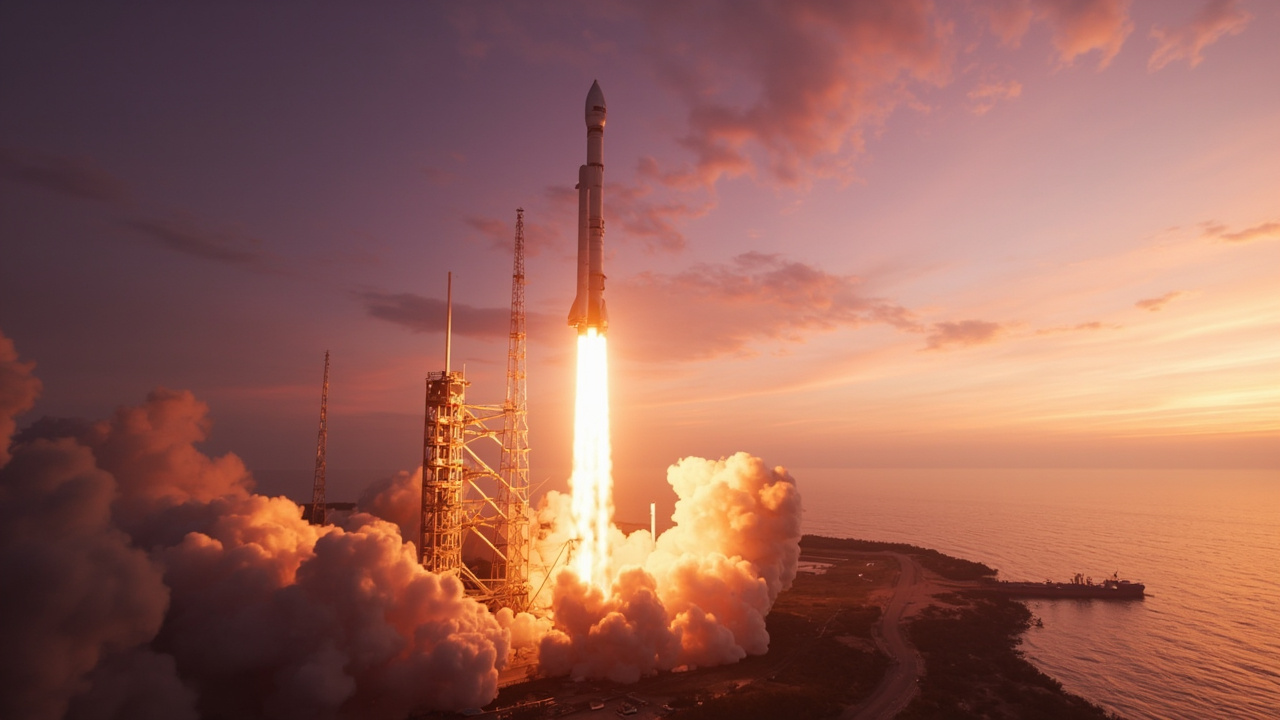
TL;DR: SpaceX is preparing Falcon 9 booster B1067 for a 37th flight carrying 29 Starlink satellites to low Earth orbit from Cape Canaveral.
SpaceX assigned veteran first-stage booster B1067 to the Starlink Group 10-49 communications mission from Space Launch Complex 40 at Cape Canaveral SFS, FL, USA, according to Space Launch Live. The mission is targeting low Earth orbit with a batch of 29 satellites for the Starlink mega-constellation, described by Space Launch Live as SpaceX's project for space-based Internet communication system. Recovery is planned on the Atlantic droneship A Shortfall of Gravitas, according to Spaceflight Now.
A fleet leader assigned to Group 10-49
The Starlink Group 10-49 mission uses the Falcon 9 rocket, manufactured by SpaceX, according to Space Launch Live. The listing identifies the mission type as communications, the target orbit as low Earth orbit, the program as Starlink, and the country as USA.
The first stage assigned is booster B1067, according to Space Launch Live. Spaceflight Now identifies the same tail number, B1067, in connection with a 37th flight and recovery on A Shortfall of Gravitas in the Atlantic Ocean.
Space Launch Live lists first flight on June 3, 2021 and previous flight on July 9, 2026 for B1067. The same tracker lists a 47-day turnaround associated with this assignment.
That history matters for readers in the United States because it shows how SpaceX rotates high-flight-count boosters between Starlink missions from Florida. A booster that first flew in 2021 and most recently flew in July is being returned to service in August for another commercial broadband launch.
What the payload is
The payload is a batch of 29 satellites for the Starlink mega-constellation, according to Space Launch Live. An automated translation in ForumAstronautico.it describes the same manifest as a batch of 29 satellites for the Starlink mega-constellation, the SpaceX project for a space-based Internet communication system.
Spaceflight Now describes the spacecraft as 29 Starlink V2 Mini satellites bound for low Earth orbit. The mission therefore adds another identical-size batch to the low-Earth-orbit network that delivers broadband internet.
For practical significance, each 29-satellite batch increases capacity and redundancy in the same orbital shell family. Space Launch Live identifies the destination as low Earth orbit and the mission program as Starlink, keeping Group 10-49 within the ongoing buildout rather than a test or one-off deployment.
Where it will lift off
The launch pad is Space Launch Complex 40, according to Space Launch Live. The launch site is Cape Canaveral SFS, FL, USA, according to the same source.
ForumAstronautico.it lists the same ramp as Space Launch Complex 40 at Cape Canaveral SFS, FL, USA, and classifies the mission as telecommunications to low Earth orbit. That pad is the workhorse Florida Starlink pad for Falcon 9.
The Atlantic recovery plan also points to an East Coast ascent. Spaceflight Now places the droneship A Shortfall of Gravitas in the Atlantic Ocean for this booster. Orbital-intel.com, in an Aug. 15 update, says the late-August 29-satellite Starlink batch with a fleet-leading 37th-flight booster is also targeting A Shortfall of Gravitas.
Schedule known on Aug. 15
As tracked on Aug. 15, the mission was listed for no earlier than Aug. 25, according to schedule-history entries compiled by Space Launch Live. ForumAstronautico.it reported takeoff programmed for NET Aug. 25 at 05:49:00, with a four-hour launch window between 05:49:00 and 09:49:00.
Space Launch Live records that on Aug. 15 at 06:18 UTC the listed time moved up by 5.2 hours, from Aug. 25 at 11:00 UTC to Aug. 25 at 05:49 UTC. ForumAstronautico.it separately noted an earlier shift of about five hours to NET Aug. 25 at 5:49 a.m.
Readers should treat those times as planning data, not liftoff guarantees. Space Launch Live labels the time as NET, meaning no earlier than, and notes that it may be subject to change. The Aug. 12 tracker entry says the launch date was set for Aug. 25 NET as confirmed by SpaceX.
The vehicle: Falcon 9 Block 5
The launcher is Falcon 9 Block 5, according to Space Launch Live and ForumAstronautico.it. Space Launch Live describes Falcon 9 as a two-stage rocket designed and manufactured by SpaceX for the reliable and safe transport of satellites and the Dragon spacecraft into orbit.
The same description says the Block 5 variant is the fifth major interval aimed at improving upon the ability for rapid reusability. That design goal is directly relevant to a 37th flight.
ForumAstronautico.it lists additional Block 5 characteristics: first flight on May 11, 2018, two stages, height of 70.00 m, diameter of 3.65 m, liftoff weight of 549 t, liftoff thrust of 7,607 kN, and cargo capacity of 22,800 kg to LEO and 8,300 kg to GTO. The same compilation listed 622 successes from 623 total launches, with 325 consecutive successes, at the time of its compilation.
That context helps explain why SpaceX can assign the same airframe repeatedly. The system was built around reuse, and Group 10-49 is an example of that approach extended to a fleet-leading flight count.
Why a 37th flight matters
Orbital-intel.com calls the booster assigned to the Aug. 25 29-satellite Starlink batch notable because it is on its fleet-leading 37th flight. The publication says both near-term Starlink statistics illustrate how far SpaceX has pushed reusability beyond what was considered operationally safe by competitors just five years ago.
The comparison mission in the same late-August window underscores the point. Orbital-intel.com says that on Aug. 20, a Falcon 9 carrying 29 Starlink satellites will fly from SLC-40 with a first-stage booster on its 30th flight, targeting downrange droneship recovery on A Shortfall of Gravitas.
Together, a 30th flight and a 37th flight within days show routine reuse at flight numbers that once would have been considered experimental. For Florida operations, it also means the same recovery vessel can support successive high-flight-count missions.
Space Coast context through mid-August
Orbital-intel.com reports 52 orbital launches through Aug. 15, 2026 as the Space Coast running tally, putting Florida's launch corridor on a plausible trajectory toward matching or approaching the record 109 orbital launches logged across all of 2025.
The breakdown through mid-August, according to Orbital-intel.com, is 44 Falcon 9 and one Falcon Heavy from SpaceX, five from United Launch Alliance comprising four Atlas V and one Vulcan, and one New Glenn on the NG-3 mission from Blue Origin. Two human spaceflights, Crew-12 and Artemis II, anchor the manifest's most visible milestones, according to the same report.
Year-over-year numbers in the same report are 72 Space Coast orbital launches in 2023, 93 launches in 2024, and 109 launches in 2025. In 2025, the vehicle flew 101 times from Florida alone, with every SpaceX launch from the Space Coast a Falcon 9, according to Orbital-intel.com.
In 2026 the mix broadened slightly, according to Orbital-intel.com: one Falcon Heavy had already flown through mid-August, with at least two more manifested in the second half. One Vulcan flew in 2025 and one had flown in 2026 through mid-August, according to the same source.
What to watch next
The immediate items to watch are pad readiness at Space Launch Complex 40, confirmation of the Aug. 25 NET time, and positioning of A Shortfall of Gravitas for Atlantic recovery. According to Space Launch Live, the mission type remains communications to low Earth orbit, with SpaceX as both agency and launch-services provider.
The booster history will also bear watching. Space Launch Live lists B1067 with first flight on June 3, 2021 and previous flight on July 9, 2026. A successful Group 10-49 flight would extend that airframe's lead as tracked in August.
Finally, Group 10-49 should be read alongside the Aug. 20 Starlink mission from the same pad. Orbital-intel.com places both missions at SLC-40, both with 29 satellites, and both targeting A Shortfall of Gravitas. That pairing shows the cadence SpaceX must sustain to keep the Space Coast near its 2025 record pace.
Sources referenced
- Falcon 9 • Starlink 10-49 – Spaceflight Now (https://spaceflightnow.com/launch/falcon-9-starlink-10-49/)
- Falcon 9 Block 5 | Starlink Group 10-49 - Space Launch Live (https://spacelaunchlive.com/launches/falcon-9-block-5-starlink-group-10-49/)