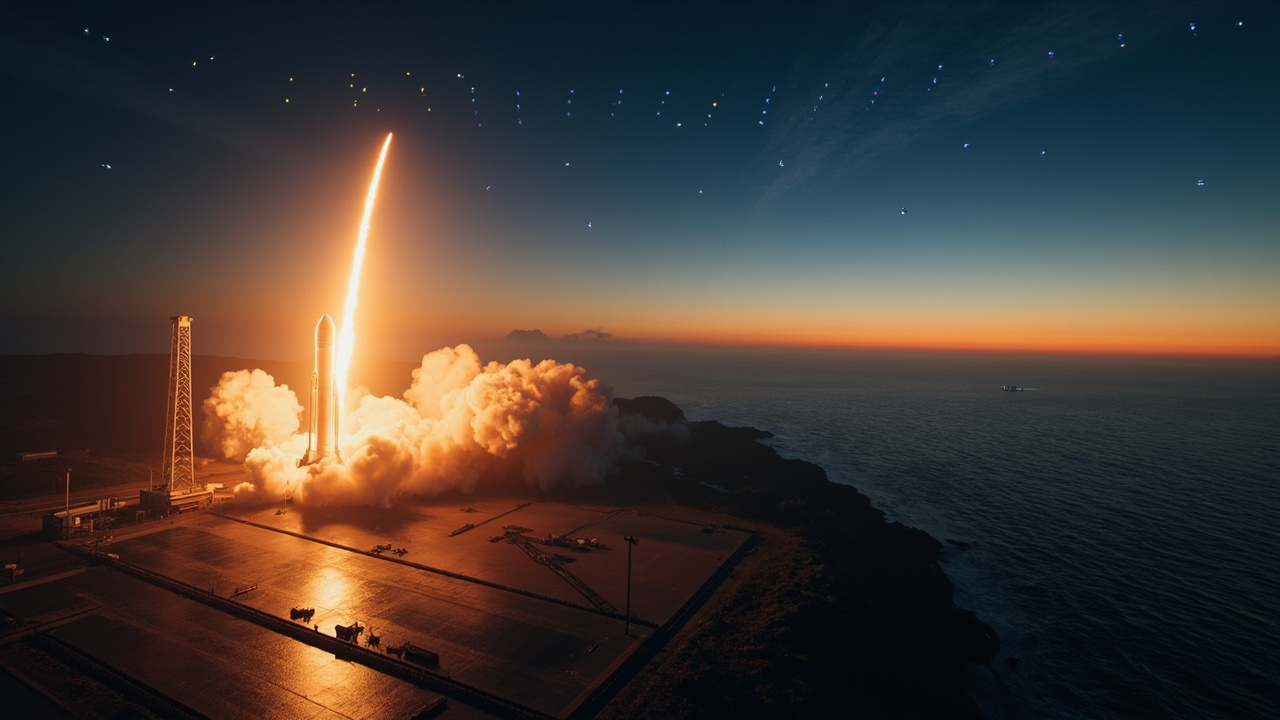
SpaceX Ends Falcon 9 Starlink Pause With 27-Satellite Launch From California
TL;DR: SpaceX launched 27 Starlink satellites on Falcon 9 from Vandenberg Space Force Base at 5:28 p.m. PT on Monday, Oct. 12, 2026, ending a three-week pause in Falcon 9 Starlink flights.
SpaceX sent 27 Starlink internet satellites to low Earth orbit atop a Falcon 9 rocket from California's Vandenberg Space Force Base at 8:28 p.m. EDT on Oct. 12, or 5:28 p.m. local time and 0028 GMT on Oct. 13, according to Space.com. The mission, designated Starlink 15-25, lifted off from Space Launch Complex 4 East at Vandenberg Space Force Base in California, according to SpaceX. The flight was the first Starlink mission for a Falcon 9 since Sept. 19, according to Space.com.
The launch carried 27 Starlink V2 Mini Optimized satellites toward an orbit inclined 70 degrees to the Equator, according to Spaceflight Now. The rocket headed on a southerly trajectory along the California coast, according to Spaceflight Now. The satellites were targeted for deployment into a 266 kilometer high orbit a little more than an hour after liftoff, according to Spaceflight Now.
Liftoff From Space Launch Complex 4 East
The Starlink 15-25 mission lifted off from Space Launch Complex 4 East at 5:28 p.m. PDT, which corresponded to 8:28 p.m. EDT and 0028 UTC, according to Spaceflight Now. SpaceX listed the launch time as Monday, October 12 at 5:28 p.m. PT from Space Launch Complex 4 East at Vandenberg Space Force Base in California, according to SpaceX.
The Falcon 9 targeted an orbit inclined 70 degrees to the Equator after flying a southerly trajectory along the California coast, according to Spaceflight Now. SpaceX said the mission delivered 27 Starlink satellites to low-Earth orbit, according to SpaceX.
SpaceX noted there was a possibility that residents of Santa Barbara, San Luis Obispo, and Ventura counties may have heard one or more sonic booms during the launch, according to SpaceX. What residents experienced depended on weather and other conditions, according to SpaceX.
The countdown included a SpaceX Launch Director verification of go for propellant load at 38 minutes before liftoff, according to SpaceX. RP-1 rocket-grade kerosene loading and first-stage liquid oxygen loading both began at 35 minutes before liftoff, according to SpaceX. Second-stage liquid oxygen loading began at 16 minutes before liftoff, according to SpaceX.
Falcon 9 began engine chill prior to launch at 7 minutes before liftoff, according to SpaceX. The command flight computer began final prelaunch checks and propellant tank pressurization to flight pressure began at 1 minute before liftoff, according to SpaceX. The SpaceX Launch Director verified go for launch at 45 seconds before liftoff, according to SpaceX. The engine controller commanded the engine ignition sequence to start at 3 seconds before liftoff, according to SpaceX.
Booster B1088 Completes 20th Flight
The first-stage booster, serial number B1088, was launching for a 20th time, according to Spaceflight Now. Following stage separation, the first stage landed on the Of Course I Still Love You droneship stationed in the Pacific Ocean, according to SpaceX.
Touchdown occurred about 8.5 minutes after launch on the drone ship Of Course I Still Love You in the Pacific Ocean, according to Space.com. Spaceflight Now reported the landing occurred nearly 8.5 minutes into the flight aboard the drone ship Of Course I Still Love You, according to Spaceflight Now.
The booster previously flew the NROL-126, Transporter-12, SPHEREx, NROL-57 and USSF-366 missions, plus 14 previous Starlink delivery runs, according to Spaceflight Now. SpaceX listed the same five prior non-Starlink missions and said the booster had now flown 15 Starlink missions, bringing its total to 20 flights, according to SpaceX.
The recovery continued SpaceX's routine of returning Falcon 9 first stages for reuse while the expendable upper stage completed the orbital delivery, according to Space.com. Space.com reported that the Falcon 9's first stage came back to Earth as planned, according to Space.com.
Minute-by-Minute Ascent and Deployment
Maximum dynamic pressure, or Max Q, the moment of peak mechanical stress on the rocket, occurred at 1 minute 8 seconds after liftoff, according to SpaceX. First-stage main engine cutoff occurred at 2 minutes 26 seconds, according to SpaceX. The first and second stages separated at 2 minutes 29 seconds, according to SpaceX.
The second-stage engine started at 2 minutes 36 seconds, according to SpaceX. Fairing separation followed at 2 minutes 58 seconds, according to SpaceX. The first-stage entry burn began at 6 minutes 1 second and ended at 6 minutes 25 seconds, according to SpaceX.
The first-stage landing burn began at 7 minutes 58 seconds, with landing at 8 minutes 21 seconds, according to SpaceX. Second-stage engine cutoff occurred at 8 minutes 40 seconds, according to SpaceX.
The second stage restarted at 53 minutes 6 seconds and shut down again at 53 minutes 7 seconds, according to SpaceX. SpaceX listed Starlink satellite deployment at 1 hour 1 minute 58 seconds after liftoff, according to SpaceX. Space.com reported that the 27 spacecraft were deployed 62 minutes after liftoff, as announced by SpaceX via X, according to Space.com.
The initial deployment orbit was about 266 kilometers high, according to Spaceflight Now. The spacecraft were identified as 27 Starlink V2 Mini Optimized satellites, according to Spaceflight Now.
Break After Rapid Late-Summer Cadence
The Oct. 12 flight was the first Starlink mission for a Falcon 9 since Sept. 19, which was another 27-satellite liftoff from Vandenberg, according to Space.com. Between Aug. 19 and Sept. 6, a span of 19 days, SpaceX launched seven Starlink missions with Falcon 9s, according to Space.com.
SpaceX did loft a batch of Starlinks after Sept. 19, but it was not aboard a Falcon 9, according to Space.com. The company's Starship megarocket carried 26 next-generation Starlink V3 spacecraft on its 14th test flight on Sept. 28, according to Space.com.
Starship reached orbit for the first time ever on Flight 14 and deployed the Starlinks successfully, according to Space.com. That flight separated the late-September Starlink activity from the Falcon 9 Starlink sequence that resumed Oct. 12, according to Space.com.
The Oct. 12 mission therefore restored the Falcon 9 Starlink launch rhythm after an interval that Space.com described as uncharacteristically long, according to Space.com. The prior Falcon 9 Starlink launch on Sept. 19 also carried 27 satellites from Vandenberg, matching the Oct. 12 payload count, according to Space.com.
Starship Test Program Carries Next Generation
Starship carried 26 next-generation Starlink V3 craft on its 14th test flight on Sept. 28, according to Space.com. That mission marked the first time Starship reached orbit, according to Space.com.
The Starlink V3 constellation will eventually consist of about 100,000 satellites, all of which will fly on Starship, according to Space.com, citing Elon Musk. Space.com reported that this deployment pattern will happen many more times going forward if all goes to plan, according to Space.com.
SpaceX plans to sunset the Falcon 9 and its cousin, the Falcon Heavy, in the next few years, according to Space.com. Their duties will shift to the fully reusable, far more powerful Starship, which remains in the test-flight phase, according to Space.com.
Starship remains in the test-flight phase while Falcon 9 continues operational Starlink deliveries, according to Space.com. The Sept. 28 Starship flight and Oct. 12 Falcon 9 flight showed the two vehicles handling different Starlink generations in successive weeks, according to Space.com.
Falcon 9 Workhorse Totals in 2026
The Oct. 12 flight was the 112th Falcon 9 liftoff of the year, according to Space.com. It was the 82nd Falcon 9 flight in service of the Starlink megaconstellation during the year, according to Space.com.
The Starlink megaconstellation currently consists of more than 11,100 active satellites, according to Space.com. In 2025, the Falcon 9 flew 165 times, roughly the same number as the rest of the world's orbital launchers combined, according to Space.com.
Nearly three-quarters of those 2025 Falcon 9 launches were Starlink missions, according to Space.com. Space.com described the Falcon 9 as the workhorse rocket of its generation, according to Space.com.
Things have slowed down a bit in 2026 relative to the 2025 pace, according to Space.com. The 112 Falcon 9 launches recorded by Oct. 12 and the 82 Starlink-dedicated flights illustrate the continued share of constellation construction in the manifest, according to Space.com.
Sources referenced
- SpaceX Falcon 9 rocket launches 27 Starlink satellites from California – Spaceflight Now (https://spaceflightnow.com/2026/10/12/spacex-falcon-9-rocket-to-launch-27-starlink-satellites-into-orbit-from-california/)
- SpaceX - Starlink Mission (https://www.spacex.com/launches/sl-15-25)