TL;DR: SpaceX launched 29 Starlink satellites from Florida on Aug. 21, 2026, while NASA cleared its Roman Space Telescope for a Falcon Heavy launch no earlier than Aug. 30.
SpaceX Flies Starlink 10-39 After Scrub as NASA Clears Roman for Aug. 30
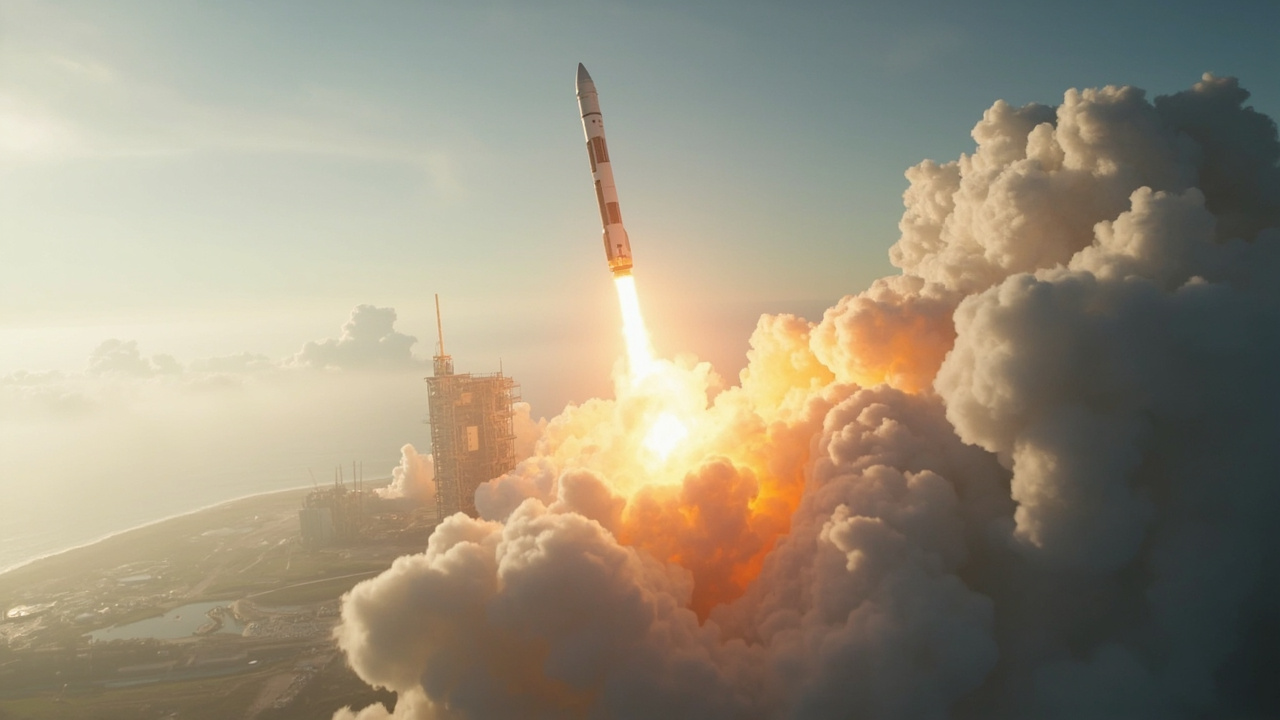
SpaceX sent 29 Starlink broadband satellites toward low Earth orbit on the morning of Aug. 21, 2026, after a one-day delay, and NASA completed a key readiness review for its next flagship observatory on the same day. The Florida Starlink flight lifted off at 11:14 a.m. EDT from Cape Canaveral Space Force Station, according to Space.com, while agency managers certified the Nancy Grace Roman Space Telescope to move into final launch preparations, according to NASA's Roman blog.
The pairing made Aug. 21 a two-track milestone day for U.S. spaceflight: an operational commercial launch that expanded an already vast communications constellation, and a formal go-ahead for a science mission intended to survey the universe at large scale. One involved a veteran reusable booster making its 30th flight. The other involved a new observatory assigned to a Falcon Heavy ride from Kennedy Space Center.
What lifted off from Cape Canaveral
The Starlink 10-39 mission used a Falcon 9 rocket departing from Space Launch Complex 40 at Cape Canaveral Space Force Station in Florida, according to Spaceflight Now. Liftoff occurred at 11:14 a.m. EDT, which corresponds to 1514 UTC, after teams stood down from an attempt on Aug. 20.
Thursday's attempt ended very late in the countdown. Florida Today reported the countdown was halted with 28 seconds remaining, while Space UpClose described a hold at about 23 seconds before liftoff. SpaceX did not immediately explain the reason for the scrub, according to Space.com, and Spaceflight Now characterized the cause as an undisclosed issue.
Friday's ascent followed a northeasterly path along the U.S. East Coast. Space UpClose reported thick clouds obscured the vehicle soon after it left Pad 40. liftoff was observed from Titusville, with photographs credited to Jean Wright for the outlet. The weather outlook had started relatively favorable and worsened through the morning. The 45th Weather Squadron estimated an 85 percent chance of acceptable conditions at the start of the window, falling to 45 percent later, according to Florida Today and Spaceflight Now.
Booster B1078 completes 30th flight
The first stage assigned to Starlink 10-39 was booster B1078, making its 30th launch and recovery. Spaceflight Now reported the flight made B1078 the sixth Falcon 9 booster to reach 30 missions. Space.com similarly recorded 30 liftoffs and touchdowns for the stage.
Its earlier manifest included a mix of crew, national-security, commercial, and demonstration payloads. Florida Today listed NASA's SpaceX Crew-6, SES O3b mPOWER-B, USSF-124, BlueBird 1-5, Nusantara Lima, also identified as PSN N5, Starfall Demo, and 23 Starlink missions before the latest flight. Space UpClose counted 24 prior Starlink assignments in the booster's history alongside those same named missions.
Recovery took place in the Atlantic Ocean. About 8.5 minutes after liftoff, the stage touched down on the droneship A Shortfall of Gravitas, according to Space.com. Space UpClose placed the recovery vessel about 400 miles downrange off the Carolina coast. Florida Today reported the touchdown completed the booster's 30th mission and noted no Central Florida sonic booms were expected because the landing was at sea rather than on land.
The drone-ship recovery continued two long-running counts tracked by the launch community. Space UpClose reported the touchdown was the 164th landing on A Shortfall of Gravitas and the 652nd SpaceX landing overall. Those figures reflect repeated reuse of first stages across Starlink and other Falcon missions.
29 satellites bound for low Earth orbit
The payload was 29 Starlink broadband internet satellites headed for low Earth orbit, according to Space.com and Spaceflight Now. The Falcon 9 upper stage was tasked with carrying them upward after stage separation, with deployment scheduled about 61.5 minutes after liftoff if operations proceeded as planned.
Florida Today published SpaceX's minute-by-minute sequence for major events after liftoff. The outline listed Max Q at 1 minute 10 seconds, main-engine cutoff at 2 minutes 26 seconds, stage separation at 2 minutes 29 seconds, second-stage engine start at 2 minutes 36 seconds, and fairing separation at 2 minutes 58 seconds. It placed the entry burn from 6 minutes 3 seconds to 6 minutes 24 seconds, the landing burn at 8 minutes 2 seconds, droneship touchdown at 8 minutes 25 seconds, and satellite deployment at 1 hour 1 minute 28 seconds.
The new spacecraft joined a very large operational network. Astronomer and satellite tracker Jonathan McDowell put the number of operational Starlink spacecraft at nearly 11,000, according to Space.com. Space UpClose separately reported SpaceX had launched more than 11,000 Starlink satellites to orbit to date, a cumulative launch total rather than the currently operational count.
Friday's flight also illustrated SpaceX's 2026 launch tempo. Space.com counted the mission as the 98th Falcon 9 flight of the year, with 75 devoted to Starlink. The company also had one Falcon Heavy launch and two Starship test flights in 2026, with Starship still described as in development. Space UpClose described the overall cadence as roughly one launch every five days, constrained in part by droneship availability, and noted occasional returns to Landing Zones at the Cape.
Second SpaceX launch marks 100 orbital missions
Aug. 21 also included activity on the West Coast. Spaceflight Now reported a Starlink 15-20 mission lifted off from Pad 4 East at 12:25 a.m. PDT, equivalent to 3:25 a.m. EDT and 0725 UTC. That flight was identified as the 99th Falcon 9 launch of the year.
The same outlet framed Aug. 21 as the date of SpaceX's 100th orbital mission of 2026 across its vehicle family. The Florida Starlink 10-39 flight and the California Starlink flight therefore fell on the same calendar day in Eastern time, underscoring parallel East Coast and West Coast operations. The Florida mission launched from Launch Complex 40, while the California mission used Pad 4 East.
Brevard County emergency officials activated a launch support team before the Florida liftoff and deactivated it afterward, according to Florida Today. The outlet also reported the Falcon 9 rumble was audible to attendees at the Space Coast Symposium and Expo at the Radisson Resort at the Port in Cape Canaveral.
NASA completes Roman readiness review
Separately on Aug. 21, mission managers from NASA, the Nancy Grace Roman Space Telescope team, and SpaceX held a Flight Readiness Review at Kennedy Space Center in Florida, according to NASA's Roman blog. The review covered mission status and certified Roman to begin final launch preparation activities.
The target cited after the review was no earlier than 7:26 a.m. EDT on Sunday, Aug. 30, aboard a SpaceX Falcon Heavy rocket from Launch Complex 39A at Kennedy. That date was a planning target rather than a completed event. The blog was published Aug. 21 at 12:49 p.m. by Elyna Niles-Carnes.
The next processing steps involved moving the observatory, already encapsulated in Falcon Heavy's fairing, to the SpaceX hangar at Pad 39A. Technicians were to attach the encapsulated spacecraft to the rocket and then move the combined vehicle to the launch pad in the coming days, according to NASA's Roman blog.
Why Roman matters for astronomy
Roman is NASA's newest space telescope and is intended to conduct broad, deep surveys of the sky. The mission is designed to help researchers study how the universe has changed over time, what drives its expansion, and what planets exist beyond the solar system, according to NASA's Roman blog.
The same overview said Roman's observations would span subjects from the solar system to galaxies near the edge of the observable universe. Its science themes include dark matter, dark energy, exoplanets, and wide-ranging astrophysical surveys. The blog directs readers to nasa.gov/roman for continuing updates.
The readiness review did not itself launch the telescope. It certified that NASA and SpaceX could proceed into the final ground phase leading toward the Aug. 30 opportunity. Final transport, integration with Falcon Heavy, and rollout remained ahead at the time of the announcement.
Countdown and weather context
The Florida Starlink countdown followed SpaceX's standard propellant-load and engine-chill sequence. Florida Today outlined milestones including a launch-director verification for propellant load at 38 minutes, engine chill at seven minutes, final prelaunch checks and tank pressurization at one minute, launch-director verification at 45 seconds, engine ignition at three seconds, and liftoff at zero.
Fueling was observed underway before the scheduled time, indicating the countdown was proceeding toward 11:14 a.m., according to Florida Today. The webcast began about eight minutes before liftoff. зрители at Space View Park and other Titusville locations watched under cloudy skies, with the vehicle entering cloud cover during its northeast climb, according to Space UpClose.
Weather remained a watch item because of clouds and electrical-field concerns. Florida Today identified cumulus clouds, anvil clouds, and surface electric fields as the principal threats cited in the 45th Weather Squadron outlook. Brevard County Emergency Management's activation and later deactivation bracketed the successful launch period.
What to watch next
For Starlink, the immediate post-launch milestone was the planned deployment a little more than an hour after liftoff. Space.com reported deployment was expected 61.5 minutes after launch if the upper-stage flight proceeded as planned. The mission continued expansion of a low Earth orbit megaconstellation already numbering in the thousands of operational spacecraft.
For Roman, the next visible milestones were ground movements at Kennedy: delivery of the fairing-encapsulated observatory to the Pad 39A hangar, mating to Falcon Heavy, and rollout to the pad. Those steps were described as upcoming work in the days after Aug. 21, according to NASA's Roman blog. The launch target remained no earlier than Aug. 30 at 7:26 a.m. EDT, subject to normal final preparations and conditions.
Sources referenced
- SpaceX launches 29 Starlink satellites, lands rocket on ship at sea (video, photos) | Space (https://www.space.com/space-exploration/launches-spacecraft/spacex-starlink-launch-group-10-39-falcon-9-asog)
- Teams Complete Flight Readiness Review for NASA’s Roman Telescope (https://science.nasa.gov/blogs/roman/2026/08/21/teams-complete-flight-readiness-review-for-nasas-roman-telescope/)