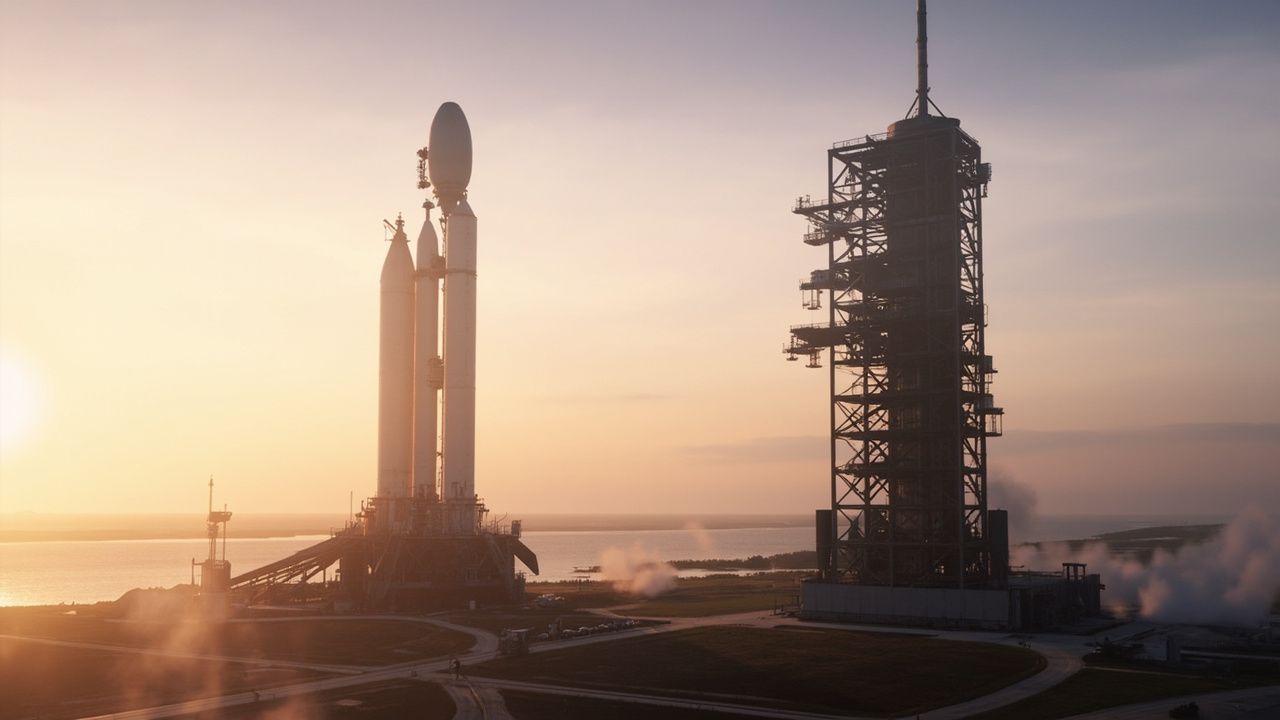
TL;DR: NASA cleared the Nancy Grace Roman Space Telescope for liftoff no earlier than 7:26 a.m. EDT Sunday, Aug. 30, from Launch Complex 39A in Florida aboard a SpaceX Falcon Heavy bound for Sun-Earth Lagrange point 2.
NASA gives final go for Sunday morning liftoff
NASA and SpaceX finished the Launch Readiness Review on Friday, Aug. 28, at Kennedy Space Center in Florida and declared the flagship observatory ready to enter countdown, according to NASA's Roman Space Telescope 'Go' for Launch update.
That review is the last formal checkpoint before countdown operations. It verified readiness of the Falcon Heavy, the observatory, forecast weather, and ground and flight teams.
Liftoff remains targeted for no earlier than 7:26 a.m. EDT Sunday, Aug. 30, from Launch Complex 39A. NASA launch coverage is scheduled to begin at 6:20 a.m. EDT that day, according to NASA Sets Coverage for Roman Space Telescope Launch from Florida.
Forecasters with the U.S. Space Force's Space Launch Delta 45 Weather Squadron predicted a 60% chance of acceptable conditions for the opening attempt.
If teams stand down for weather or a technical issue, SpaceX has identified Monday, Aug. 31, as the next opportunity, with a target time a few minutes earlier, at 7:22 a.m. EDT. That backup timing reflects the daily shift in the trajectory to the mission's distant destination.
How launch day will unfold
The flight plan calls for Roman to separate from the Falcon Heavy upper stage about 31 minutes and 31 seconds after liftoff, beginning an extended cruise into deep space.
The Heavy's two side boosters are programmed to separate after less than two and one-half minutes of powered flight and fly back for landings at Cape Canaveral Space Force Station. Touchdowns are expected about 7 minutes and 23 seconds after launch.
SpaceX said the side boosters represent a mix of new and reused hardware. One side booster is flying for the first time, while the other is making its third flight after earlier support for the GOES-U weather satellite and the ViaSat-3 F3 communications mission. Both are assigned to Landing Zones 2 and 40.
No recovery of the center core on a drone ship is planned for this high-energy departure. The mission needs the full performance of the triple-core vehicle to send the large observatory outward.
Encapsulation of the telescope inside the Falcon Heavy payload fairing took place Friday, Aug. 21, inside the Payload Hazardous Servicing Facility at Kennedy. NASA said the fairing protects the spacecraft during rollout, ascent, and the earliest phase of flight.
A wide-view flagship bound for L2
After separation, Roman will travel to the second Sun-Earth Lagrange point, about one million miles from Earth in the direction opposite the Sun's pull when viewed from the night side.
At L2, the combined gravity of the Sun and Earth, together with the spacecraft's orbital motion, helps hold a spacecraft roughly in place with relatively little fuel use. NASA's James Webb Space Telescope operates in the same general region.
NASA said Roman will trace a large halo-like path around the actual Lagrange point, a loop wider than the Moon's orbit around Earth. That spacing allows controllers to keep Roman and Webb well separated.
The cruise to the operating orbit is expected to last about 30 days. Commissioning of spacecraft systems and science instruments will then require additional months. NASA anticipates beginning the five-year primary science mission in early 2027.
The mission is designed for five years of primary operations, with capability to support an additional five-year extended mission. NASA said propellant is expected to be the life-limiting resource. Although no servicing capability currently exists at L2, the observatory was designed to permit future refueling.
Why astronomers call Roman a survey speed machine
Roman is named for Dr. Nancy Grace Roman, who lived from 1925 to 2018 and served as NASA's first chief of astronomy. She advocated for observatories above Earth's atmosphere and for broad sharing of their data, according to 9 Things to Know About NASA's Nancy Grace Roman Space Telescope.
Roman is widely described as the mother of the Hubble Space Telescope. NASA notes that her influence extended across the Great Observatories program, which included Hubble, the Chandra X-ray Observatory, and the former Compton Gamma Ray Observatory and Spitzer Space Telescope.
The new observatory carries a 2.4-meter primary mirror, the same diameter class as Hubble. Its power for surveys comes from pairing Hubble-like sharpness with a far larger view.
NASA said the Wide Field Instrument is a 300-megapixel visible and near-infrared camera with resolution comparable to Hubble but a field at least 100 times larger. Each exposure covers a sky patch about 1.5 times larger than the apparent size of a full Moon.
The European Space Agency, which is contributing hardware and ground-station support, said the design combines Hubble-quality imaging with a field more than 200 times larger in its configuration for broad surveys. That difference in stated multiples reflects different ways of comparing active survey area, optical performance, and observing modes.
The practical result is survey speed. NASA expects Roman to map large volumes of sky far faster than prior infrared missions, producing deep, uniform datasets useful for cosmology, galaxy evolution, stellar populations, solar-system objects, and time-domain astronomy.
Dark matter, dark energy and billions of galaxies
Roman's core cosmology program will examine how invisible components have shaped expansion and structure across cosmic history, according to NASA Sets Coverage for Roman Space Telescope Launch from Florida.
Scientists estimate that about 25% of the universe consists of dark matter, which does not emit light but reveals itself through gravity. One Roman technique, weak gravitational lensing, measures tiny distortions in the shapes of distant galaxies caused by intervening clumps of ordinary and dark matter.
Roman plans to scan about 12% of the sky away from the bright plane of the Milky Way, measuring lensing effects in millions of distant galaxies. By tracking small changes in galaxy shapes, astronomers intend to map matter distribution and trace galaxy growth over time.
Dark energy, thought to account for about 70% of the universe, is associated with the accelerating expansion of space. Roman will use several independent approaches, including observations of Type Ia supernovae and mapping of galaxy clustering shaped by ancient sound waves known as baryonic acoustic oscillations.
Because Type Ia supernovae reach a predictable peak brightness, they serve as distance markers for measuring expansion. Because frozen sound-wave imprints set preferred separations between galaxy clusters, their apparent scale across cosmic distances records how expansion has stretched space.
ESA said Roman will join its Euclid mission in attacking those questions. Euclid is surveying a larger total sky area with less detail, while Roman's higher-quality measurements over overlapping regions can help calibrate wider datasets.
Exoplanets, black holes and public data
Roman will also conduct a large census of planetary systems. Its wide, sensitive view toward the center of the Milky Way will monitor brightness changes in millions of stars.
Gravitational microlensing events, in which a foreground star and planet briefly magnify background starlight, could reveal more than 1,200 new worlds. Transits, in which planets dim their host stars by crossing their faces, are expected to reveal more than 100,000 additional candidates, according to ESA's prelaunch science summary.
The observatory's second instrument, the Coronagraph Instrument, is a technology demonstration led by NASA's Jet Propulsion Laboratory. It uses masks, mirrors, and deformable optics to suppress starlight and expose faint reflected light from nearby planets.
The system is intended to image giant planets that are older, colder, and closer to their stars than the hot young super-Jupiters accessible to earlier direct-imaging systems. In favorable cases, it could detect planets more than 100 million times fainter than their host stars.
NASA's Ames Research Center developed supporting tools for sharper images and expanded planet imaging. One software package predicts and removes stray light and zodiacal background, while experimental masks and control methods could extend coronagraph observations to multi-star systems, where overlapping glare is harder to suppress.
All Roman science data will be made public after processing, without a prolonged proprietary period. NASA said that policy will allow many teams to analyze the same deep surveys simultaneously, from exploding stars and growing black holes to outer solar-system bodies and billions of galaxies.
Weekend briefings and road to countdown
NASA scheduled a mission science briefing for 9 a.m. EDT Saturday, Aug. 29, followed by a prelaunch news conference at 10:30 a.m. EDT in the Kennedy Press Site auditorium.
The science panel includes astrophysics director Shawn Domagal-Goldman, senior project scientist Julie McEnery, coronagraph scientist Vanessa Bailey, science operations lead Kristen McQuinn, and science support lead Lee Armus.
The prelaunch panel includes science associate administrator Nicky Fox, program executive Lucas Paganini, project manager Jackie Townsend, launch director Denton Gibson, SpaceX director Julianna Scheiman, and launch weather officer Justin McReynolds.
NASA Administrator Jared Isaacman was also expected to fly past the pad in a jet near 11:45 a.m. Saturday, conditions permitting, with views carried on the briefing stream. A postlaunch news conference is planned for 9:30 a.m. EDT Sunday.
If countdown proceeds on schedule, Roman would become the sixth NASA primary mission to launch aboard a SpaceX Falcon rocket from Kennedy, following IXPE, Psyche, GOES-U, Europa Clipper, and IMAP.
Sources referenced
- NASA’s Roman Space Telescope ‘Go’ for Launch (https://science.nasa.gov/blogs/roman/2026/08/28/nasas-roman-space-telescope-go-for-launch/)