TL;DR: NASA's Nancy Grace Roman Space Telescope launched at 7:26 a.m. EDT on Aug. 30, 2026, aboard a SpaceX Falcon Heavy from Kennedy Space Center to begin a three-month cruise to Sun-Earth L2 for a wide-view infrared survey of dark energy, dark matter and exoplanets.
NASA's Next Great Observatory Is on Its Way
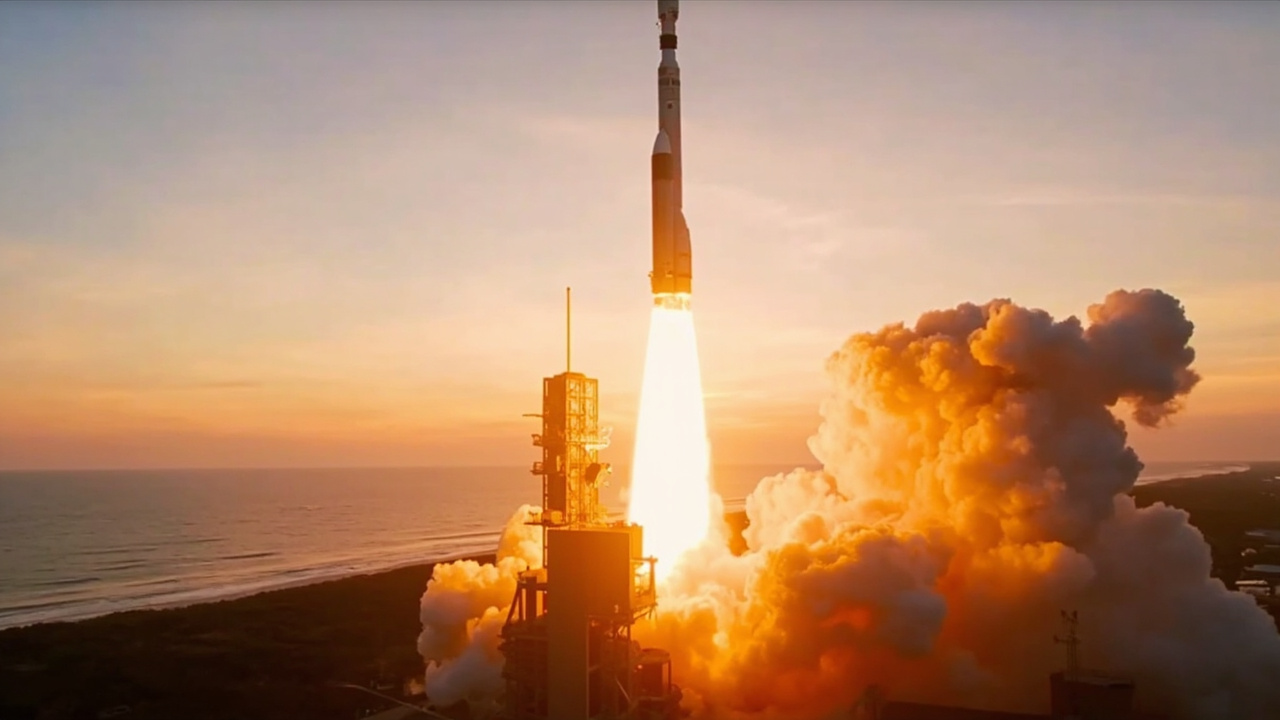
NASA opened a new flagship era in space astronomy on Sunday morning with a liftoff that sent its next great observatory toward a distant perch a million miles from Earth. According to NASA's news release titled "NASA’s Dark Universe-Seeking Nancy Grace Roman Space Telescope Launches," the Nancy Grace Roman Space Telescope lifted off at 7:26 a.m. EDT on Aug. 30, 2026, aboard a SpaceX Falcon Heavy rocket from Launch Complex 39A at Kennedy Space Center in Florida.
The mission is now on a three-month, million-mile journey to its final orbit, where it will use a large field of view paired with crisp infrared vision to explore vast swaths of sky and probe deeply into cosmic history. NASA describes Roman as a flagship mission to help astronomers explore dark matter, dark energy and worlds outside the solar system, known as exoplanets, while its surveys support a broad range of research extending beyond those main science goals.
NASA Administrator Jared Isaacman said the mission was delivered ahead of schedule and on budget and reflects more than a decade of dedication from the NASA workforce and industry partners. He said Roman will provide a new atlas of the universe, push the boundaries of discovery, and demonstrate what is possible when ambition is paired with disciplined execution.
A Sunrise Liftoff From Pad 39A
The Falcon Heavy ascent went as planned in the opening half hour of flight. According to NASA, the ground control team at Goddard Space Flight Center in Greenbelt, Maryland, began receiving telemetry data from Roman seven minutes after launch.
The Falcon Heavy performed as expected and separated from the observatory 31 minutes into the flight. After separating from the center core, the rocket's boosters safely returned to the launch site for refurbishment, NASA said.
A NASA mission blog update titled "NASA's Roman Space Telescope Flying on Its Own" reported that Roman separated from the Falcon Heavy second stage at 7:57 a.m. EDT and was flying on its own. The same update said Roman established communications through a NASA Tracking and Data Relay Satellite earlier in ascent at 7:33 a.m., as mission controllers continued monitoring the observatory at the start of its journey toward orbit around the second Sun-Earth Lagrange point, or L2.
Roman is the fourth primary mission NASA has launched on a Falcon Heavy rocket. NASA said its Launch Services Program worked with SpaceX earlier this year to accelerate the launch date to accommodate the telescope's early completion.
The Million-Mile Cruise to L2
Roman's destination is the second Sun-Earth Lagrange point, about one million miles from Earth, the same general location as NASA's James Webb Space Telescope. According to NASA's explainer titled "9 Things to Know About NASA’s Nancy Grace Roman Space Telescope," gravity from the Sun and Earth works together with an object's motion around the Sun at L2 to hold it roughly in place, giving Roman a relatively steady orbit without using much fuel.
That explainer notes that, like Webb, Roman will trace a large orbit around the actual L2 point — much larger than the Moon's orbit around Earth — and the two observatories will easily be kept far apart. During launch and early orbit, Roman uses the Near Space Network's ground stations and relay satellites to exchange tracking, telemetry and command data with ground controllers, according to NASA.
About 70 minutes after launch, the Deep Space Network takes over communications and guides Roman toward L2. NASA said Roman first connects to that network through the Canberra Deep Space Communication Complex in Australia. Approximately six hours later it will transfer to the Madrid Deep Space Communication Complex in Spain and then to the Goldstone Deep Space Communication Complex in California, ensuring continuous contact throughout its journey.
The NASA mission blog said that when science operations begin, the Near Space Network will transmit Roman's high-rate science data, while the Deep Space Network will continue providing critical tracking data, including precise range and angle measurements that show ground teams where Roman is in space. Additional support for downlinking Roman data will come from ESA and JAXA through their New Norcia and Misasa ground stations, respectively.
First Deployments in the Opening Hours
Controllers quickly confirmed that the spacecraft survived launch in good shape. According to NASA, the Roman team confirmed successful deployment of the observatory's solar panels and lower instrument sun shade an hour and 23 minutes after launch.
The mission blog said that in the next 30 minutes after separation, Roman will deploy its Solar Array Sun Shield, which provides power and doubles as a thermal shield. After separation, the four outer panels swing into place to form the full six-panel array, keeping the observatory powered and cool for the journey to L2.
Space.com reported in its article titled "Inside the Nancy Grace Roman Space Telescope, NASA's next great observatory" that the Solar Array Sun Shield consists of six solar panels, with two remaining fixed to the spacecraft while four more unfold after Roman reaches orbit. Angled toward the Sun, the array generates electricity and throws shade over much of the spacecraft, helping keep sensitive instruments at the low temperatures they need to operate.
Within the upcoming days, NASA said, Roman's high-gain antenna and visor-like deployable aperture cover will deploy, ground controllers will initiate the first of two mid-course corrections, and the Coronagraph Instrument will power on.
Why Roman Sees So Much Sky So Fast
Roman is designed for survey speed. NASA said the observatory's rigid design and stable optical performance will allow it to scan the sky rapidly without needing substantial time between separate observations. The telescope is designed to survey the universe a thousand times faster than NASA's Hubble Space Telescope.
The scale comes from combining Hubble-class sharpness with a much wider view. According to NASA, the Wide Field Instrument gives Roman the same sharpness, or angular resolution, as Hubble but with a field of view at least 100 times larger. Using that instrument, each Roman image will capture a patch of sky about 1.5 times bigger than the apparent size of a full Moon.
Space.com reported that its field of view is 100 times larger than Hubble's, meaning that in just the five years of its primary scheduled mission, it will capture more than 50 times as much sky as Hubble did in its first 30 years. With that reach, Roman is expected to map roughly 20 billion stars, measure light from more than a billion galaxies, and turn up as many as 200,000 new exoplanets, according to NASA as cited by Space.com.
Roman pairs that wide view with infrared sensitivity. Its data will be made public as soon as it is processed, allowing many teams to analyze it simultaneously, NASA said.
Two Instruments, Two Different Jobs
Roman carries two main instruments. The primary instrument is the Wide Field Instrument, described by NASA as a 300-megapixel infrared camera with 18 4K detectors, each about the size of a saltine cracker. Those detectors collect photons that are decoded into crisp cosmic panoramas.
Space.com reported that the camera uses a mosaic of 18 detectors arranged in an arc, each packing more than 16 million pixels, which collect light and convert it into electrical signals that can ultimately be turned into images. Because each image covers an enormous field, scientists expect virtually every exposure to be packed with information. NASA said the data will help scientists uncover insights into planetary systems around other stars and map how matter is structured and distributed, offering clues about dark energy.
The second instrument is the Coronagraph Instrument, designed to demonstrate advanced technologies for directly imaging planets around other stars. It blocks the glare from stars so scientists can see faint reflected light from planets in orbit around them. NASA said it will reveal giant worlds that are older, colder and in closer orbits than the hot, young super-Jupiters that direct imaging has mainly revealed so far.
NASA said the Coronagraph will demonstrate technology that future missions like NASA's Habitable Worlds Observatory concept could use to image Earth-like planets in the search for life. Roman's Coronagraph will take a step in that direction by taking pictures of Jupiter-like planets.
How the Telescope Itself Is Built
At the heart of Roman is a primary mirror 7.9 feet, or 2.4 meters, across — the same size as Hubble's — while a smaller secondary mirror just under 2 feet, or 0.5 meters, wide sits in front of it, according to Space.com. Both mirrors are kept cold, chilled to about 19 degrees Fahrenheit, or minus 7 degrees Celsius, to prevent heat from the telescope itself from interfering with observations.
The telescope is protected by the Deployable Aperture Cover, located at the very front of Roman. Space.com described it as a hat-like shade that pops open once the observatory reaches orbit, blocking stray light from entering the telescope barrel and helping protect sensitive optics throughout the mission.
NASA's "9 Things to Know About NASA’s Nancy Grace Roman Space Telescope" says Roman will scan the skies for at least five years, with a primary mission lifetime of five years and design support for an additional five-year extended mission. Fuel is expected to be the life-limiting resource, and while NASA does not currently have an ability to service observatories at L2, Roman is designed to be refuelable.
The same NASA explainer says the spacecraft also carries the names of more than 1.3 million people who submitted them to be added to a memory card attached to a plaque on Roman for the trip to L2.
A Data Firehose for Astronomers
Roman will produce an unprecedented flow of astrophysics data. NASA said Roman will send back 1.4 terabytes of data every day, the highest data rate of any NASA astrophysics mission so far. Machine learning, artificial intelligence and citizen scientists will help sift through it and flag significant findings for astronomers to study.
The commissioning sequence will take time before that survey begins. Throughout the rest of Roman's three-month commissioning period, scientists will run the instruments through calibrations and tests. NASA anticipates releasing Roman's first images by early 2027.
A few weeks into the voyage, the Wide Field Instrument will activate. Within the upcoming days after launch, the Coronagraph Instrument will power on, ahead of later calibration work.
Julie McEnery, Roman's senior project scientist at NASA Goddard, said researchers have never been able to view the universe with eyes like Roman's before. Nicky Fox, associate administrator for the Science Mission Directorate, said Roman will usher in a new era of discovery with its large field of view and fast survey speeds and set the foundation for the search for life beyond the solar system.
Named for Hubble's "Mother"
The mission is named after Dr. Nancy Grace Roman, from 1925 to 2018, NASA's first chief of astronomy. According to NASA, she championed space-based observatories that could study the universe above Earth's hazy atmosphere while making their data broadly available to the scientific community.
While she is known as the "mother" of Hubble, NASA said Roman played a broader role as the driving force behind NASA's entire Great Observatories program, which included Hubble along with the Chandra X-ray Observatory and the retired Compton Gamma Ray Observatory and Spitzer Space Telescope.
NASA said her vision and leadership helped establish NASA as a world-class scientific institution and laid the foundation for generations of space telescopes. The telescope is managed at NASA Goddard with participation by the Jet Propulsion Laboratory in Southern California, Caltech/IPAC in Pasadena, California, the Space Telescope Science Institute in Baltimore and scientists from research institutions. Primary industrial partners are BAE Systems Inc., L3Harris Technologies and Teledyne Scientific & Imaging, with contributions from ESA, JAXA, the French space agency CNES and the Max Planck Institute for Astronomy in Germany.
Sources referenced
- NASA’s Dark Universe-Seeking Nancy Grace Roman Space Telescope Launches - NASA (https://www.nasa.gov/news-release/nasas-dark-universe-seeking-nancy-grace-roman-space-telescope-launches/)