TL;DR: NASA's $4.3 billion Nancy Grace Roman Space Telescope is scheduled to launch aboard a SpaceX Falcon Heavy from Kennedy Space Center on Sunday, Aug. 30.
A flagship is packed and waiting for Sunday morning
NASA's next flagship observatory is encapsulated, transported to the pad and counting down to liftoff, according to Live Science.
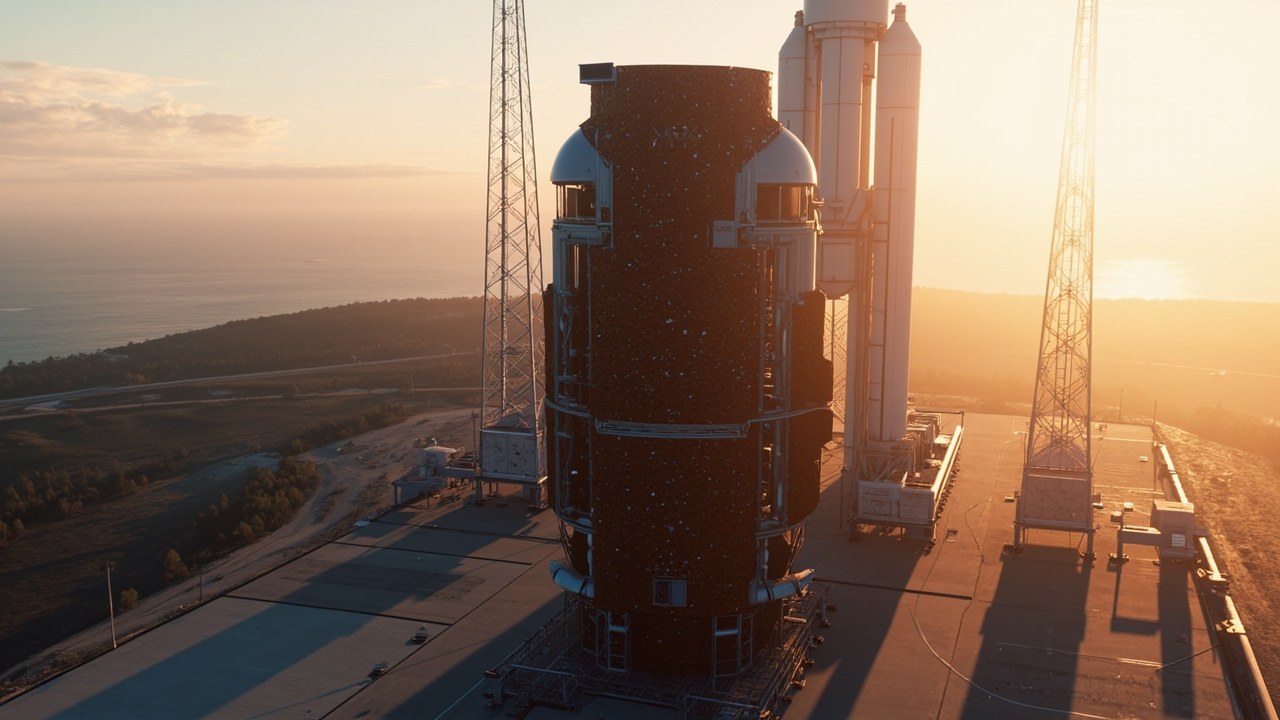
The Nancy Grace Roman Space Telescope is scheduled to lift off aboard a SpaceX Falcon Heavy rocket Sunday, Aug. 30, at 7:26 a.m. EDT from Launch Complex 39A at NASA's Kennedy Space Center in Florida, according to Live Science. A photo captured Aug. 25 shows the payload being transported to Launch Complex 39A, according to Live Science. The observatory was encased in its protective fairing earlier in the week ahead of the proposed launch, according to Live Science.
A few hours after liftoff, the telescope will be released from the rocket's second stage and be exposed to the vacuum of space for the first time, according to Live Science. NASA's Kennedy Space Center in Florida is the departure point, with the vehicle riding atop a SpaceX Falcon Heavy rocket, according to the Houston Chronicle, which lists the time as 6:26 a.m. Central time.
As of Thursday morning, Aug. 27, the National Weather Service forecasts a 50% chance of thunderstorms at Kennedy Space Center Sunday, so weather could delay the launch, according to Live Science. If that happens, a second launch window is available Monday, Aug. 31, at 7:22 a.m. EDT, when there is a reduced risk of thunderstorms, according to Live Science. Viewers can watch the event on a SpaceX livestream and follow last-minute developments and postlaunch news via a live blog from Space.com, Live Science reported.
Where Roman is going
Roman will head to sun-Earth Lagrange Point 2, an orbital sweet spot about 930,000 miles, or 1.5 million kilometers, away that will park the spacecraft on the side of Earth opposite the sun, according to Space.com.
Roman will eventually be stationed around 1 million miles, or 1.6 million km, from Earth at what scientists call a Lagrange point — a fixed point relative to our planet where the gravity of two objects cancels out, according to Live Science. Its specific Lagrange point will be Sun-Earth L2, where the James Webb Space Telescope and the European Space Agency's Gaia and Euclid space telescopes already reside, according to Live Science.
The destination places Roman alongside established observatories rather than replacing them. Roman will work alongside Hubble and Webb to help scientists scour the skies like never before, according to Live Science. Roman follows the James Webb Space Telescope, which launched in 2021, and the Hubble Space Telescope, which has been in orbit since 1990, according to Live Science.
What the observatory looks like
The spacecraft stands 42 feet tall and weighs around the same as a fully grown T. rex, according to Live Science. It is approximately 42 feet, or 12.7 meters, tall and 14 feet, or 4.4 meters, wide and weighs around 18,000 pounds, or 8,000 kilograms — about the same as a fully grown Tyrannosaurus rex, according to a NASA fact sheet cited by Live Science.
A photo taken on Dec. 4, 2025, shows Roman shortly after the spacecraft was fully constructed, according to Live Science. Roman was fully completed in December 2025, almost a decade after construction began and within its initial $4.3 billion budget, less than half what the James Webb Space Telescope cost, according to Live Science.
Since completion, it has been moved more than 900 miles, or 1,450 kilometers, from Goddard Space Flight Center in Maryland and undergone a series of final checks in NASA's clean rooms, according to Live Science. Having initially been slated for a 2027 liftoff, the telescope is technically launching ahead of schedule, according to Live Science. Development also reflects nearly two decades and $4 billion of work, according to Space.com.
The telescope is named for NASA's first chief astronomer. Nancy Grace Roman, who died in 2018, was an advocate for observatories that could fly above Earth's hazy atmosphere, according to the Houston Chronicle. She's often called the mother of NASA's Hubble Space Telescope, which has been circling the Earth for 36 years, according to the Houston Chronicle. The observatory is named after pioneering scientist Nancy Grace Roman, who served as NASA's first chief astronomer between 1960 and 1979, according to Live Science.
Why astronomers call it a speed machine
Roman has two key instruments that set it apart from its predecessors, according to Live Science. The first is its Wide Field Instrument, a 288-megapixel camera attached to a 7.9-foot, or 2.4-meter, mirror, which gives it a field of view 100,000 times greater than Hubble's, according to Live Science.
Roman's Wide Field Instrument utilizes a 7.9-foot-wide mirror to focus infrared light into a 288-megapixel camera, according to Live Science. It will also see the cosmos in infrared light, similar to Webb, according to Live Science. These combined capabilities will allow Roman to observe the cosmos like never before, according to Live Science.
The scope will capture visible-to-near-infrared images of the universe that are 50 times wider than the field of view on the James Webb Space Telescope, according to Space.com. According to NASA, Roman's images will be significantly bigger than Hubble's, the Houston Chronicle reported. One month of Roman's observations would take a century to complete with Hubble, according to NASA as reported by the Houston Chronicle.
"It is literally a speed machine," Nicky Fox, NASA's Associate Administrator for the Science Mission Directorate, said in an April news conference, according to the Houston Chronicle. Fox added that the speed at which the mission will scan the sky, deliver vast amounts of data and return results will be at an unprecedented rate never done before, according to the Houston Chronicle.
Hunting exoplanets, dark matter and dark energy
NASA is preparing to launch a new space telescope on Sunday, unveiling an observatory that could help scientists create a 3D map of the universe and find distant worlds, according to the Houston Chronicle.
"In NASA astrophysics, we pursue the big questions: Are we alone? How did we get here? How does the universe work?" Shawn Domagal-Goldman, director of NASA's Astrophysics Division, said in a July news conference, according to the Houston Chronicle. Domagal-Goldman said Roman will help answer those curiosity-driven questions, according to the Houston Chronicle.
Roman's 3D map will help scientists study two especially big mysteries: dark matter and dark energy, according to the Houston Chronicle. The upcoming launch will usher in a new wave of astronomical research into dark matter and dark energy, exoplanet discoveries and wide-field imaging, according to Space.com.
Dark matter is like an invisible glue that holds the universe together, according to the Houston Chronicle. Scientists have seen evidence of its existence — by its gravitational effects on visible items — but don't know if it's made of heavy, sluggish particles or light, fast-moving particles, according to NASA as reported by the Houston Chronicle.
Dark energy is the name given to whatever is causing the universe to expand at an accelerating rate, according to the Houston Chronicle. NASA says it makes up 68% of the universe, but the agency doesn't know much more about it, according to the Houston Chronicle.
The telescope's other major quarry is planets outside the solar system. To date, scientists have cataloged more than 6,300 planets circling other stars, according to the Houston Chronicle. Roman could uncover 100,000 more, according to NASA as reported by the Houston Chronicle. One of the biggest claims researchers have made about Roman is that it could help reveal up to 100,000 exoplanets, according to Live Science. Researchers have uncovered over 6,000 exoplanets since the first one was spotted in 1992, according to Live Science.
The telescope is also expected to help scientists studying other phenomena, including rogue planets, isolated black holes, starquakes and planet-forming disks around nearby stars, according to the Houston Chronicle. The telescope will also conduct long-term surveys that will help astronomers map the Milky Way and find extremely distant galaxies, according to Live Science.
"Almost regardless of what your scientific interest is, Roman is probably already planning to take observations," Julie McEnery, Roman's senior project scientist at NASA, said during a July news conference, according to the Houston Chronicle.
The coronagraph advantage
The telescope's secret weapon is arguably its coronagraph, which can block out the light from distant stars, allowing Roman to see fainter objects, such as the exoplanets that orbit these stars, according to Live Science.
Until now, scientists' main way of finding alien worlds was to wait for them to pass in front of, or transit, their home star, but Roman will be able to directly image exoplanets at almost any time in their orbital cycles, according to Live Science. Exoplanets remain out of view when they are directly behind their home stars, according to Live Science.
How Roman survived a budget fight
Roman's arrival at the pad follows a turbulent budget year, according to Space.com. In April 2025, reporting about initial passback budget documents outlined a proposal for the largest cut in NASA's history — a 24% overall reduction in funding, with a 50% loss to science programs, according to Space.com. The document detailed continued support for missions like Hubble and Webb but allocated no funding for other telescopes, according to Space.com.
For Roman's team, the prospect of abandoning the telescope just before the finish line hit hard, according to Space.com. Lisa, an engineer who worked on Roman's team at NASA's Goddard Space Flight Center in Maryland and wished to be identified by an alias, said the team was 95% there, according to Space.com.
Jamie Dunn has worked at Goddard since 1991, according to Space.com. He served as Roman's project manager from 2018 until he was appointed director of the center this past June, according to Space.com. During a question-and-answer session with a committee of the National Academies of Sciences, Engineering, and Medicine on Aug. 10 — part of a congressionally mandated assessment prompted in part by reporting from Space.com about accelerated facility closures and consolidations at Goddard last year — Dunn described a calmer reaction to Roman's potential cancellation, according to Space.com.
"Out of the eight years I [worked on Roman]," he told the committee, "we were zeroed out in the president's budget ... in at least half of them," according to Space.com.
When the president's official skinny budget proposal was published a few weeks after the April leak last year, Roman's prospects shifted from dire to just worrisome, according to Space.com. Instead of cancelling the mission outright, the administration's budget request allocated just $156.6 million to Roman's continued development in fiscal year 2026 — less than half of what the project received in fiscal year 2025, according to Space.com.
Goddard personnel began working around the clock at a time when government agencies, including NASA, were initiating reductions in force and encouraging civil servants to accept a deferred resignation option, according to Space.com. Of three skilled technicians working in one department of Roman's team, two left, according to Lisa as reported by Space.com.
Rather than merely stay on schedule, the Roman mission team was pushed to accelerate it, according to Space.com. Congress ultimately rejected the steep cuts to NASA in the president's budget request and restored the agency's funding to the previous year's levels, according to Space.com. Not wanting to go through a repeat of uncertainty for fiscal year 2027, Roman mission management began eyeing faster routes to the launch pad, according to Space.com.
What happens after launch weekend
Roman's initial mission will last five years, but experts hope it could survive at least twice that long, according to Live Science. Some space telescopes far outlast their initial missions; for example, Hubble is more than two decades past its original mission parameters, and NASA's recently doomed Swift Observatory lasted 10 times longer than predicted, according to Live Science.
Even if everything goes according to plan, observers will still have to wait a while to get a glimpse of Roman's first groundbreaking images, according to Live Science.
Sources referenced
- NASA's Nancy Grace Roman Space Telescope is set to launch this weekend. When will we see its first photos? | Live Science (https://www.livescience.com/space/space-exploration/nasas-nancy-grace-roman-space-telescope-is-set-to-launch-this-weekend-when-will-we-see-its-first-photos)
- Trump tried to scrap NASA's Roman Space Telescope last year. Now it's ready to launch | Space (https://www.space.com/space-exploration/launches-spacecraft/trump-tried-to-scrap-nasas-roman-space-telescope-last-year-now-its-ready-to-launch)