TL;DR: NASA's Nancy Grace Roman Space Telescope is scheduled to lift off no earlier than 7:26 a.m. EDT on Sunday, Aug. 30, aboard a SpaceX Falcon Heavy from Kennedy Space Center in Florida.
NASA's next flagship astrophysics observatory is on the pad and cleared to fly. After a final Launch Readiness Review on Friday, Aug. 28, NASA and SpaceX are targeting liftoff of the Nancy Grace Roman Space Telescope no earlier than 7:26 a.m. EDT Sunday, Aug. 30, from Launch Complex 39A at Kennedy Space Center in Florida, according to NASA Sets Coverage for Roman Space Telescope Launch from Florida.
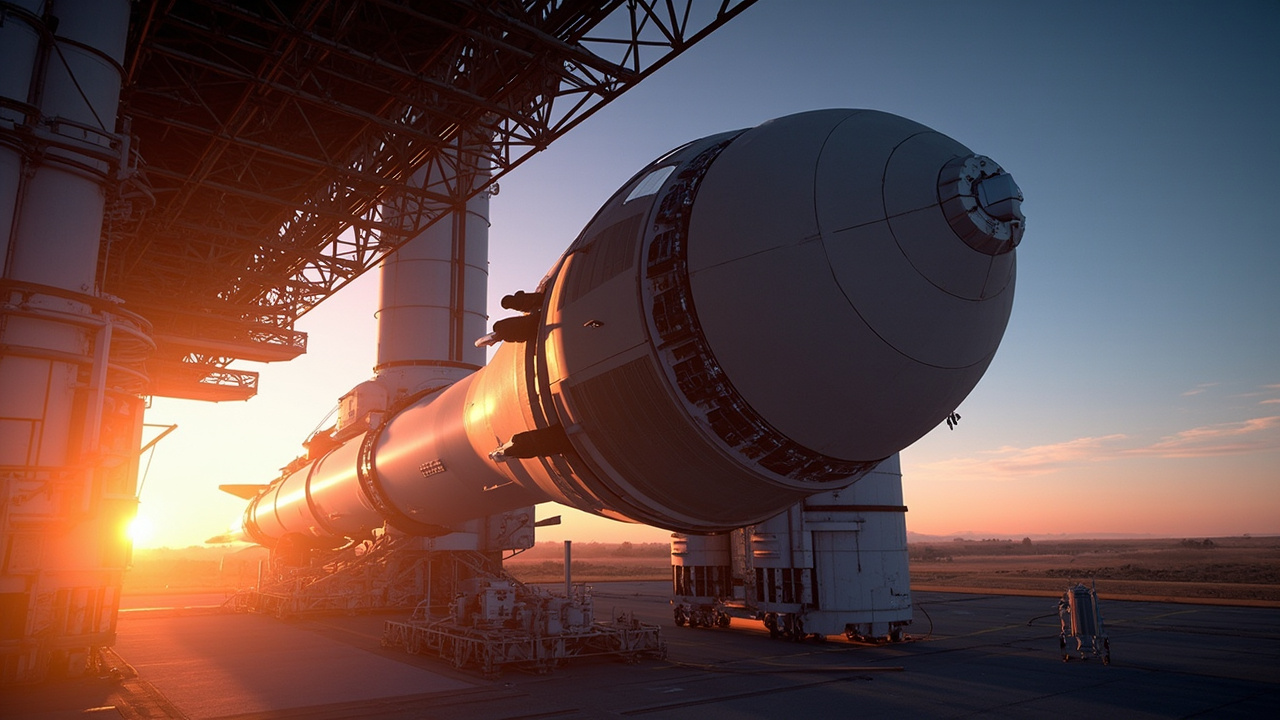
The mission has not yet launched as of Saturday, Aug. 29. Everything in this report describes final prelaunch status, the launch plan, and the science program as announced by NASA and the European Space Agency (ESA). The spacecraft is encapsulated in its payload fairing for protection during rollout, ascent and early flight, and teams have moved it toward integration with the Falcon Heavy.
Roman is designed to pair sharp infrared vision with a sweeping field of view to investigate dark energy and dark matter, survey exoplanets, map billions of galaxies, study black holes, and observe targets from the outer solar system to the edge of the observable universe. After separation from the rocket, the plan calls for Roman to cruise to the second Sun-Earth Lagrange point, about 1 million miles from Earth, for a five-year primary mission with a goal of 10 years of operation.
Launch plan: when, where and how to watch
The targeted liftoff time is 7:26 a.m. EDT on Sunday, Aug. 30, aboard a SpaceX Falcon Heavy rocket from Launch Complex 39A, according to NASA Sets Coverage for Roman Space Telescope Launch from Florida. NASA lists that target as no earlier than that time, meaning the time can move with real-time operations.
NASA's launch-day television and online coverage is scheduled to begin at 6:20 a.m. EDT on Sunday. The agency said live coverage will stream across NASA platforms, with details at nasa.gov/live. Audio-only coverage was also planned on NASA communications channels described in the coverage advisory.
The observatory was encapsulated within the payload fairing at Kennedy Space Center ahead of mating to the Falcon Heavy, NASA reported. Encapsulation shields the spacecraft during rollout, ascent and the early phases of flight. Teams completed encapsulation work on Friday, Aug. 21, inside the Payload Hazardous Servicing Facility, according to 9 Things to Know About NASA’s Nancy Grace Roman Space Telescope.
Meteorologists with the U.S. Space Force's Space Launch Delta 45 Weather Squadron predicted a 60% chance of favorable weather conditions for the Sunday morning attempt, according to NASA’s Roman Space Telescope ‘Go’ for Launch. That forecast was issued as part of the Aug. 28 readiness update.
NASA said the Launch Readiness Review on Friday confirmed readiness of the Falcon Heavy, the Roman observatory, weather and supporting teams to proceed into countdown. The review is the final major poll before launch operations begin.
Busy prelaunch day on Aug. 29
NASA scheduled a full day of briefings and media events for Saturday, Aug. 29, at the Kennedy Press Site, all times Eastern and subject to change. The schedule illustrates how NASA uses the final day to explain science goals, mission management and countdown status before a flagship launch.
At 9 a.m., NASA planned a Mission Science Briefing with Shawn Domagal-Goldman, director of the Astrophysics Division at NASA Headquarters; Julie McEnery, Roman senior project scientist at NASA's Goddard Space Flight Center; Vanessa Bailey, Roman Coronagraph Instrument scientist at NASA's Jet Propulsion Laboratory; Kristen McQuinn, Roman Science Operations Center lead at the Space Telescope Science Institute; and Lee Armus, Roman Science Support Center lead at Caltech/IPAC.
At 10:30 a.m., NASA planned a Prelaunch News Conference with Nicky Fox, associate administrator for the Science Mission Directorate; Lucas Paganini, Roman program executive; Jackie Townsend, Roman project manager at Goddard; Denton Gibson, launch director for NASA's Launch Services Program at Kennedy; Julianna Scheiman, director of NASA Science and Dragon Programs at SpaceX; and Justin McReynolds, launch weather officer with the 45th Weather Squadron, according to NASA Sets Coverage for Roman Space Telescope Launch from Florida.
At 11:45 a.m., NASA Administrator Jared Isaacman was expected to fly past the Roman spacecraft and Falcon Heavy on the launch pad in his jet, subject to weather and operational considerations. The flyby was to be shown live on the same stream as the prelaunch news conference. At noon, NASA planned in-person interviews at the Kennedy Press News Center with managers, scientists and industry partners, including representatives from Goddard, NASA's Jet Propulsion Laboratory, L3Harris Technologies and BAE Systems.
For Sunday after liftoff, NASA scheduled a postlaunch news conference for 9:30 a.m. with Administrator Isaacman, Nicky Fox, Jackie Townsend, Julie McEnery and Denton Gibson.
Why Roman matters for cosmology
Roman's central science goal is to examine the universe's expansion and hidden mass. ESA, a partner on the mission, said Roman will conduct detailed scans of the sky in visible to near-infrared light to reveal the nature of dark energy and dark matter and find new exoplanets, according to Cutting-edge infrared space telescope Roman set to launch.
Scientists estimate about 25% of the universe appears to be invisible dark matter, detectable only by how it bends and distorts light from distant galaxies in an effect called weak gravitational lensing. Scientists think dark energy makes up about 70% of the universe and is driving an accelerating expansion, yet its nature remains a mystery, ESA reported.
One of Roman's main tasks will be to scan about 12% of the sky high above the galactic plane to look for lensing in millions of distant galaxies. By measuring tiny changes in galaxy shapes, astronomers plan to map ordinary and dark matter across cosmic history and trace how galaxies evolved.
To probe dark energy, Roman will use exploding stars and galaxy clustering. Because Type Ia supernovas peak at a predictable brightness, astronomers can use them to measure cosmic distances and expansion. Roman will also map how galaxies cluster in time and space to test dark energy's effects, including study of baryonic acoustic oscillations, described by ESA as frozen imprints of sound waves that once rippled through the very early universe.
A wide-view telescope built for surveys
Roman is designed for breadth without giving up sharpness. NASA said it will pair sharp infrared vision with a field of view at least 100 times larger than the Hubble Space Telescope, according to NASA Sets Coverage for Roman Space Telescope Launch from Florida.
NASA's explainer said the observatory's Wide Field Instrument is a 300-megapixel infrared camera with Hubble-like angular resolution but a field at least 100 times larger. Each Roman image will capture a patch of sky about 1.5 times bigger than the apparent size of a full Moon, according to 9 Things to Know About NASA’s Nancy Grace Roman Space Telescope.
ESA described the capability in similar terms, saying Roman will combine Hubble-quality imaging with a field more than 200 times larger, allowing study of billions of stars, millions of galaxies, thousands of exoplanets and large regions of previously unexplored space, according to Cutting-edge infrared space telescope Roman set to launch.
That survey speed matters for U.S. researchers because Roman's data will be made public as soon as it is processed, allowing many teams to analyze it simultaneously. NASA said each survey will sample such a large volume of the cosmos that the mission will support a broad range of additional science, from objects in the outer solar system and exploding stars to growing black holes and billions of galaxies.
Two instruments, two search strategies
Roman carries two main instruments. The Wide Field Instrument handles the large surveys for cosmology and exoplanet demographics. The Coronagraph Instrument is a technology demonstration for directly imaging planets around other stars.
NASA said the coronagraph is designed to demonstrate the most advanced technologies ever flown in space for directly imaging exoplanets. It will block glare from stars so scientists can see faint reflected light from planets in orbit around them, revealing giant worlds that are older, colder and in closer orbits than the hot, young super-Jupiters that direct imaging has mainly revealed so far.
For population statistics, Roman will stare toward the heart of the Milky Way and track light from millions of stars. ESA said Roman will watch for microlensing events that may reveal over 1,200 new worlds. At the same time, the telescope is expected to reveal more than 100,000 transiting planets that dim their host stars when crossing in front of them.
The combination lets Roman both count planets across the galaxy and test techniques to see them directly. The wide-field surveys find candidates and cosmic structure at scale, while the coronagraph tests starlight-suppression tools needed for future missions that could image smaller, more Earth-like planets.
Distant outpost at L2 and a five-year survey plan
After launch and separation, Roman is planned to travel to the second Sun-Earth Lagrange point, or L2, about 1 million miles from Earth. NASA lists a five-year primary lifetime with a goal of operating for 10 years, with science data publicly available after processing.
L2 is the same general location as NASA's James Webb Space Telescope. At L2, gravity from the Sun and Earth works with an object's motion around the Sun to hold it roughly in place, giving Roman a relatively steady orbit without using much fuel, according to 9 Things to Know About NASA’s Nancy Grace Roman Space Telescope. Like Webb, Roman will trace a large orbit around the actual L2 point, much larger than the Moon's orbit around Earth, and the two spacecraft will easily be kept far apart.
Fuel is expected to be the mission's life-limiting resource. NASA does not currently have an ability to service observatories at L2, but Roman is designed to be refuelable, NASA said. The design choice preserves an option for an extended mission if future servicing becomes possible.
Roman is also carrying a public time capsule of sorts. This summer, people were invited to submit names for a memory card attached to a plaque on the spacecraft. More than 1.3 million people did so, and their names will travel to L2 with the observatory.
Namesake, partners and place in the fleet
The mission is named for Dr. Nancy Grace Roman, NASA's first chief of astronomy, who served from 1925 to 2018. She championed space-based observatories above Earth's atmosphere and broad access to their data. Known as the mother of Hubble, she also helped drive NASA's Great Observatories program, which included Hubble, the Chandra X-ray Observatory and the retired Compton Gamma Ray Observatory and Spitzer Space Telescope, according to 9 Things to Know About NASA’s Nancy Grace Roman Space Telescope.
Roman will not work alone. NASA said its panoramas will uncover targets for Hubble follow-up in infrared, visible and ultraviolet light, while Webb can use its larger mirror for ultra-sharp detailed observations. Roman can also provide context around objects Hubble or Webb observe.
Europe's Euclid mission, with key NASA contributions, will observe a larger sky area than Roman with less detail. Because survey areas overlap, scientists can use Roman's higher-quality data to apply corrections to Euclid's and extend refinements over Euclid's larger area. Scientists can also pair Roman infrared data with visible-light observations from the ground-based Vera C. Rubin Observatory, a National Science Foundation-Department of Energy collaboration.
ESA's hardware role includes star trackers, batteries, detectors for the coronagraph instrument and communications support through its deep-space ground-station network. ESA will also enable data download using a new 35-metre antenna in New Norcia, Australia, according to Cutting-edge infrared space telescope Roman set to launch.
This will be the sixth NASA primary mission with SpaceX to launch on a Falcon rocket from Kennedy, after IXPE, Psyche, NOAA's GOES-U, Europa Clipper and IMAP, according to NASA’s Roman Space Telescope ‘Go’ for Launch. For U.S. space policy and science, Roman represents the next large astrophysics survey after Hubble and Webb, built to map the sky quickly and share the data widely.