TL;DR: SpaceX launched NASA's CRS-35 cargo mission on Oct. 13 with more than 6,300 pounds of science and the final pair of Roll-Out Solar Arrays, docking Oct. 15, amid a packed October manifest tracked by Spaceflight Now.
Spaceflight Now's October mission reports describe a rapid sequence of SpaceX flights from both coasts in early to mid-October 2026, centered on International Space Station logistics and U.S. national security launches. According to Spaceflight Now, the newest verified cargo milestone was the Oct. 13 sunrise launch of NASA's SpaceX CRS-35 mission from Cape Canaveral, carrying more than 6,300 pounds of science and supplies. According to NASA, the Dragon spacecraft docked Oct. 15 to the Harmony module and is scheduled to remain until mid-November for return off the coast of California.
CRS-35 lifts off from Cape Canaveral
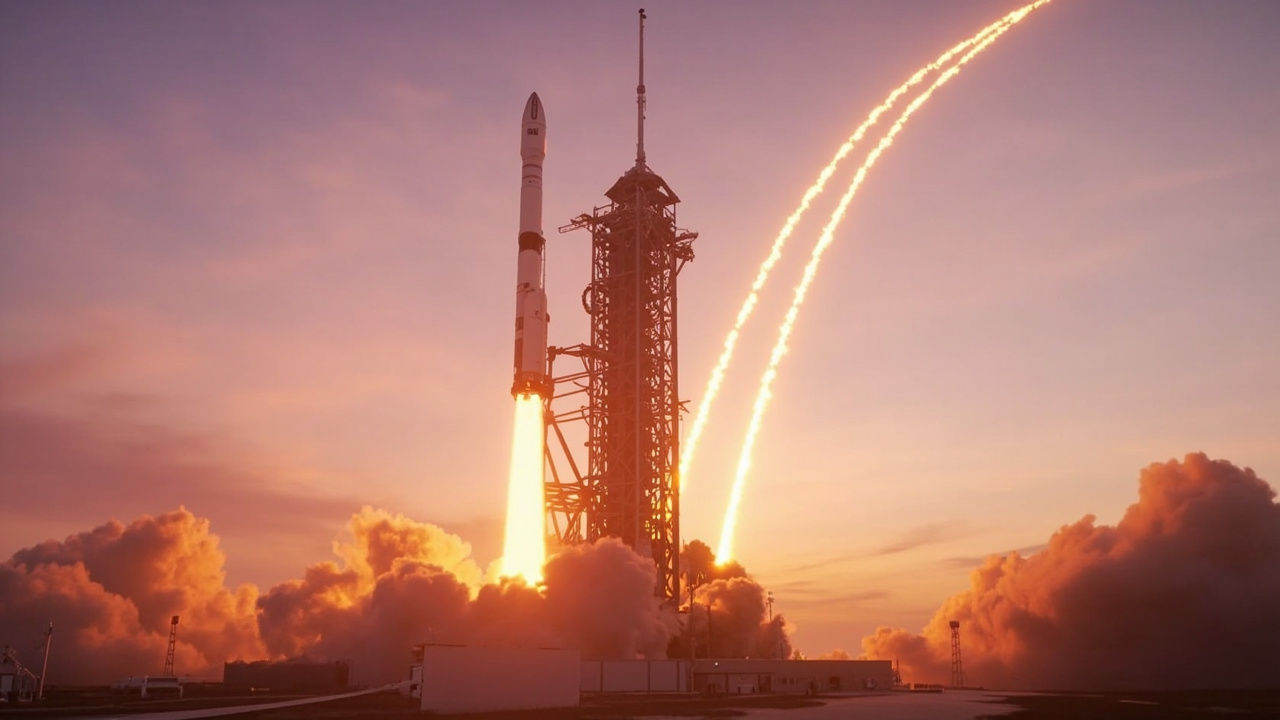
According to Spaceflight Now, a SpaceX Falcon 9 rocket lifted off from pad 40 at Cape Canaveral Space Force Station at 6:33 a.m. EDT (1033 UTC) on Tuesday, Oct. 13. According to NASA, the mission was NASA's SpaceX 35th commercial resupply mission to the International Space Station.
The flight was the 35th SpaceX flight under the Commercial Resupply Services 2 contract with NASA, according to Spaceflight Now. Liftoff occurred under sunrise conditions, with images showing the booster and upper stage plumes illuminated by the rising sun.
Fewer than 7.5 minutes after leaving the pad, first stage booster tail number B1096 completed its eighth trip to space and back with a landing at Landing Zone 40 adjacent to the pad, according to Spaceflight Now. A sonic boom rang across the spaceport and beyond during the return.
About nine minutes after launch, Dragon separated from the rocket's second stage, opened its nosecone, and began thruster firings to reach the station, according to NASA's space station blog summary. Cargo Dragon spacecraft tail number C211 separated from the Falcon 9 upper stage two minutes after the booster landing to begin a two-day journey, according to Spaceflight Now.
According to NASA, Dragon was scheduled to autonomously dock at 11 a.m. Thursday, Oct. 15, to the space-facing port of the Harmony module. NASA streamed rendezvous and docking coverage beginning at 9:15 a.m. NASA astronaut Anil Menon and Canadian Space Agency astronaut Joshua Kutryk monitored the arrival, according to Spaceflight Now.
Final Roll-Out Solar Arrays ride in Dragon's trunk
Onboard cameras showed two Roll-Out Solar Array wings nestled inside Dragon's unpressurized trunk, according to Spaceflight Now. The arrays are intended to augment power on the International Space Station.
Built by Redwire Space, the arrays were the fourth and final pair of ROSAs bound for the station, according to Spaceflight Now. Each array is capable of providing more than 20 kW of power for more than 10 years. NASA has been preparing for installation with a series of spacewalks.
According to NASA, the final pair will complete the station's power system augmentation, boosting available electricity for research, operations, and the station's safe, controlled deorbit. Astronauts will install the arrays during spacewalks planned for later this fall.
NASA operations integration manager of its Low Earth Orbit Program Gaurang Patel described the history during post-launch remarks on the agency broadcast, according to Spaceflight Now. Patel said, "It's been quite the journey."
Patel recalled that teams demonstrated the ROSA deployment approach on CRS-11 in 2017 and then examined how to apply it to the station, according to Spaceflight Now. He said legacy arrays were not outfitted for standard upgrades, requiring modification kits and non-standard interfaces to mount the new arrays safely.
According to Spaceflight Now, a version of the ROSA will be used to help power NASA's Space Reactor 1 Freedom, or SR-1 Freedom, when it launches in 2028.
More than 40 science investigations onboard
Also onboard Dragon was equipment to support more than 40 different scientific studies, according to Spaceflight Now. The complement included biological and plant science experiments and testing of a new type of glass.
According to NASA, Dragon delivered hardware to manufacture artificial retinas in microgravity that could help restore vision for patients on Earth. Dragon also delivered 3D heart tissue models to advance large-scale drug testing on future space missions.
Dragon carried materials to study how a new type of glass is formed in microgravity, according to NASA. It also carried brain organoids that could uncover potential treatment targets for neurodegenerative diseases like Alzheimer's, Parkinson's, and multiple sclerosis.
NASA deputy chief scientist within its ISS Office Dr. Liz Warren said most ordinary glass forms from silica, the main component in sand, according to Spaceflight Now. Warren said unconventional glass is made from heavier elements not traditionally used to form glass.
Warren said the unconventional glasses could have refractive indices higher than diamond, greater resistance to breaking, and the ability to contract rather than expand when heated, according to Spaceflight Now. She said new types of glass could advance optics and electronics on Earth and support exploration with stronger, lighter, radiation-resistant, or higher-performing glass, with potential use in lunar rovers and lunar habitats.
According to NASA, research aboard the orbiting laboratory benefits people on Earth and lays groundwork for deep space missions. NASA said that as part of the Artemis program, the agency will send astronauts to the Moon to prepare for future human exploration of Mars.
Dragon C211 will spend about a month docked to the International Space Station, according to Spaceflight Now. According to NASA, Dragon is scheduled to depart in mid-November and return to Earth with time-critical research and cargo, splashing down off the coast of California.
Crew-13 begins six-month station stay
According to SpaceX, Falcon 9 launched Dragon's 13th operational human spaceflight mission, Crew-13, to the International Space Station on Oct. 1 at 11:10 a.m. ET from Space Launch Complex 40 at Cape Canaveral Space Force Station. Dragon autonomously docked Oct. 1 at 7:05 p.m. ET.
The crew comprised NASA astronaut Jessica Watkins, pilot Luke Delaney, Canadian astronaut Joshua Kutryk, and Russian cosmonaut Sergey Teteryantnikov, according to Spaceflight Now and SpaceX mission pages. Spaceflight Now reported liftoff from pad 40 at 11:10 a.m. EDT for a six-month stay.
Watkins will become the first agency astronaut to fly for a second time onboard a SpaceX Dragon spacecraft, according to Spaceflight Now's launch preview. Watkins served as Crew-13 commander, with Delaney as pilot.
According to SpaceX, the Dragon spacecraft supporting the mission previously flew the Ax-4 mission to and from the station. The first stage supporting the mission made its third flight, having previously launched Crew-12 and one Starlink mission. Following stage separation, the first stage landed on Landing Zone 40 at Cape Canaveral Space Force Station.
During time on the orbiting laboratory, the crew will conduct new research to prepare for human exploration beyond low-Earth orbit and to benefit humanity on Earth, according to SpaceX. According to SpaceX tracking, the Crew-13 mission return is listed as April 2027, while CRS-35 return is listed as November 2026.
Classified and defense launches from both coasts
According to Spaceflight Now, a SpaceX Falcon 9 rocket launched carrying a classified payload for the United States Space Force on Oct. 15. Liftoff from Space Launch Complex 4 East at Vandenberg Space Force Base in California happened at 5:01 p.m. PDT, or 8:01 p.m. EDT and 0001 UTC. SpaceX landed its booster on a droneship, according to the Spaceflight Now live update.
According to SpaceX's launch listing, the mission was designated USSF-481, flown by Falcon 9 from SLC-4E in California with droneship recovery. Spaceflight Now identified the flight as a classified U.S. Space Force mission.
According to Spaceflight Now, SpaceX launched 21 data satellites for the Space Development Agency on Oct. 9. Liftoff from Vandenberg Space Force Base came at 12:39 a.m. PDT, or 3:39 a.m. EDT and 0739 UTC. The satellites support the Proliferated Warfighter Space Architecture constellation.
The Oct. 9 flight was the fourth flight supporting the constellation and was designated the fourth Tranche 1 mission, according to Spaceflight Now and SpaceX listings. Spaceflight Now reported an Oct. 4 scrub of the Tranche 1 Transporter Layer A mission attempt, with a subsequent attempt possible as soon as Saturday.
According to SpaceX's launch listing, a Falcon Heavy launched the NROL-97 mission Oct. 1 from Launch Complex 39A at Kennedy Space Center. Spaceflight Now described it as the 14th Falcon Heavy rocket flying its first mission for the U.S. spy satellite agency, scheduled at 11:54 p.m. EDT, or 0354 UTC.
Starlink, Transporter rideshare add volume
According to Spaceflight Now, a SpaceX Falcon 9 rocket launched 27 Starlink satellites from California on Oct. 12. Liftoff of the Starlink 15-25 mission from Space Launch Complex 4 East came at 5:28 p.m. PDT, or 8:28 p.m. EDT and 0028 UTC.
According to Spaceflight Now, SpaceX's Transporter-18 mission on Oct. 1 carried 130 payloads to Sun-synchronous orbit. Liftoff from pad 4E at Vandenberg happened at 11:32 a.m. PDT, or 2:32 p.m. EDT and 1832 UTC.
According to SpaceX's launch listing, Starship Flight 14 flew Sept. 28 from Pad 2 at Starbase in Texas. Spaceflight Now previewed a planned orbital flight aiming to send 26 Starlink Version 3 satellites to low Earth orbit during a 75-minute window opening at 7:15 a.m. CDT, or 8:15 a.m. EDT and 1215 UTC.
What Spaceflight Now's schedule shows next
According to Spaceflight Now's launch schedule, SpaceX's Bandwagon-5 mission was set for Oct. 19 with a window opening at 6:30 a.m. EDT from SLC-40 in Florida to mid-inclination low Earth orbit. The mission featured 31 separation events, with first stage booster B1085 making its 19th flight and targeting landing on the droneship A Shortfall of Gravitas.
The schedule listed an H3 launch of the Martian Moons eXploration mission, or MMX, no earlier than Oct. 19-20 from Tanegashima, with launch at 4:41:03 JST on Oct. 20, according to Spaceflight Now. The mission is intended to survey Phobos and Deimos, with Phobos samples expected to return to Earth in fiscal year 2031, supported by NASA, CNES, DLR, and ESA.
The schedule also listed Falcon 9 Starlink missions Oct. 20 and Oct. 24 from Vandenberg, Rocket Lab Electron missions for HawkEye 360 and iQPS, and an Ariane 6 mission with 36 Amazon Leo satellites no earlier than Nov. 23, according to Spaceflight Now. It listed an uncrewed Boeing Starliner cargo flight test no earlier than December 2026 and Sierra Space's Dream Chaser first flight no earlier than the fourth quarter of 2026.
Sources referenced
- SpaceX launches NASA science and cargo to the International Space Station – Spaceflight Now (https://spaceflightnow.com/2026/10/13/spacex-launches-nasa-science-and-cargo-to-the-international-space-station/)
- NASA Science, Cargo Launch on 35th SpaceX Resupply Mission to Station - NASA (https://www.nasa.gov/news-release/nasa-science-cargo-launch-on-35th-spacex-resupply-mission-to-station/)