TL;DR: NASA has no new Mars landers or rovers planned for the first time in more than 30 years, so three self-landing SkyFall helicopters launching in late 2028 are its next surface mission.
A gap in surface missions
For the first time in more than 30 years, NASA has no firm plans to send any new landers or rovers to Mars, according to Ars Technica.
The agency's near-term work at the planet is instead centered on aerial drones, a form of exploration that did not appear realistic until recent years.
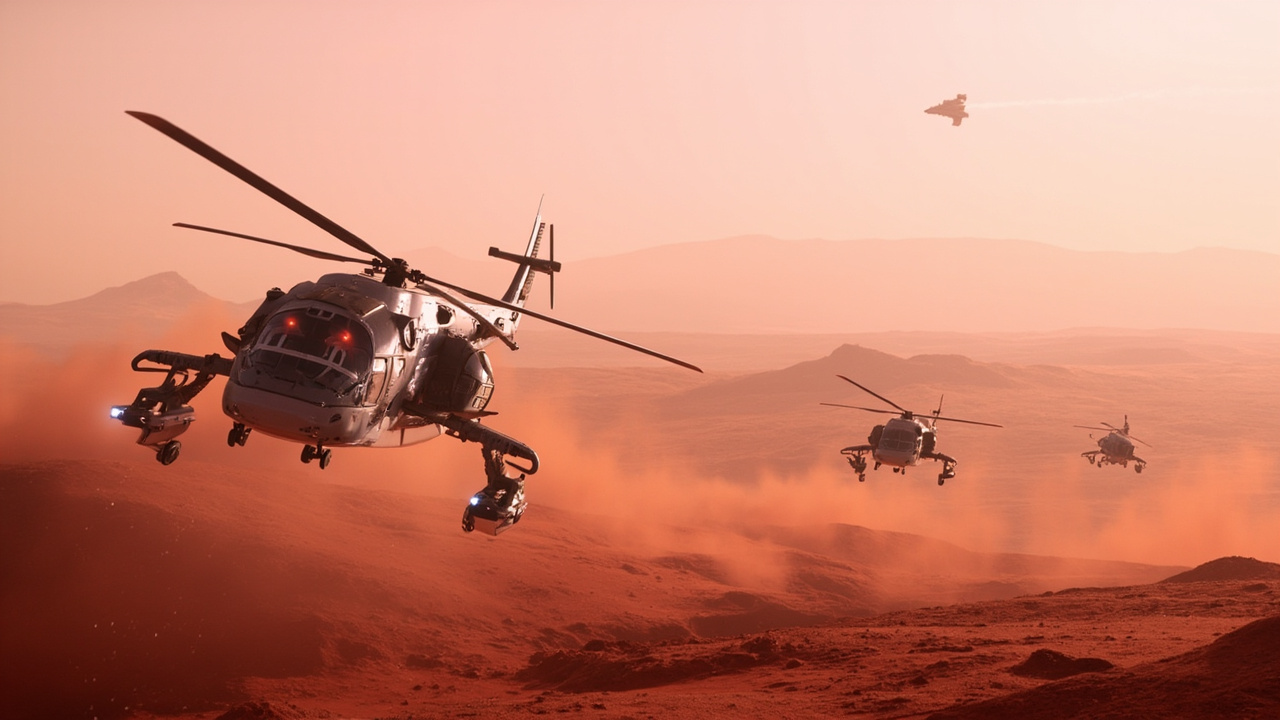
The first scientific use of drones at Mars will arrive with SkyFall, a fleet of three helicopters set for launch as soon as late 2028.
SkyFall will travel to Mars with NASA's Space Reactor-1 "Freedom" mission, whose primary objective is demonstrating nuclear electric propulsion in deep space.
The schedule is aggressive for both efforts, which did not exist in NASA's portfolio six months ago, according to Ars Technica reporting published September 1, 2026.
That timing places unusual pressure on design, testing, and integration, because a Mars departure opportunity constrains when the combined spacecraft can leave Earth.
NASA currently plans a launch window in November 2028, followed by a cruise to Mars, according to AeroVironment.
Arrival timing will be tuned to local time, dust conditions, and power needs, the company said.
Riding with Space Reactor-1 Freedom
SR-1 Freedom is estimated to cost $2.1 billion, a figure that does not include the helicopters, according to Ars Technica.
NASA's plan calls for repurposing the core module of the canceled Gateway lunar space station into a testbed for nuclear electric propulsion.
The reactor-propulsion demonstration is the main purpose of the flight, while the helicopters travel as an additional surface payload.
NASA and AeroVironment are moving ahead with development of helicopters to be sent to Mars on a nuclear propulsion demonstration mission at the end of 2028, according to SpaceNews.
The arrangement makes SkyFall dependent on a separate technology mission for its ride out of Earth orbit and across interplanetary space.
It also links two firsts: a fission-electric deep-space cruise stage and the first team of instrument-carrying helicopters operating on Mars.
SkyFall is an active NASA mission under the Science Mission Directorate, optimized for the Mars Exploration Program, according to AeroVironment.
The company said the August 27, 2026 contract moved the helicopter effort from future concept to a formally funded Mars science mission.
That status matters because earlier helicopter ideas remained studies without a manifest, while SkyFall now has a carrier, a destination, and a path toward a late-2028 launch.
From Ingenuity to a three-aircraft team
NASA's Jet Propulsion Laboratory is partnering with AeroVironment to design and build the three SkyFall helicopters, plus one spare.
The same organizations previously cooperated on Ingenuity, which reached Mars with NASA's Perseverance rover five years earlier.
Ingenuity became the first rotorcraft to fly on another world in 2021, according to Ars Technica.
The experimental vehicle flew 72 times before a crash landing in early 2024, far exceeding an original plan of five test flights.
Engineers are building on that design for SkyFall, but the new aircraft will be larger and more capable.
Each new vehicle will weigh about 2.5 kilograms, or 5.5 pounds, compared with 1.8 kilograms, or 4 pounds, for Ingenuity.
Upgraded rotors will handle the heavier mass and support a larger payload.
AeroVironment announced last week that it received a JPL contract to co-design and co-manufacture the three flight vehicles, according to Ars Technica.
The August 27 announcement identified the work as coming from the company's MacCready Works advanced solutions team.
SkyFall is described as the first mission to fly a team of three instrument-carrying helicopters on Mars, according to AeroVironment.
It is also intended to demonstrate a fully integrated system capable of autonomous atmospheric entry and powered descent.
Jeff Rodrian, head of AeroVironment's MacCready Works division, said SkyFall will show that Mars helicopters can be built as a repeatable product line rather than a single delivery.
He characterized the effort as a public-private partnership intended to create a helicopter platform NASA could apply to many science missions across multiple launch windows.
Who builds what
The division of work separates flight-vehicle structures from core electronics and flight behavior.
AeroVironment is responsible for rotor systems, airframes, structures, avionics integration, and accommodation for science payloads, the company said in a press release summarized by Ars Technica.
JPL will develop the power system, electronics, algorithms, and software.
JPL is also supplying a ground-penetrating radar intended to search for shallow subsurface ice below the Martian surface.
Each helicopter will additionally carry cameras and sensors to gather data on the Martian atmosphere.
The assignment reflects experience from Ingenuity: AeroVironment and JPL were co-developers of that vehicle, which completed 72 flights at Jezero Crater, according to AeroVironment.
For SkyFall, the teams are evolving Ingenuity-derived designs into aircraft intended to deliver science for the Mars Exploration Program.
NASA has not disclosed the projected cost of SkyFall, and an agency spokesperson declined to provide Ars Technica with the value of JPL's contract with AeroVironment.
That leaves the $2.1 billion SR-1 Freedom estimate as the only public program-cost figure, while helicopter costs remain undisclosed.
The SkyFall maneuver: no lander, no rover
SkyFall will not ride to the ground attached to a rover, as Ingenuity did.
Instead, the helicopters will separate from the SR-1 Freedom spacecraft during approach to Mars.
They will enter the atmosphere inside a protective heat shield, then release and land autonomously under their own power.
AeroVironment calls that sequence the SkyFall maneuver.
The technique releases all three helicopters directly from the carrier spacecraft into the atmosphere, where they separate, deploy, descend, and land without assistance from the ground, according to the company.
By eliminating a single-use lander stage or a host rover, a step Ingenuity required through Perseverance, the approach is intended to reduce the technical and financial risk of reaching the surface.
Will Pomerantz, head of space ventures at AeroVironment, said the team examined NASA launch plans for another opportunity to carry a rotorcraft inside a rover, lander, or other surface-bound vehicle.
He said it became clear, especially as Mars Sample Return plans changed, that nothing was likely to head for the Martian surface soon, and the team did not want to wait.
Pomerantz described the resulting idea as helicopters thrown overboard from an entry capsule during atmospheric entry, without requiring a lander or rover to reach the ground.
He said the concept could open new operational modes and launch windows for surface exploration at a new price point, including places that might not be feasible with other exploration methods.
What the helicopters will study
Unlike Ingenuity, SkyFall is designed as a science mission rather than a flight demonstration alone.
The central instrument is JPL's ground-penetrating radar, intended to examine terrain beneath the aircraft.
The radar is designed to map subsurface ice at fine spatial resolution, supporting a more precise assessment of where water ice is located, according to AeroVironment.
That information carries implications for Mars science and for future human exploration, where accessible ice could affect site selection and resources.
In addition, each aircraft will host instruments intended to provide data on the Martian atmosphere, dust-particle transport, and other environmental processes.
This represents an upgrade over Ingenuity, which carried two cameras but lacked sophisticated scientific instruments, according to Ars Technica.
The communications approach is also different.
Ingenuity's range was limited by a requirement to communicate through a base station on Perseverance.
SkyFall aircraft will be capable of transmitting and receiving data through communications relay orbiters flying overhead.
That change would allow operations farther from any rover or stationary station and support broader surveys by three mobile aircraft.
Why helicopters, and what they cannot do
The shift reflects both opportunity and constraint.
Miniaturization now makes it feasible to place payloads such as radars on platforms as small as SkyFall.
Yet a helicopter cannot carry a full rover-class instrument suite, meaning drones expand access without replacing larger surface laboratories.
The trade is mobility and lower landing infrastructure against limited mass, power, and instrument capacity.
Three aircraft offer redundancy and wider coverage than one, while remaining far smaller than a rover.
NASA's decision leaves the agency without a newly approved lander or rover after more than three decades of nearly continuous surface missions.
Whether helicopters become a routine path to the surface will depend on successful development, testing, and the late-2028 flight.
For now, SkyFall is the agency's funded route back to new Mars surface data: three small rotorcraft, a nuclear-propulsion carrier, and an entry method that makes the aircraft its own landing system.
Sources referenced
- Without new landers or rovers, it's helicopters or bust for NASA's Mars program - Ars Technica (https://arstechnica.com/space/2026/09/without-new-landers-or-rovers-its-helicopters-or-bust-for-nasas-mars-program/)
- AV Awarded Contract for Three Autonomous Helicopters in Support of NASA's SkyFall Mission to Mars - AeroVironment (https://www.avinc.com/2026/08/27/av-awarded-contract-for-three-autonomous-helicopters-in-support-of-nasas-skyfall-mission-to-mars/)