TL;DR: NASA links beating China to the moon with U.S. alliances and security
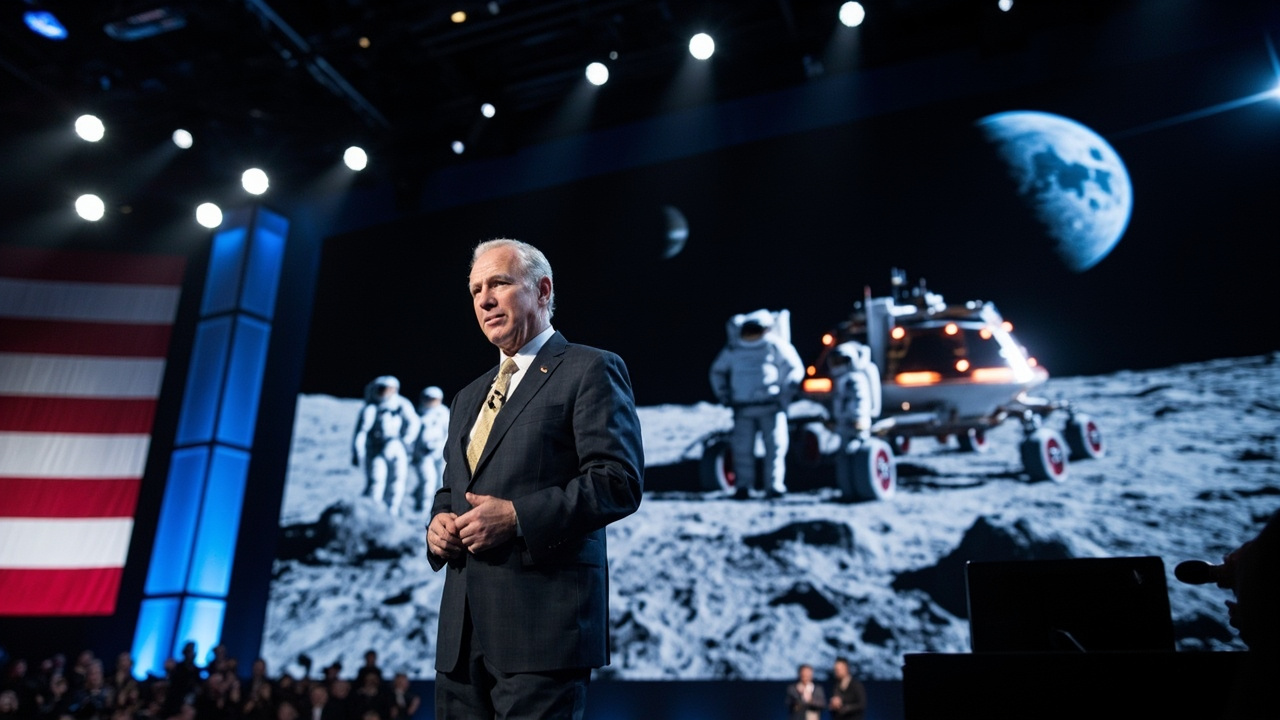
NASA Administrator Jared Isaacman told a military audience in National Harbor, Maryland, on Sept. 15, 2026, that returning American astronauts to the moon before China is a national security task, not only a science mission.
According to Air & Space Forces Magazine, Isaacman said NASA is working to land astronauts on the lunar surface by 2028, while the Chinese government is aiming for a crewed landing around 2030. He warned that the two-year margin could disappear. According to SpaceNews, he argued that the result of that contest could affect alliances, technology standards, and how other nations judge American power.
Speech puts Artemis in strategic terms
Isaacman spoke at the Air & Space Forces Association's Air, Space & Cyber conference. The setting placed NASA's civil lunar program directly before Airmen, Guardians, and defense leaders.
According to Air & Space Forces Magazine, he described cooperation between NASA and the Department of Defense as important, while contrasting that relationship with China's approach. He said the People's Republic of China does not clearly separate military and civilian space operations.
According to SpaceNews, his central message was that civil and military space programs should share capabilities and investments where practical. NASA was created outside the Defense Department and remains devoted to peaceful exploration, but he said joint work has a long history and should grow as activity expands farther from Earth.
2028 target leaves little margin before China's 2030 plan
NASA's current objective is to return astronauts to the moon by 2028. According to Air & Space Forces Magazine, that schedule has changed over time and is viewed as ambitious.
China is targeting 2030 for its first crewed lunar landing, leaving an apparent American lead of about two years. Isaacman said that advantage could easily vanish.
He credited China with an workable design for the mission, based on launching the crew vehicle and lunar lander separately. According to Air & Space Forces Magazine, he said China has demonstrated rocket reusability, possesses relevant expertise, and has a record suggesting it could arrive early while the United States arrives late.
"Success in this endeavor will be measured in months, not years," Isaacman said.
According to Air & Space Forces Magazine, he added that allies and competitors are observing the race, along with countries choosing technology suppliers, technical standards, security partnerships, and competing visions of the future.
Why the south pole draws both programs
The immediate prize is the lunar south pole. According to Air & Space Forces Magazine, the region holds resources and offers a demanding environment that can help prepare crews and hardware for later Mars expeditions.
According to MeriTalk, Isaacman called the south pole scarce strategic terrain because of water ice, sunlight access, and the small number of usable sites. Those features also make it valuable for testing power, mobility, habitation, and other systems needed for longer stays.
Isaacman compared the scale of the choice in geographic terms. According to MeriTalk, he likened the total surface of the moon to the size of Africa, while comparing the south pole to the size of Washington, D.C. He said there are only a limited number of routes and desirable positions.
There are "limited parking spots," as Isaacman put it, according to Air & Space Forces Magazine. He said the pressure comes from the fact that Chinese missions are headed for the same areas.
Alliances, standards, and credibility cited as stakes
Isaacman connected a lunar setback to wider doubts about American reliability. According to Air & Space Forces Magazine, he said a failure to return first could lead allies to question U.S. security assurances, technology choices, and standards.
He framed prestige as a practical factor. Nations deciding what hardware to buy and what rules to follow, he argued, will watch which country reaches the preferred terrain first and establishes sustained operations.
He also invoked the first moon landing as a security signal. According to Air & Space Forces Magazine, he said the July 20, 1969, Apollo landing may have caused adversaries to reconsider challenging American interests. He argued that the opposite result would encourage challenges.
"China will accomplish what the Soviets never could," he said.
The Soviet Union never landed people on the moon. Isaacman said China should not be expected to falter in the same way.
China-Russia base and reactor plan sharpens urgency
According to MeriTalk, Isaacman said China intends to build a lunar base with Russia and install a nuclear reactor in one of the constrained south-polar locations. That prospect, he argued, makes timing especially important.
Because China does not draw a sharp line between civil and military space activity, according to Air & Space Forces Magazine, Isaacman said any base it establishes could carry security consequences.
NASA's own lunar base concept centers on the same southern region. According to MeriTalk, the agency sees the site as the starting point for a sustained presence by the mid-2030s and as a test area for Mars-bound systems.
Artemis status: what has flown and what is next
According to MeriTalk, Isaacman described the Artemis campaign as the effort rebuilding American capacity for extended lunar operations and eventual Mars missions.
Artemis I completed an uncrewed flight around the moon. Artemis II then became the program's first crewed mission.
Isaacman called Artemis II a turning point that put the country "back in the business of sending astronauts to the lunar environment." According to MeriTalk, he called it a test mission in every respect, described it as a success, and said it lifted the workforce.
Work on Artemis III is underway in the Vehicle Assembly Building at Kennedy Space Center in Florida, with a targeted launch in 2027. According to MeriTalk, NASA plans to send uncrewed robotic landers to the south pole on a near-monthly rhythm beginning in early 2027.
Those landers are intended to evaluate surface power, crewed and autonomous mobility, positioning, navigation and timing, and equipment for future living quarters. Isaacman said NASA is standardizing its rocket, restoring operational experience, and reducing procedural delays to prevent long intervals between flights.
Moon work framed as preparation for Mars
According to MeriTalk, NASA treats the south pole as a nearby training ground for Mars, about three days of travel from Earth. Crews there can trial spacesuits, habitats, life-support equipment, mobility systems, and use of local materials.
Isaacman said those trials would build the skills needed for the next destination. According to MeriTalk, he called the moon the place where NASA would master the methods required before going to Mars.
The limited number of suitable southern sites adds competitive pressure to that technical plan. Securing access, in his account, preserves both a scientific laboratory and an operational classroom for deep-space missions.
Civil-military cooperation, including nuclear power
Cislunar space, the volume including Earth orbit, the moon, and the region between them, was a major theme. According to Air & Space Forces Magazine, Isaacman said NASA and the Pentagon should cooperate there on work that supports exploration and science while also strengthening the American security position farther out.
Nuclear power in space was his example. Both NASA and defense organizations have interests in compact fission systems for surface energy and propulsion. Isaacman argued that separate, parallel projects would divide funding and lower the chance of success.
He also pointed to aeronautics. NASA and the Air Force previously worked together on flight research, and Isaacman said the agency is giving that field renewed attention after what he described as years of neglect. According to Air & Space Forces Magazine, he said recent aeronautics spending had focused on helping industry improve efficiency of established engine designs.
He said that emphasis will change. NASA plans to concentrate instead on higher-risk, higher-payoff flight technologies.
More experimental aircraft planned
NASA currently has one experimental aircraft in its portfolio, the X-59, which is designed to study supersonic flight with reduced noise. According to Air & Space Forces Magazine, Isaacman said more such test aircraft are being developed.
He described the shift as deliberate. Rather than incremental gains in mature propulsion, he wants NASA's aeronautics budget to support designs that could alter future aviation options.
The broader point returned to shared investment. According to SpaceNews, Isaacman maintained that pooling knowledge, test infrastructure, and technology development can serve both civil discovery and defense needs without merging the two institutions.
Sources referenced
- NASA Boss: Race to Moon Has National Security Stakes - Air & Space Forces Magazine (https://www.airandspaceforces.com/nasa-administrator-moon-race-china-national-security-stakes/)
- NASA Chief Outlines Accelerated Moon-to-Mars Strategy Amid New Space Race – MeriTalk (https://www.meritalk.com/articles/nasa-chief-outlines-accelerated-moon-to-mars-strategy-amid-new-space-race/)