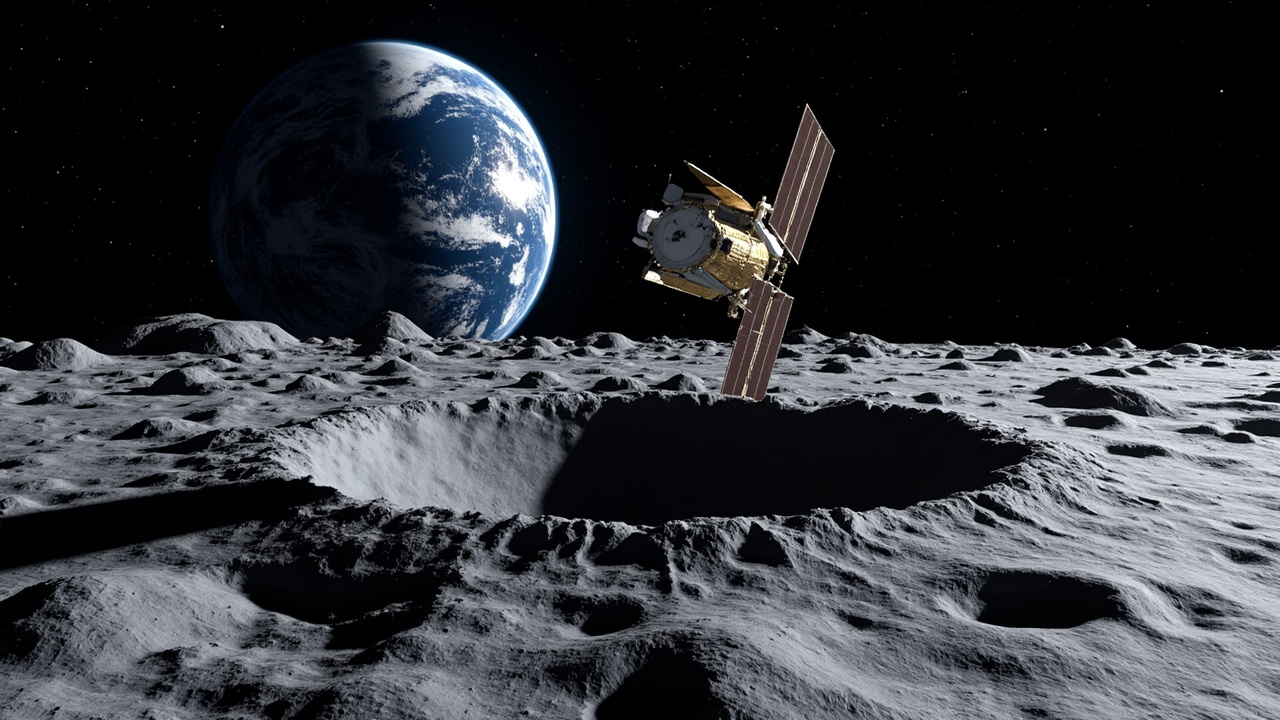
TL;DR: A spent SpaceX Falcon 9 upper stage struck the Moon on Aug. 5, 2026, leaving a 60-foot-wide crater photographed Aug. 11-12 by NASA's Lunar Reconnaissance Orbiter, while United Launch Alliance named longtime Vulcan lead Mark Peller as CEO on Aug. 17.
Fresh crater documents Falcon 9 Moon impact
Between Aug. 11 and 12, NASA's Lunar Reconnaissance Orbiter (LRO) captured a series of images of a new crater that formed Aug. 5, when a SpaceX Falcon 9 upper stage impacted the surface following its January 2025 launch of the Firefly Blue Ghost 1 mission, according to NASA Science.
The defunct upper stage crashed uncontrolled at an estimated 5,400 mph, according to NBC News. The roughly 10,800-pound booster had launched two landers to the Moon in January 2025, then remained adrift in orbit until the impact.
NASA on Aug. 18 released before-and-after views that reveal a bright divot in the Moon's already-pockmarked terrain. Each image shows an area about 1,000 feet wide, with an enlarged view covering about a quarter-mile wide, according to NASA Science and NBC News.
Scientists measured the rim at 60 feet wide and determined the crater is less than 10 feet deep based on the length of its shadow. LRO used its Narrow-Angle Camera, which can spot features as small as 3 feet wide, according to NASA Science.
The images show bright and dark rays stretching outward. The darker streaks are made of surface dust and rocks altered over a long time by solar wind, galactic cosmic rays and micrometeorite impacts, excavated by the collision from 1.5 feet into the lunar surface. The brighter streaks near the rim are fresh material excavated from deeper underground, according to NASA Science.
To capture the impact, engineers tilted the spacecraft so its cameras would point toward the crater each time LRO passed about 60 miles above the Moon, traveling 1 mile per second. The orbiter circles the Moon from pole to pole every two hours, while the Moon slowly rotates underneath it. To photograph a specific spot, the spacecraft must wait until that location turns into view, which took six days in this case, according to NASA Science.
Timing had to be exact. If the camera snapped even 10 seconds too early or too late, the target would drift off-center by 10 miles, according to NASA Science.
Global tracking effort pinpointed crash site
Finding the impact site took global coordination among experts and hobbyists. Independent astronomers first identified the rocket's trajectory using publicly available data, according to NASA Science.
NASA's Center for Near Earth Object Studies, which tracks natural objects that could pose hazards to Earth for the agency's Planetary Defense program, used the opportunity to test and validate tools and techniques for predicting impacts, according to NASA Science.
Based at NASA's Jet Propulsion Laboratory in Southern California, the center incrementally refined the trajectory until identifying the location of impact, which it provided to the Republic of Korea for their Korea Pathfinder Lunar Orbiter (Danuri) team. The team used the high-resolution LUTI camera on Danuri a few hours later to image the crater, finding the prediction was accurate to about 0.6 miles, according to NASA Science.
After capturing images, the Danuri mission sent coordinates to NASA's LRO team to help refine their follow-up imaging sequence. Comparing new crater images with pre-impact images, the LRO team updated the crater center coordinates to 19.4759°N, 266.7138°E, 511 meters elevation, according to NASA Science. That elevation is roughly 1,700 feet, according to NBC News.
Researchers tracked the trajectory and pinpointed the expected site along the western edge of the Moon's sunlit side, although there were no live views of the Aug. 5 impact, according to NBC News. Shortly after the crash, a telescope in Chile spotted a debris plume, and the Korea Pathfinder Lunar Orbiter, which launched in 2022 as South Korea's first Moon mission, later flew over the site and photographed the crater and ejected material, according to NBC News.
The Falcon 9 crash was only the second known case of a rocket unintentionally hitting the lunar surface. In 2022, what was thought to be the upper stage of a Chinese rocket that sent a test capsule to the Moon in 2014 smacked into the far side, carving out a double crater that LRO spotted months later. China has denied that its spacecraft was involved, according to NBC News.
In a statement on Aug. 5, SpaceX said it tries to properly account for hardware after missions. "We actively work to be as responsible as possible with hardware left in space to ensure space safety, including for more complex missions," the company said. "In this case, over time, solar activity and gravity led the second stage toward the Moon. Impacts like this are rare, but they can happen with objects in these types of orbits, and we worked with NASA on the optimal disposal solution," according to NBC News.
ULA names veteran Mark Peller as CEO
United Launch Alliance on Aug. 17 named veteran aerospace executive Mark Peller as its next president and chief executive officer, effective immediately, according to United Launch Alliance.
Prior to the appointment, he served as chief operating officer responsible for operations of the Atlas and Vulcan launch vehicle programs, including engineering, supply chain, production, launch, quality assurance, information systems and overall program management and integration, according to United Launch Alliance.
Peller has been at ULA since its formation in 2006 and led development of the Vulcan rocket from inception through entry into service and certification for U.S. government missions, according to United Launch Alliance.
"We completed a thorough, months-long process where both internal and external candidates were interviewed," said Kay Sears, vice president and general manager of Space, Intelligence & Weapon Systems for Boeing and a ULA board member, according to United Launch Alliance.
"This is an exciting time in the launch industry where there is unprecedented demand for access to space," said Robert Lightfoot, president of Lockheed Martin Space and ULA board chair. "We see a strong future with continued growth for ULA and have tremendous confidence in Mark's ability to lead this company," according to United Launch Alliance.
Peller began his career with Rockwell International in 1990 as a propulsion engineer supporting the Space Shuttle program. He joined Boeing in 1996 when it acquired the aerospace and defense businesses of Rockwell, moved to the Delta program in 1997, and later served as chief engineer for both Delta II and IV after ULA's formation, according to United Launch Alliance. He holds a bachelor's degree in applied mechanics from the University of California, San Diego, a master's in aerospace engineering from the University of Southern California and a master's in business administration from the University of California, Irvine.
Peller succeeds interim CEO John Elbon, who held the role since December 2025 and will retire at the end of the year following a 45-year career, according to United Launch Alliance.
The appointment followed an eight-month search after former CEO Tory Bruno stepped down in December to join Blue Origin, according to Florida Today. During the search, Elbon postponed planned retirement to provide a transition while the board conducted its selection process.
Vulcan grounded as leadership changes
ULA's Vulcan rocket is currently grounded following a booster anomaly during its last launch in February, although the Space Force payload made it safely to orbit, according to Florida Today.
Sparks were seen flying from the area of the solid booster shortly after liftoff from Cape Canaveral, triggering an investigation, according to Florida Today. Neither Vulcan nor Blue Origin's New Glenn, which uses the same first-stage BE-4 engines, has an announced return-to-flight date after a faulty oxygen valve triggered a New Glenn explosion in May during a test fire.
Vulcan is replacing both the Atlas V and the now-retired Delta IV rockets. A few Atlas V rockets remain, set aside for launch of Boeing's Starliner spacecraft, according to Florida Today.
When it returns to flight, Vulcan is tapped to be a major launcher of Amazon Leo satellites, previously known as Project Kuiper. ULA recently conducted a tanking test at the Amazon-branded Launch Complex 41 at Cape Canaveral, and Vulcan has been upgraded with an optimized Centaur V upper stage for those missions, according to Florida Today. ULA employs approximately 500 people in Brevard County.
Long March rebounds, Taiwan and Innospace stumble
China's Long March family appears to be rebounding quickly from a rare launch failure Aug. 10, when a Long March 7A broke apart less than 90 seconds after liftoff, according to Ars Technica. Chinese officials have not publicly released information on what may have caused the breakup, but use of YF-100 engines raised questions about other rockets using the same engines.
Those engines returned to flight six days later with the successful flight of a Long March 12, and the heavy-lift Long March 5 — also with YF-100 engines — is set to launch in a few days with Chang'e 7, a lunar lander headed to the Moon's south pole, according to Ars Technica.
In Taiwan, a prototype for a future satellite launch vehicle veered off course shortly after liftoff Wednesday, Taiwan's Central News Agency reports, according to Ars Technica. The trajectory anomaly prompted activation of the rocket's self-destruct mechanism. The National Chung-Shan Institute of Science and Technology reported no injuries or property damage, with debris falling into a planned safety zone near Taiwan's southern tip.
The flight was likely a sub-scale suborbital version of a planned military satellite launcher and the first test flight for a solid-fueled program to place small payloads into low-Earth orbit, while the civilian Taiwan Space Agency is developing a liquid-fueled launcher that could be ready for orbital missions in the early 2030s, according to Ars Technica.
South Korean startup Innospace lost control of its small Sebit suborbital rocket seconds into a test flight Thursday from Brazil's Alcântara Space Center, according to Ars Technica. The Brazilian Air Force, which runs the spaceport, activated flight termination after deviation from the planned trajectory, with no injuries or property damage reported.
Sebit is a multipurpose suborbital rocket designed to carry payloads up to 100 kilometers, or 62 miles altitude. The flight was the second consecutive failure for Innospace, whose Hanbit-Nano orbital rocket spun out of control seconds after liftoff from the same spaceport in December, according to Ars Technica.
Commercial launch worries and wartime strike
Satellite operators fear a launch crisis as SpaceX looks to retire Falcon 9 in favor of the much larger, still unproven Starship, according to Ars Technica. Concerns are growing that SpaceX will focus on its own Starlink V3 satellites and orbital data centers, with Starship's Pez dispenser optimized for Starlink indicating priorities.
SpaceX's Gwynne Shotwell has previously said Falcon 9's operational lifetime may end in 2030 or 2032. More recently, commercial customers have had difficulty purchasing a launch after 2028, with one source saying SpaceX told the U.S. government it intends to end commercial launches after 2028 but continue a limited number of federally contracted missions, according to Ars Technica.
Separately, Ukrainian President Volodymyr Zelenskyy confirmed Saturday that Ukraine struck the Progress Rocket Space Center in Russia's Samara region using ground-launched Flamingo cruise missiles, according to Ars Technica. The facility about 900 kilometers from the Ukrainian border assembles Russia's Soyuz-2 and newer Soyuz-5 rockets and builds military satellites.
Russia uses the Soyuz-2, with about 8 metric tons of lift capacity to low-Earth orbit, for civil and military purposes. It is the principal rocket for Russian human spacecraft launches, raising questions about spillover effects for the International Space Station, according to Ars Technica.
Sources referenced
- NASA's LRO Images Falcon 9 Crater on Moon, Learns New Details - NASA Science (https://science.nasa.gov/solar-system/moon/nasas-lro-images-falcon-9-crater-on-moon-learns-new-details/)
- NASA spots new crater on the moon created when a SpaceX rocket crashed - NBC News (https://www.nbcnews.com/science/space/nasa-images-moon-crater-spacex-rocket-crash-rcna593224)