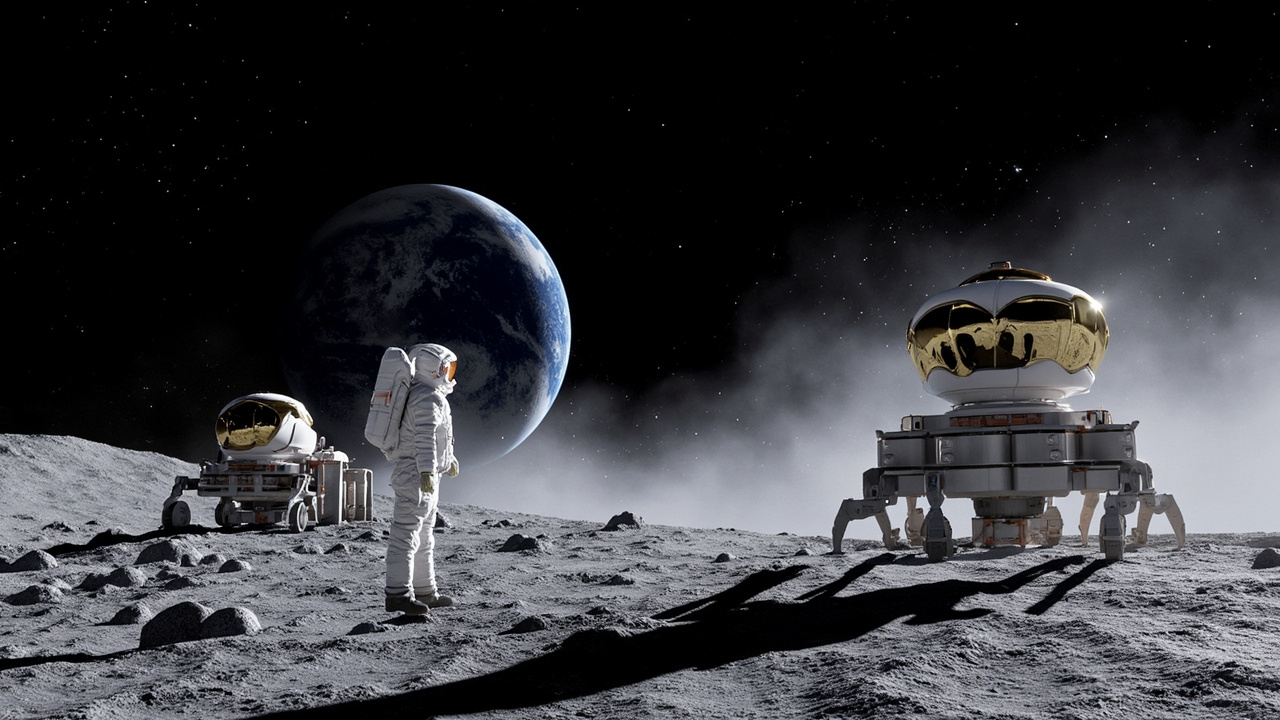
TL;DR: NASA updated its Moon Base rover plan on Oct. 20, 2026, with VIPER targeting a 2027 South Pole water hunt and crew-capable lunar terrain vehicles targeting delivery by 2028.
NASA's newest verified milestone is a surface-mobility update for its planned Moon Base. According to NASA's Oct. 20, 2026 report titled "NASA Provides Progress Update on Moon Base Rovers," the agency released a Moon Base video update on Tuesday describing commercial lunar terrain vehicles and robotic rovers intended to support early construction and operations of a first lunar outpost.
The update frames rovers as transport, mapping, science and prospecting tools. According to NASA, crewed and robotic rovers will contribute during early development through technology demonstrations, astronaut transport, terrain mapping, scientific investigations and resource prospecting. Data from those early missions is expected to inform later mobility systems and infrastructure for living and working on the Moon.
NASA Surface Mobility Office director Robert Pickle said lunar rovers are central to the surface mobility strategy in that report. The agency said their performance will lay groundwork for later systems and affect how effectively infrastructure for long-duration exploration can be built, operated and expanded.
Moon Base video outlines rover roles
The Tuesday video update gives the clearest near-term picture of how NASA intends to move people and cargo around the South Pole. According to NASA, the commercial vehicles and robotic rovers discussed in the video are meant to provide the surface mobility needed to build a human outpost.
That distinction matters for U.S. readers because mobility determines where astronauts can land, work and return samples. Early robotic driving and mapping can reduce risk before crew arrives, while later crewed driving extends the range of geology traverses and construction tasks.
According to Xinhua's Oct. 21, 2026 summary titled "NASA advances lunar rover development for future Moon Base," NASA on Tuesday provided an update on crewed and robotic rover development to support sustained operations. The Xinhua account similarly describes surface mobility work as preparation for future exploration and longer stays.
VIPER targets 2027 South Pole water search
NASA's VIPER, the Volatiles Investigating Polar Exploration Rover, is the robotic precursor in the plan. According to NASA, VIPER will embark on a mission to the lunar South Pole region in 2027 to enter permanently shadowed craters in search of water and other resources important for sustainable exploration.
Delivery will use a commercial lander. According to NASA and restated by Xinhua, VIPER will reach the surface aboard a Blue Moon Mark 1 lander supplied by Blue Origin. After landing, the rover is expected to travel more than 18 miles, or 30 kilometers, while recording thermal, lighting and terrain conditions around the South Pole.
Scientists want that traverse to answer practical resource questions. According to NASA, the data could inform understanding of the origin and distribution of water on the Moon, show how lunar resources might support a Moon Base, and improve knowledge of the history of the Moon, Earth and processes that shaped conditions for life.
Operations and hardware status are also defined. According to NASA, mission operations for VIPER will be run from NASA's Ames Research Center in Silicon Valley, where teams are simulating scenarios for lunar operations. The rover itself is currently at NASA's Johnson Space Center in Houston, where NASA says it is fully built and undergoing final testing before shipment to NASA's Kennedy Space Center in Florida for launch.
Crew-capable LTVs aim for 2028 delivery
The second element is larger: lunar terrain vehicles, or LTVs, designed to carry crew. According to NASA, the agency awarded task orders to Astrolab and Lunar Outpost to build the first phase of Moon Base rovers capable of carrying crew. Those vehicles are intended to arrive ahead of crewed Artemis surface missions.
Logistics are assigned to Blue Origin. According to NASA, Blue Origin received a task order to deliver the LTVs to the lunar South Pole region by 2028 through the agency's CLPS, or Commercial Lunar Payload Services, initiative. Xinhua's summary of the same NASA update likewise reports the 2028 delivery target through the commercial lunar payload program.
Before astronauts board, the rovers will work alone. According to NASA, the LTVs will be remotely operated from Earth and will traverse up to 3.7 miles, or 6 kilometers, per day while mapping the surface to help scientists produce high-resolution maps. That advance mapping is paired with environmental testing, including data on lighting, navigation, energy retention and driving in and out of permanently shadowed regions that can reach minus 334 degrees Fahrenheit, or minus 203 degrees Celsius.
The crewed specifications describe a short-range geology truck. According to NASA, Artemis astronauts will drive the LTVs across geologically diverse areas of the South Pole, gather geology samples for return to Earth, support up to three moonwalks per Artemis mission, transport up to 176 pounds, or 80 kilograms, of samples and tools, and travel up to six miles, or 10 kilometers, on a single battery charge. Xinhua repeats the same three performance figures in its account of the NASA announcement.
Astrolab and Lunar Outpost test crew interfaces
The two vendors are following parallel test paths. Astrolab's crewed vehicle is called Crewed Lunar Vehicle 1, or CLV-1, adapted from the company's FLEX, or Flexible Logistics and Exploration Vehicle, architecture, according to NASA. The company recently delivered a mockup of CLV-1 to Axiom Space, where NASA astronauts wearing mock-ups of the Artemis lunar spacesuit evaluated the rover's design, crew cabin and display interfaces.
A smaller robotic precursor comes first for Astrolab. According to NASA, Astrolab will first send its robotic FLIP, or FLEX Lunar Innovation Platform, to the surface as a payload on Voyager Technologies' Griffin Mission One scheduled to launch in late 2026. FLIP is intended to study the South Pole environment and serve as a testbed for CLV-1 subsystems, including similar tires, batteries, radios and cameras.
Wheel testing is next on the schedule. According to NASA, Astrolab engineers will in the next few weeks use the Simulated Lunar Operations laboratory at NASA's Glenn Research Center in Cleveland to evaluate how CLV-1's flexible, airless wheels perform on simulated lunar soil.
Lunar Outpost's vehicle is named Pegasus. According to NASA, Pegasus is a lighter, mission-ready evolution of the company's Eagle LTV. The company built two mockups before the award and recently delivered a third static mockup to Johnson Space Center for crewed testing, during which NASA astronauts wore pressurized spacesuits and assessed design, usability and crew comfort.
Nuclear-propulsion demo SR-1 Freedom advances
A separate Oct. 20, 2026 NASA report covers deep-space power. According to NASA's article titled "NASA's SR-1 Freedom Advances with Progress on Nuclear Power Module," the Space Reactor-1 Freedom spacecraft is intended to become the first spacecraft to demonstrate fission power beyond Earth's orbit, flying to Mars to deliver a science payload called SkyFall.
The mission is designed to demonstrate nuclear electric propulsion in deep space. Program director Steve Sinacore said recent contract actions reduce technical risk and maintain momentum toward a 2028 launch while strengthening collaboration, according to NASA. The agency said the actions keep SR-1 Freedom on track and support technology that could extend to future space nuclear uses.
Hardware responsibilities are split. According to NASA, Sierra Lobo Inc. will provide the closed Brayton cycle power conversion system that turns reactor heat into electricity for propulsion, under the Space Flight Systems Development and Operations Contract III awarded in 2024, with work supporting design, development, testing and operations at Glenn Research Center in Cleveland. The fission reactor itself is being designed by the Department of Energy's Idaho National Laboratory.
Safety controls are explicit. According to NASA, the agency and DOE apply safety standards including interagency reviews, continuous oversight by a NASA chief safety officer, regulatory compliance and a design process focused on hazards, failure tolerance and nuclear safety. The reactor portion will remain inactive until the spacecraft leaves Earth orbit.
The Mars destination links power and science. According to NASA, launching in late 2028, SR-1 Freedom will deliver SkyFall, a team of three Mars helicopters evolved from the Ingenuity design, to collect scientific data, demonstrate exploration zones and identify potential water sources. The agency said the mission could prepare for deeper exploration and for fission systems that keep a Moon Base operating through darkness and in places where solar power alone is not sufficient.
Artemis and space station context this month
Two October Reuters reports set the crewed-flight context around the rover news. According to Reuters in "Next Artemis mission on track for 2027, but anything can happen, astronaut says," published Oct. 5, 2026, NASA's third Artemis mission is described as a docking rehearsal in Earth's orbit, while Moon landers from SpaceX and Blue Origin face delays. The report says meetings are planned over the next few months to determine lander readiness.
Station crew rotation also continued. According to Reuters in "SpaceX launches 13th long-duration astronaut crew to International Space Station," published Oct. 1, 2026, a SpaceX Falcon 9 and Dragon lifted off from Cape Canaveral Space Force Station in Florida carrying NASA astronauts Jessica Watkins and Luke Delaney, Canadian Space Agency astronaut Joshua Kutryk and Russian cosmonaut Sergey Teteryatnikov. Reuters' Space vertical also lists video coverage titled "Artemis II set to fly past Moon's far side, set distance record," indicating continued attention on the crewed lunar flyby program alongside the new surface-mobility schedule.
Sources referenced
- NASA Provides Progress Update on Moon Base Rovers - NASA (https://www.nasa.gov/missions/moon-base/nasa-provides-progress-update-on-moon-base-rovers/)
- NASA advances lunar rover development for future Moon Base-Xinhua (https://english.news.cn/20261021/cbb0bd9f634f4158bf5ac6ca664c1d72/c.html)