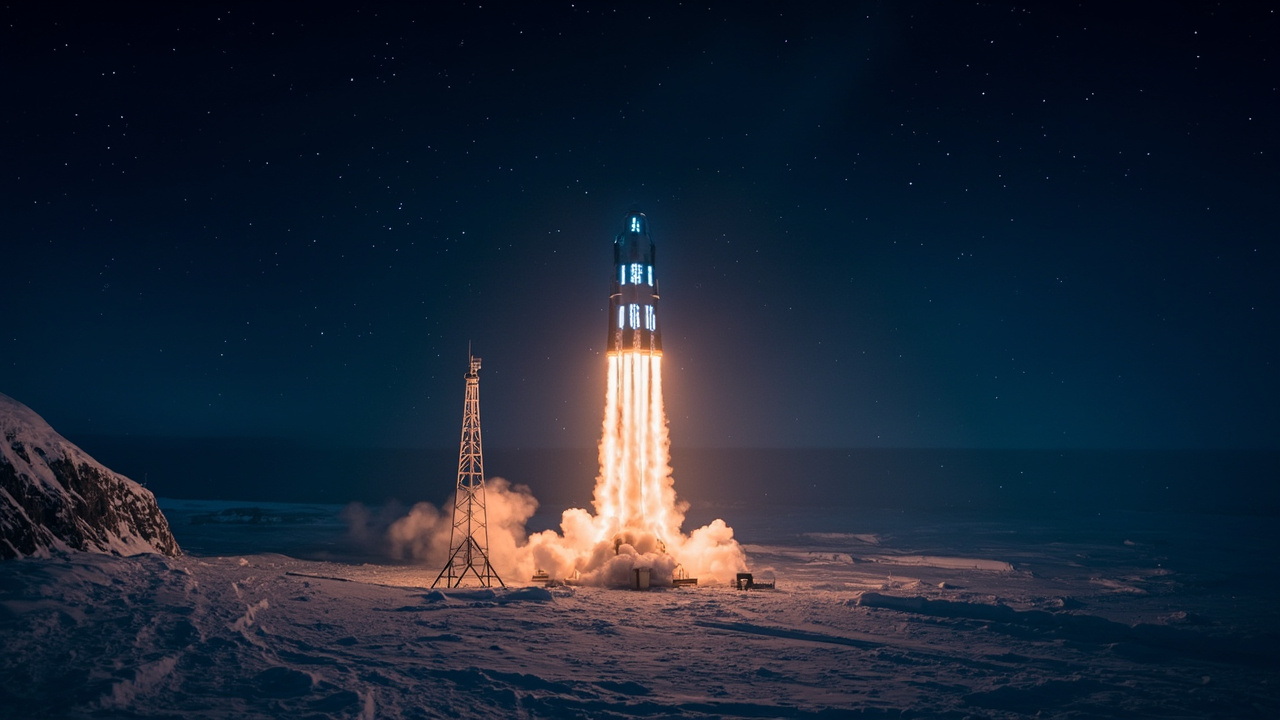
TL;DR: Germany's Isar Aerospace reached orbit on September 5, 2026, with its Spectrum rocket from Andøya Spaceport in Norway, becoming the first purely commercial European company to do so on its second attempt.
That single flight reset the conversation about European launch. According to Ars Technica, the two-stage Spectrum lifted off Saturday inside the Arctic Circle and delivered payloads to low-Earth orbit, making Isar the clear leader among startups trying to bring competition to a market long dominated by government-led programs.
Spectrum reaches orbit from Norway
The mission, named "Onward and Upward," launched on the evening of September 5, 2026, from Andøya Spaceport, according to the Civil Aviation Authority of Norway. The regulator said the flight achieved its goal of placing satellites into orbit and called it an important step for Norwegian and European industry.
According to the European Space Agency, the flight was the first launch to orbit from continental Europe. ESA described Spectrum as 28 meters tall and 2 meters in diameter, with nine in-house-developed Aquila engines on the first stage, targeting up to 1,000 kilograms to low-Earth orbit.
For this second Spectrum flight, ESA said Isar carried six commercial and educational CubeSats plus an experiment intended to prove new technologies in orbit and support student experiences in Europe. Norway's aviation authority said the manifest included five small satellites and one experiment, including the Norwegian student satellite FramSat-1.
ESA said the mission was supported by its Boost! program, which co-funds commercial space transportation services. The agency said it supported development of the Spectrum launch service under a Boost! contract, including this second flight. Payloads were also selected through the first Microlauncher Competition awarded by the German Space Agency at DLR.
The result carries programmatic weight. According to ESA, Isar was selected in 2025 for the European Launcher Challenge, with a contract signed recently. As a first milestone, that challenge requires providers to achieve an orbital launch no later than 2027. ESA said this flight demonstrated the Spectrum system successfully, making Isar the first provider to reach that milestone.
Eight years, $1 billion, 500 people
According to Ars Technica, Isar Aerospace was founded in 2018 by three students at a German university. It took eight years to reach orbit, a timetable the publication compared to other successful commercial rocket startups in the West.
In that period, the company raised roughly $1 billion through several private financing rounds and now employs nearly 500 people, according to Ars Technica. That private-capital path contrasts with Europe's traditional procurement model known as geographical return, or geo-return, in which governments fund development and influence where hardware is built.
European space officials hope competition will energize the continent's rocket sector, according to Ars Technica. The practical question now is scale: how quickly Isar can increase production, launch cadence, and reliability, and how quickly a second European startup follows to orbit.
Britain funds spaceports and connectivity
The same week brought a policy move in the United Kingdom. According to Ars Technica, the U.K. unveiled a national space strategy intended to drive growth, strengthen security, and support everyday technologies.
The government is investing 7.8 billion pounds, or $10.5 billion, through 2030, according to Ars Technica. About 40 percent will go toward strengthening connectivity, including the Connectivity in Low Earth Orbit program and the SKYNET defense communications program, described as playing a pivotal role in keeping British armed forces connected wherever they operate.
For launch infrastructure, the government will provide 30 million pounds, or $40.5 million, for SaxaVord Spaceport in Shetland, an archipelago north of the Scottish mainland, according to Ars Technica. The stated aim is helping Britain and partners launch satellites without relying on countries further afield while creating jobs.
No orbital rocket has ever successfully launched from the United Kingdom, according to Ars Technica. The main tenant at SaxaVord is German launch company Rocket Factory Augsburg, another of the firms chasing Isar.
Firefly and SSC lock in Swedish launches
Sweden also advanced its orbital ambitions. According to Firefly Aerospace, the Texas company signed a multi-launch agreement with SSC Space for two Alpha rocket launches from Esrange Space Center in Sweden, announced September 9, 2026.
The missions are targeted to launch no earlier than 2028 and will serve Sweden's national security customers plus additional commercial rideshare customers, according to Firefly Aerospace. The company called it a significant step toward orbital launch capability from mainland Europe.
Under the agreement, SSC Space secured the full payload capacity and can allocate space to government and commercial customers, providing flexible accommodations for the European satellite market, according to Firefly Aerospace.
Firefly CEO Jason Kim said the two missions are just the start of a long-term, multi-launch partnership with SSC Space that will provide assured access to space for years to come. SSC Space CEO Charlotta Sund said adding orbital capability to mainland Europe strengthens competitiveness and contributes to resilience and strategic autonomy in defense, according to Firefly Aerospace.
The partners said transatlantic regulatory frameworks are established and key infrastructure at Launch Complex 3C is complete, including the launch control center, payload processing facility, launch vehicle integration building, tracking and control systems, and security and storage facilities. The companies are now progressing through final pad construction, according to Firefly Aerospace.
A Ravn X sighting in Long Beach?
One of the week's most curious items involved a long-quiet spaceplane concept. According to Ars Technica, the publication had written precisely one article about Ravn X, an autonomous aircraft and launch vehicle under development by Aevum, back in December 2020. Its initial target of an orbital mission in 2021 came and went.
Then photographers at Long Beach Airport reported a sleek, large aircraft silhouette last week, according to Ars Technica, citing reporting by TWZ. The object was later described as likely a mockup of Ravn X.
Aevum founder Jay Skylus subsequently said on X that the company conducted Test 2 of Ravn X SN0 early that morning, with Ravn X completing its first fully autonomous taxi lasting about 37 minutes, according to Ars Technica. Skylus said the team was reviewing telemetry and test data. Ars Technica cautioned readers not to expect flights imminently.
Cargo, heavy lift, and small launch
Europe's cargo plans also moved forward. According to the Rocket Report summary, the European Space Agency awarded The Exploration Company a 760-million-euro service contract, or $880 million, to support development of Nyx, covering a demonstration mission and two operational cargo missions.
The Exploration Company's founder said development of Nyx began with private funding only and had reached a maturity where ESA and member-state public funding could support completion as anchor clients, according to that summary. The company also announced a $450 million Series C funding round.
The same company will continue development of the Storm rocket engine, projected at about 400,000 pound-feet of thrust, according to the summary. That engine would power a reusable rocket intended to launch 40 metric tons in reusable mode and 60 tons in expendable mode, compared with about 20 tons maximum for the expendable Ariane 6. The founder said Europe would not stay relevant without a massive rocket at a massive cadence, and cited an aggressive development timeline of 2033.
In the United States, NASA awarded a Launch Services II contract to Relativity Space, allowing the Terran R rocket to be on-ramped into the agency's launch services program, according to the summary. The service will be available for future science, research, and human spaceflight missions, although NASA still wants to see Terran R demonstrate flight success. The vehicle has yet to debut. The current ordering period covers missions through December 2032.
Italy-based Avio is seeking a higher tempo for Vega-C, according to Aviation Week. The company is working to increase cadence to six missions per year as a first step, roughly double the current level, and potentially another 50 percent higher.
What flies next
The immediate manifest underscores how crowded the schedule remains.
According to the Rocket Report summary, the next three launches on the calendar were:
- September 13: Falcon 9 with O3b mPOWER 11, 12, 13 from Cape Canaveral Space Force Station in Florida at 18:49 UTC
- September 15: Vega C with Sentinel-3C, Flex from Guiana Space Center in French Guiana at 01:21 UTC
- September 15: Zhuque-2E with an unknown payload from Jiuquan Satellite Launch Center in China at 06:25 UTC
For U.S. readers, the takeaway is direct: a new commercial ride to orbit has been demonstrated in Europe, new mainland launch sites in Norway and Sweden are moving from plans to operations, and American vehicles from Firefly to Relativity are part of that transatlantic build-out.
Sources referenced
- Rocket Report: Europe joins the commercial launch club; a Ravn X sighting? - Ars Technica (https://arstechnica.com/space/2026/09/rocket-report-europe-joins-the-commercial-launch-club-a-ravn-x-sighting/)
- ESA - Spectrum lifts off (https://www.esa.int/ESA_Multimedia/Images/2026/09/Spectrum_lifts_off)