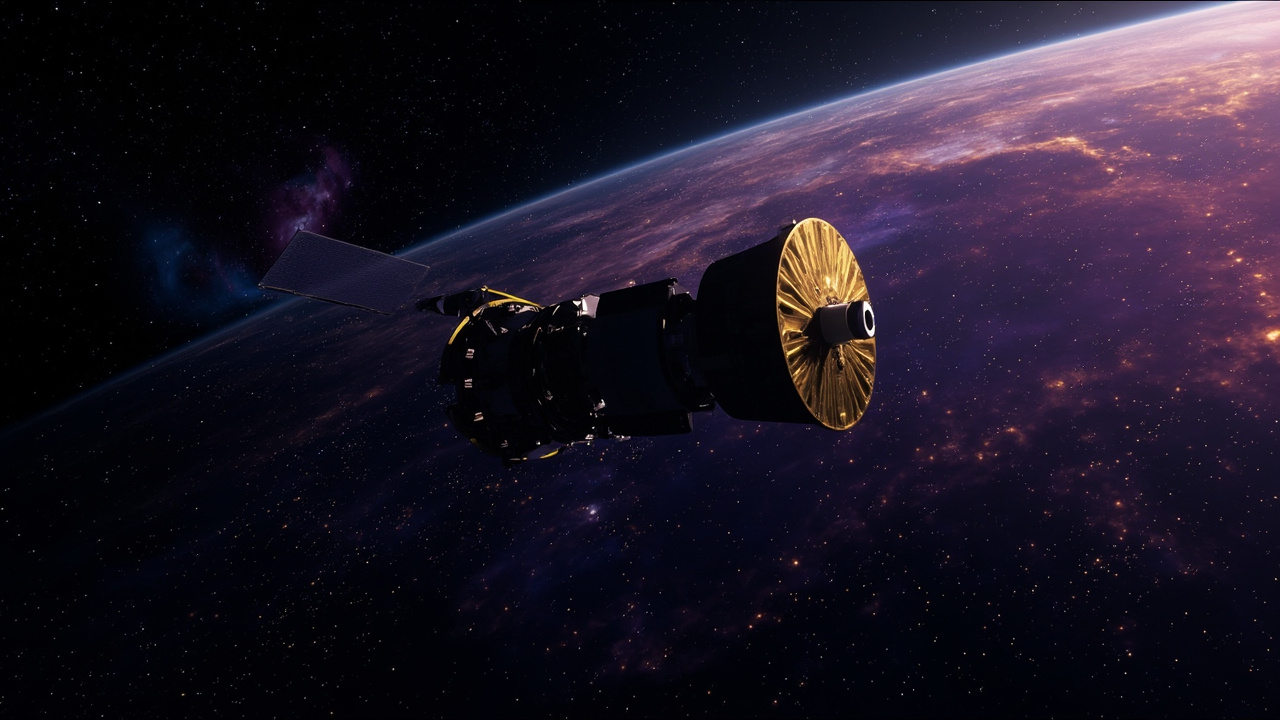
TL;DR: NASA's new Curious Universe episode says the Nancy Grace Roman Space Telescope will make unexpected discoveries because its wide, sharp infrared surveys will record billions of galaxies and thousands of exoplanets for open public study.
A science episode frames the surprise mission
NASA's Scientific Visualization Studio published a special video episode titled Curious Universe: Why Roman Will Make Unexpected Discoveries built around an interview with Julie McEnery, Roman's senior project scientist, according to NASA SVS | Curious Universe: Why Roman Will Make Unexpected Discoveries.
The studio listing describes the installment as a deep dive into the science of NASA's Nancy Grace Roman Space Telescope, according to NASA SVS | Curious Universe: Why Roman Will Make Unexpected Discoveries.
McEnery serves as Roman senior project scientist at NASA's Goddard Space Flight Center in Greenbelt, Maryland, according to NASA Sets Coverage for Roman Space Telescope Launch from Florida and The Nancy Grace Roman Space Telescope is ready to launch.
The episode was hosted by Sophia Roberts and produced by Ryan Fitzgibbons, Jacob Pinter and Katie Konans, with videography by Rob Andreoli, John D. Philyaw, Sophia Roberts and Scott Wiessinger and editing by Ryan Fitzgibbons, according to NASA SVS | Curious Universe: Why Roman Will Make Unexpected Discoveries.
A video version was made available through the NASA Goddard YouTube channel, according to NASA SVS | Curious Universe: Why Roman Will Make Unexpected Discoveries.
Podcast listings identify the installment as Season 13, Episode 4 of NASA's Curious Universe, with a duration listed as 26 to 27 minutes, according to NASA SVS | Curious Universe: Why Roman Will Make Unexpected Discoveries.
The central message highlighted in the listing is that Roman survey data will be so detailed that the images could cover a 4K screen the size of dozens of city blocks, according to NASA SVS | Curious Universe: Why Roman Will Make Unexpected Discoveries.
The same listing says McEnery does not merely hope Roman changes understanding of the universe, she knows it will, according to NASA SVS | Curious Universe: Why Roman Will Make Unexpected Discoveries.
Countdown narrows toward an Aug. 30 liftoff
NASA and SpaceX targeted liftoff no earlier than 7:26 a.m. EDT Sunday, Aug. 30, aboard a SpaceX Falcon Heavy rocket from Launch Complex 39A at Kennedy Space Center in Florida, according to NASA Sets Coverage for Roman Space Telescope Launch from Florida.
Launch coverage was scheduled to begin at 6:20 a.m. Eastern, according to NASA Sets Coverage for Roman Space Telescope Launch from Florida.
The schedule corresponds to 12:26 BST and 13:26 CEST on Aug. 30, according to Cutting-edge infrared space telescope Roman set to launch.
Teams encapsulated the observatory inside the Falcon Heavy payload fairing on Aug. 21 inside the Payload Hazardous Servicing Facility at Kennedy, according to NASA's Roman Telescope Enclosed in SpaceX Falcon Heavy Rocket Fairing.
The fairing stands 43 feet tall, encloses the spacecraft for mounting atop Falcon Heavy, and maintains a controlled environment during ground handling and transport, according to NASA's Roman Telescope Enclosed in SpaceX Falcon Heavy Rocket Fairing.
During ascent the fairing was designed to shield Roman from acoustic vibration, aerodynamic pressure and heating, then separate a few minutes into flight once conditions were safe, according to NASA's Roman Telescope Enclosed in SpaceX Falcon Heavy Rocket Fairing.
The two fairing halves were to return to Earth for recovery by SpaceX, according to NASA's Roman Telescope Enclosed in SpaceX Falcon Heavy Rocket Fairing.
Roman departed the servicing facility overnight on Aug. 24 and arrived Aug. 25 at the SpaceX hangar at Launch Complex 39A for mating to Falcon Heavy, after prelaunch processing there since June, according to NASA's Nancy Grace Roman Space Telescope Arrives at Hangar.
A convoy escorted the enclosed payload and monitored normal operations during the move, according to NASA's Nancy Grace Roman Space Telescope Arrives at Hangar.
Mission managers completed a Flight Readiness Review on Aug. 21 and certified the mission to proceed into final launch preparations, according to Teams Complete Flight Readiness Review for NASA's Roman Telescope.
A Launch Readiness Review was planned for Friday, Aug. 28, for the final go/no-go poll, according to NASA's Nancy Grace Roman Space Telescope Arrives at Hangar.
NASA described Roman as launching nine months ahead of schedule, according to NASA's Nancy Grace Roman Space Telescope Arrives at Hangar.
A wide, sharp infrared eye
Roman is named for NASA's first chief astronomer, Nancy Grace Roman, according to NASA Sets Coverage for Roman Space Telescope Launch from Florida.
NASA describes Roman as a next-generation observatory designed to explore major cosmic mysteries including dark energy, according to NASA Sets Coverage for Roman Space Telescope Launch from Florida.
The telescope pairs sharp infrared vision with a field of view at least 100 times larger than Hubble Space Telescope, according to NASA Sets Coverage for Roman Space Telescope Launch from Florida.
European Space Agency material describes Hubble-quality imaging with a field more than 200 times larger, enabling study of billions of stars, millions of galaxies and thousands of exoplanets, according to Cutting-edge infrared space telescope Roman set to launch.
The primary mirror measures 2.4 meters in diameter, according to Cutting-edge infrared space telescope Roman set to launch.
Roman carries two main instruments, the Wide Field Instrument and a Coronagraph Instrument, according to Cutting-edge infrared space telescope Roman set to launch.
The Wide Field Instrument is a 300-megapixel multi-band visible and near-infrared camera capable of crisp images and sensitive spectroscopic data, according to Cutting-edge infrared space telescope Roman set to launch.
NASA says the same camera will capture expansive high-resolution pictures in optical and near-infrared light to decode deep cosmic mysteries, according to NASA Ames' Contributions to Roman's Mission.
After separation from the rocket, Roman was to travel to the second Sun-Earth Lagrange point, L2, about one million miles from Earth, according to NASA Sets Coverage for Roman Space Telescope Launch from Florida.
Planetary Society interviewers described the post-launch cruise as a hundred-day journey to L2, according to The Nancy Grace Roman Space Telescope is ready to launch.
The mission has a five-year primary lifetime with a goal of operating for 10 years, according to NASA Sets Coverage for Roman Space Telescope Launch from Florida.
Why breadth creates surprises
NASA says Roman's sweeping surveys will investigate dark energy and dark matter, discover and characterize exoplanets, map billions of galaxies, study black holes and explore objects from the solar system to the edge of the observable universe, according to NASA Sets Coverage for Roman Space Telescope Launch from Florida.
The mission is expected to conduct the widest surveys of the universe ever attempted, probing dark energy, discovering thousands of new exoplanets and imaging billions of galaxies, according to The Nancy Grace Roman Space Telescope is ready to launch.
Roman's science data will be publicly available after processing, according to NASA Sets Coverage for Roman Space Telescope Launch from Florida.
Scientists around the world will be able to access and work with its data, according to The Nancy Grace Roman Space Telescope is ready to launch.
That combination of enormous sky coverage, fine detail and open access underlies the prediction of unplanned finds emphasized in the Curious Universe episode, according to NASA SVS | Curious Universe: Why Roman Will Make Unexpected Discoveries.
NASA Ames researchers developed software called ROSALIA, the Roman Sky Analyst for Low Surface Brightness Imaging and Astronomy, to predict and remove unwanted light from Wide Field Instrument images, according to NASA Ames' Contributions to Roman's Mission.
The software was built with collaborators at Goddard and IPAC/Caltech in Pasadena, California, according to NASA Ames' Contributions to Roman's Mission.
Contaminating stray light occurs when photons scatter inside the optical system, producing glints that can mimic real planets or nebulae, according to NASA Ames' Contributions to Roman's Mission.
Stray light can also appear as diffuse background that interferes with observations of the darkest regions important for understanding formation of large structures, according to NASA Ames' Contributions to Roman's Mission.
Zodiacal emission from scattering of sunlight by interplanetary dust adds natural background contamination, according to NASA Ames' Contributions to Roman's Mission.
ROSALIA is intended to let astronomers adjust observing plans to limit glints and to strip zodiacal and stray light, exposing faint diffuse emission at galaxy edges where evolutionary histories are hidden, according to NASA Ames' Contributions to Roman's Mission.
Dark matter and dark energy census
About 25% of the universe appears to consist of invisible dark matter, detectable only through its effect on apparent galaxy shapes, according to Cutting-edge infrared space telescope Roman set to launch.
Light from a distant galaxy bends and distorts around clumps of dark matter, leaving galaxies slightly warped in an effect called weak gravitational lensing, according to Cutting-edge infrared space telescope Roman set to launch.
One main Roman task is to scan about 12% of the sky above the galactic plane to search millions of distant galaxies for that lensing signature, according to Cutting-edge infrared space telescope Roman set to launch.
By measuring tiny shape changes, astronomers intend to map ordinary and dark matter across cosmic history and trace galaxy evolution, according to Cutting-edge infrared space telescope Roman set to launch.
Scientists think dark energy makes up about 70% of the universe and drives accelerating expansion, yet its nature remains mysterious, according to Cutting-edge infrared space telescope Roman set to launch.
Roman will look for distant Type Ia supernovas, which peak at predictable brightness and therefore help measure cosmic distances and expansion, according to Cutting-edge infrared space telescope Roman set to launch.
It will also map galaxy clustering in time and space to test dark energy, including baryonic acoustic oscillations, frozen imprints of sound waves from the early universe, according to Cutting-edge infrared space telescope Roman set to launch.
As the universe cooled those ripples froze, galaxy clusters later formed along them, and expansion stretched the separation between surrounding galaxies, according to Cutting-edge infrared space telescope Roman set to launch.
Roman will map how galaxies form, cluster and evolve by tracing dark-matter influence, while investigating dark energy as the force accelerating expansion, according to NASA's Nancy Grace Roman Space Telescope Arrives at Hangar.
Exoplanets, black holes and distant quasars
Roman will peer toward the center of the Milky Way, track light from millions of stars, and watch intensity changes over time to find planetary systems including analogs of the solar system, according to Cutting-edge infrared space telescope Roman set to launch.
It will watch for microlensing events that may reveal more than 1,200 new worlds, while expected to reveal more than 100,000 transiting planets that dim host-star light during crossings, according to Cutting-edge infrared space telescope Roman set to launch.
Researchers are eager to study thousands of exoplanets Roman will discover to learn how closely some resemble solar-system planets, according to NASA's Roman Telescope Enclosed in SpaceX Falcon Heavy Rocket Fairing.
NASA also describes a precision statistical census of planetary systems in the galaxy as a Roman objective, according to NASA's Nancy Grace Roman Space Telescope Arrives at Hangar.
The Coronagraph Instrument is a high-performance technology demonstrator that blocks starlight to search for faint nearby planets, according to Cutting-edge infrared space telescope Roman set to launch.
It could directly image reflected starlight from Jupiter-sized exoplanets in Jupiter-like orbits, according to Cutting-edge infrared space telescope Roman set to launch.
The coronagraph uses masks and mirrors, including two deformable mirrors whose shapes are controlled precisely to suppress starlight and create a dark zone where faint reflected light from orbiting planets becomes visible, according to NASA Ames' Contributions to Roman's Mission.
It can reveal planets more than 100 million times fainter than their host stars by blocking stellar light, according to Cutting-edge infrared space telescope Roman set to launch.
Its baseline mode supports exoplanet observations in single-star systems, while roughly half of Sun-like stars reside in multi-star systems, according to NASA Ames' Contributions to Roman's Mission.
Ames researchers developed Multi-Star Wavefront Control, with custom masks and software to suppress light from multiple stars, included on the flight coronagraph in collaboration with the Jet Propulsion Laboratory as capability beyond baseline modes, according to NASA Ames' Contributions to Roman's Mission.
Roman's sensitivity should also capture extreme events such as black-hole births when neutron stars merge, tidal disruption events, active galaxies with extremely bright central quasars, and faint distant quasars from the reionization period, according to Cutting-edge infrared space telescope Roman set to launch.