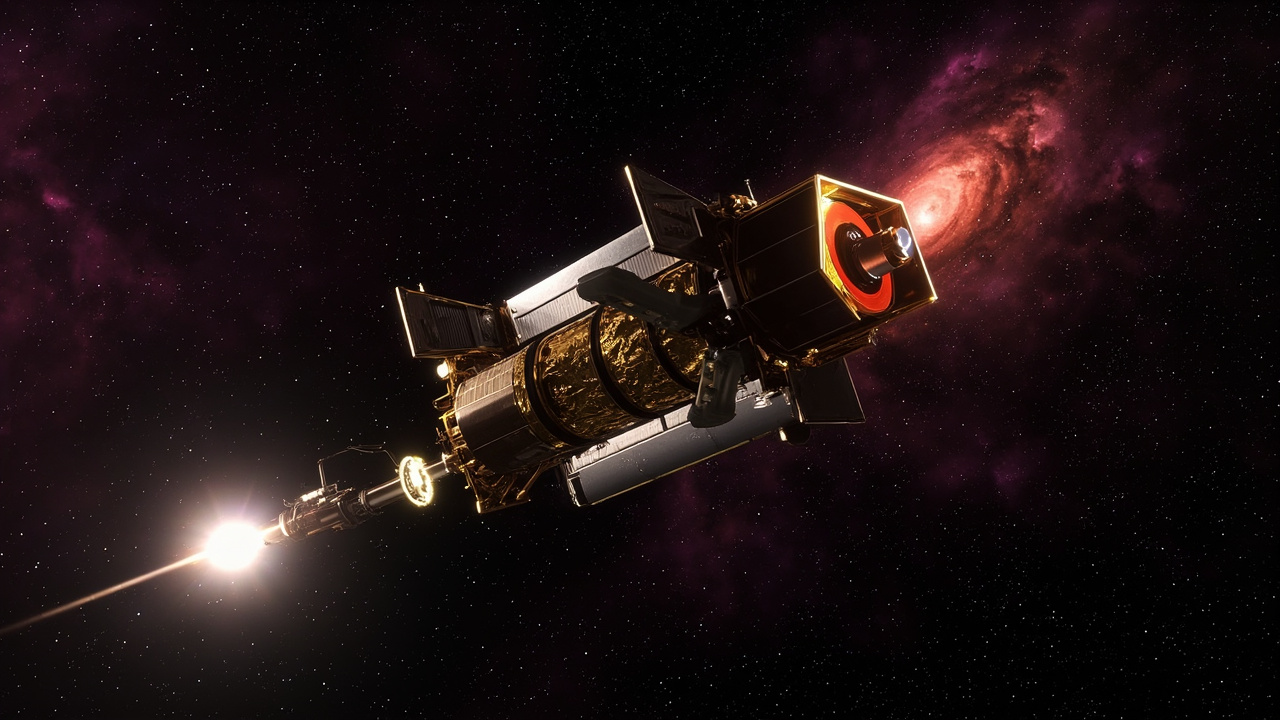
TL;DR: NASA advanced PRIMA, the Probe far-Infrared Mission for Astrophysics, into Phase B as the first Probe Explorer with a 2033 launch target and $1.2 billion cost cap.
NASA moves PRIMA into preliminary design
NASA announced Wednesday that PRIMA (PRobe far-Infrared Mission for Astrophysics) is advancing to the next phase of development to explore the history and evolution of the universe, according to NASA's "NASA Selects Far-Infrared Telescope as First in New Mission Class."
The release was updated on Sept. 24, 2026, to reflect current international partners.
NASA selected PRIMA to move into Phase B, the stage of development that advances the preliminary design and technology development for the mission.
The mission is subject to a confirmation review, based on technical, programmatic, and cost performance, to determine its readiness to begin implementation in Phase C.
If confirmed, PRIMA's project cost is capped at $1.2 billion, not including launch and other non-project costs.
The observatory will be targeted to launch in 2033, for a planned five-year mission.
NASA will select a launch provider at a later time, according to Spaceflight Now's "NASA announces new space telescope ‘PRIMA’ to launch in 2033."
A first for the Probe Explorer line
PRIMA is the first in a new class of NASA astrophysics missions, called Probe Explorers, within the agency's longstanding Explorers Program.
The National Academies of Sciences, Engineering, and Medicine's 2020 Decadal Survey, Pathways to Discovery in Astronomy and Astrophysics for the 2020s, recommended NASA establish this new Probe Explorers mission class.
NASA selected PRIMA for development after detailed evaluation of concept studies for Probe Explorer missions, based on their scientific merit in alignment with the Decadal Survey's recommendations, feasibility of their development plans on cost and schedule, and use of technologies that could support the development of future large missions.
The Explorers Program is the oldest continuous NASA program designed to provide frequent, low-cost access to space using principal investigator-led space science investigations relevant to the Science Mission Directorate's astrophysics and heliophysics programs.
Since the Explorer 1 launch in 1958, which discovered Earth's radiation belts, the Explorers Program has launched more than 100 missions, including the Uhuru and Cosmic Background Explorer missions that led to Nobel prizes for their investigators.
The Explorers Program is managed by NASA Goddard for the Science Mission Directorate, which conducts a wide variety of research and scientific exploration programs for Earth studies, space weather, the solar system, and the universe.
What the telescope will observe
With a 5.9-foot telescope, PRIMA will conduct deep, sensitive surveys of the universe in far-infrared light, helping bridge the gap between existing infrared observatories, such as NASA's James Webb Space Telescope, and radio telescopes.
By studying radiant energy that only emerges in the far-infrared, PRIMA will address questions about the universe, including the origins of planets outside our solar system, how galaxies and their black holes have grown and evolved over cosmic history, and how dust and heavy elements have built up in the universe over time.
The mission features a cryogenically cooled 1.8-meter telescope, an imaging polarimeter called PRIMAger to map large areas of the sky, and a high-resolution spectrometer called FIRESS to conduct multimode spectroscopy.
PRIMA has been designed with its telescope and detectors cooled to hundreds of degrees below zero, significantly reducing thermal noise that can muddy images, according to Caltech's "NASA Selects PRIMA Mission; Key Roles for Caltech, JPL, and IPAC."
As a result, PRIMA is orders of magnitude more sensitive than previous far-infrared space missions, and it will produce images with unprecedented sharpness.
With that suite, PRIMA will investigate the universe at far-infrared wavelengths ranging from 24 micrometers, described as one-third the thickness of a human hair, to 235 micrometers, described as roughly the thickness of two stacked pieces of paper.
The observatory will provide insight into a universe otherwise hidden at visible wavelengths, helping scientists study the formation of stars and planetary systems, trace the evolution of galaxies across cosmic time, and characterize the composition of exoplanet atmospheres and solar system bodies.
Why far-infrared matters after Webb and Roman
Nicky Fox, associate administrator for the Science Mission Directorate at NASA Headquarters in Washington, said the mission will examine planet, star and black-hole formation and the origin of water on Earth.
Shawn Domagal-Goldman, director of the Astrophysics Division at NASA Headquarters, said extending survey capabilities into far-infrared wavelengths with PRIMA enables a comprehensive look at the cosmos alongside Webb and Roman.
Domagal-Goldman said Webb and Roman set a cadence of launching premiere-class missions in both halves of the decade, and PRIMA would kick off the next decade as part of a pipeline of missions of that caliber.
The announcement followed the Aug. 30 launch of NASA's Nancy Grace Roman Space Telescope, which lifted at 7:26 a.m. EDT Sunday aboard a SpaceX Falcon Heavy rocket from Launch Complex 39A at Kennedy Space Center in Florida, according to NASA's Astrophysics Science Division listing.
That listing describes Roman as pairing a large field of view with survey capability for studies including dark energy, and as beginning a three-month, million-mile journey to its final orbit.
Alexandra Pope, professor of astronomy at the University of Massachusetts Amherst, serves as Science Team Lead for PRIMA, with concept development led by Jason Glenn, professor of astronomy at the University of Virginia.
Pope said Webb, launched almost five years earlier, pushed understanding while leaving mysteries Webb cannot solve because it cannot see the far-infrared part of the spectrum, and that PRIMA would provide complete infrared coverage for the first time.
The PRIMA proposal includes three core science questions developed with Pope as lead: how planets form atmospheres and how water reaches a planet, how supermassive black holes and galaxies co-evolve, and how the universe built complex elements beyond helium and hydrogen from the Big Bang.
Infrared spectroscopy would allow astronomers to trace cool water in planet-forming disks as material coalesces into planets, while infrared sensors would examine cosmic dust across environments and times to measure properties and element evolution.
Who builds and operates PRIMA
NASA's Jet Propulsion Laboratory in Southern California will manage the PRIMA mission.
Other partners include NASA's Goddard Space Flight Center in Greenbelt, Maryland and NASA's Marshall Space Flight Center in Huntsville, Alabama.
The mission also will have contributions from international partners: CNES, ASI, DLR, CSA, KASI/KASA, JAXA, and the UK Space Agency.
Spaceflight Now summarized the non-U.S. participants as the space agencies of Canada, France, Germany, Japan, South Korea, and the United Kingdom.
Caltech's IPAC will serve as the mission science center, where raw data from the telescope is received, processed, and archived for use by astronomers.
IPAC will also be responsible for scheduling astronomers' time and use of the telescope.
JPL, which Caltech manages for NASA, will develop and operate the observatory, and will lead mission architecture, systems engineering, and integration of the spacecraft and payload, drawing on decades of infrared astrophysics mission experience.
Detector heritage at Caltech and JPL
Caltech and JPL scientists pioneered the superconducting microwave kinetic inductance detectors, called MKIDs or KIDs, that enable PRIMA's ultrasensitive far-infrared cameras and spectrometers.
MKIDs and KIDs were invented by Jonas Zmuidzinas, Merle Kingsley Professor of Physics at Caltech, and JPL engineer Rick LeDuc, in 1999.
The two first worked out the key to using superconducting materials to detect far-infrared light at a Peet's coffee shop near Caltech.
Over the next few years, Zmuidzinas and LeDuc, with colleagues at Caltech and JPL, worked out other details in the detectors' design.
In 2007, the detectors were installed and successfully tested at the now-decommissioned Caltech Submillimeter Observatory near the summit of Maunakea in Hawaii.
The detectors were subsequently used in ground-based and balloon-borne instruments.
In the past five years, the Caltech-JPL team, including members of JPL's Microdevices Laboratory, focused on advancing KID arrays to the sensitivity required for PRIMA and to withstand the space environment, leading to prototype arrays that demonstrate readiness for flight onboard PRIMA.
PRIMA is described as NASA's first probe-class astrophysics mission, filling the gap between Explorer-class missions like SPHEREx and flagship missions like Roman, a framework tied to the Astro 2020 Decadal Survey led by Caltech's Fiona Harrison.
Hubble marks 200,000 orbits and hunts supernova return
NASA's Hubble Space Telescope completed its 200,000th orbit around Earth on Sept. 19, according to NASA Science's "NASA's Hubble Seeks Lensed Supernova, Marks 200,000 Orbits."
Hubble has traveled more than 5 billion miles around Earth over its 36-year lifetime, exceeding 1.7 million total observations.
An observation completed on the day of the 200,000th orbit relates to measuring the expansion rate of the universe, or the Hubble Constant.
The image uses the telescope's ability to return to the same sky regions over time to monitor for the reappearance of a supernova called Athena.
Massive galaxy cluster MACS J0417, located at the left center of the image, acts as a gravitational lens, bending and magnifying light from objects far behind it.
Light from a supernova can reach Earth along multiple paths, causing the same stellar explosion to appear more than once at times separated by months or even years depending on the path it took.
Supernova Athena, discovered by NASA's James Webb Space Telescope in 2025, is predicted to reappear between now and early March 2027.
Measuring the timing of Athena's reappearances can help researchers map the mass of MACS J0417, which acts as a magnifying foreground lens for distant objects, and refine understanding of the expansion rate of the universe.
After more than 36 years in space, Hubble's ability to observe and analyze light in ultraviolet and visible wavelengths complements Webb's and Roman's capabilities.
Demand for Hubble observing time remains high as astronomers request about seven times as much observing time as is available each year.
Hubble continues to observe targets across every area of astronomy around the clock, with real-time tracking of those observations available on NASA's website.
Sources referenced
- NASA Selects Far-Infrared Telescope as First in New Mission Class - NASA (https://www.nasa.gov/news-release/nasa-selects-far-infrared-telescope-as-first-in-new-mission-class/)