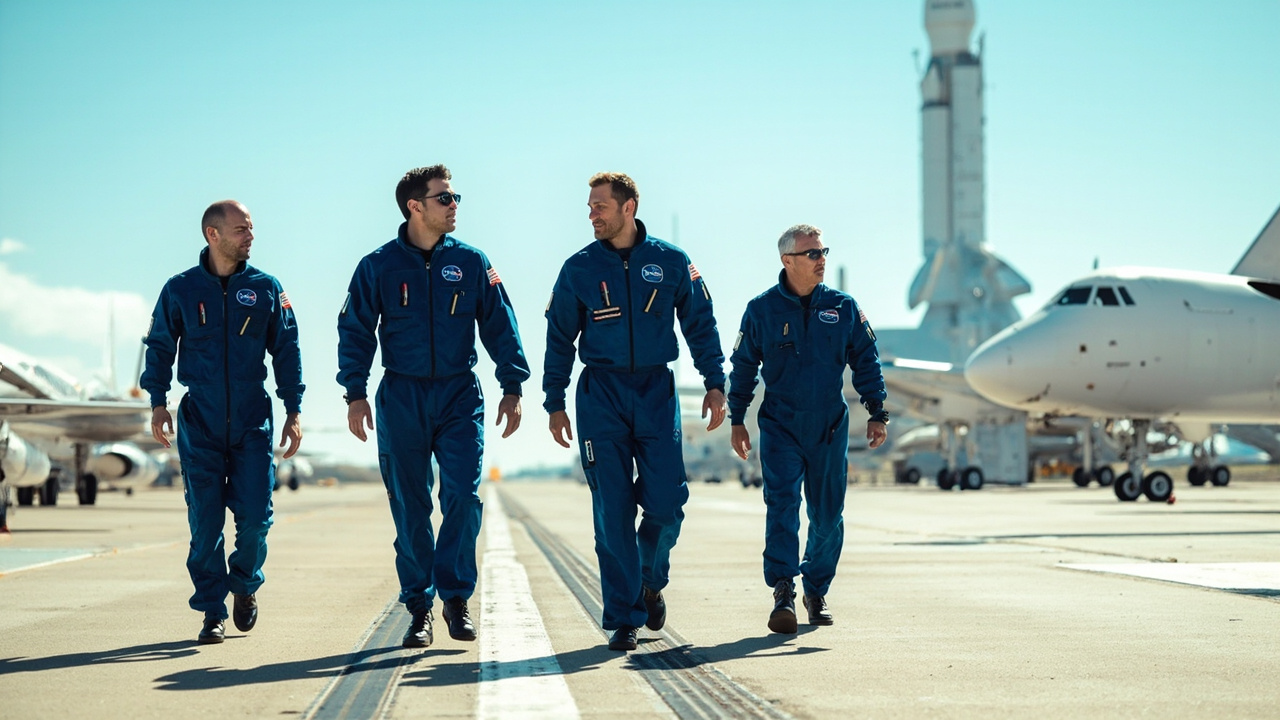
TL;DR: NASA's SpaceX Crew-13 arrived at Kennedy Space Center Sept. 26, 2026, aiming for an Oct. 1 station launch at the earliest at 11:10 a.m. EDT.
Arrival day at Kennedy
The next crew bound for the International Space Station touched down in Florida on Saturday afternoon. NASA put touchdown at 12:56 p.m. EDT at Kennedy Space Center's Shuttle Landing Facility.
The four arrived aboard two T-38 jets after departing the agency's Johnson Space Center in Houston. According to NASA, the cross-country flight included a brief refueling stopover in Mississippi.
Coverage from Spaceflight Now described the landing conditions as largely cloud-free with a light breeze at the Launch and Landing Facility. The publication identified the pilots for the ferry flight as NASA astronaut Luke Delaney and Canadian Space Agency astronaut Joshua Kutryk.
Reporting from Spectrum News 13 said Delaney and Kutryk flew the T-38N Talon jets from outside Johnson Space Center earlier that morning. According to Spaceflight Now, commander Jessica Watkins rode alongside Kutryk, while Roscosmos cosmonaut Sergey Teteryatnikov flew with Delaney.
A crew arrival media event was streamed on NASA Kennedy's YouTube channel, according to NASA. The crew was joined at the event by NASA Kennedy officials and agency Low Earth Orbit Program staff.
Who is flying on Crew-13
Crew-13 brings together two NASA astronauts, one Canadian astronaut and one Russian cosmonaut.
NASA astronaut Jessica Watkins commands the mission. NASA astronaut Luke Delaney serves as pilot for the SpaceX Dragon capsule. Joshua Kutryk of the Canadian Space Agency and Sergey Teteryatnikov of Roscosmos serve as mission specialists.
Spectrum News 13 reported the commander, pilot and mission-specialist assignments. NASA also identified the four crew members and their agencies.
Watkins is the only veteran of spaceflight among the four. Spectrum News 13 reported that her earlier spaceflight was Crew-4 in 2022, lasting 170 days. Spaceflight Now likewise identified Crew-13 as her second trip to space.
Delaney, Kutryk and Teteryatnikov are each preparing for a first trip to space. Spaceflight Now and Spectrum News 13 both reported that the three crewmates have not previously flown to orbit.
Watkins said the crew had trained together for more than a year before arriving in Florida. WESH also quoted her describing excitement about being at Kennedy after that extended joint preparation period.
Florida homecoming for the pilot
For Delaney, the arrival carried added personal meaning. He is a Volusia County native, a detail noted by both Spectrum News 13 and WESH.
Spectrum News 13 reported that his hometown of DeBary was about 50 miles from the arrival site. During a press question-and-answer session, Delaney discussed returning to Florida and recalled watching shuttle launches while growing up.
Spaceflight Now also characterized the stop as a homecoming for the Florida native and mission pilot. It reported Delaney's remarks about watching Space Shuttle launches during childhood and anticipating a different perspective in the coming days.
WESH added that Delaney grew up watching shuttle missions in Central Florida. It identified the upcoming flight as his first trip to space and Watkins' second mission aboard the station.
Delaney also thanked aircraft operations personnel for preparing the jets and supporting what he described as a smooth flight to Florida, according to Spaceflight Now.
Launch target: Oct. 1 from Cape Canaveral
All four sources point to the same launch target.
A SpaceX Falcon 9 liftoff is set for Thursday, Oct. 1 at 11:10 a.m. EDT at the earliest, according to NASA. Spaceflight Now listed the same time as 11:10 a.m. EDT, or 1510 UTC.
NASA placed the launch at Cape Canaveral Space Force Station's Complex 40 in Florida. WESH identified the spacecraft as the SpaceX Crew Dragon Grace.
The crew will spend the days before launch in quarantine while completing final preflight operations at Kennedy, according to NASA. WESH described that period as involving suit checks, equipment reviews and mission briefings alongside continued quarantine protocols.
Spaceflight Now's Sept. 26 report said NASA and SpaceX had completed a Flight Readiness Review at Kennedy the previous day to assess progress toward launch. That report listed a Falcon 9 engine test for Sept. 27 and a crew launch-day rehearsal for Sept. 29; it did not establish whether those planned events subsequently took place.
NASA said more launch details would appear on its mission blog and NASA Kennedy social channels, including @NASAKennedy on X and NASA Kennedy on Facebook.
Why the date moved
The Oct. 1 target followed a delay tied to the Dragon propulsion system.
Spaceflight Now reported that the four had originally been slated to launch on Sept. 12. An oxidizer leak in Dragon Grace prompted NASA and SpaceX to postpone the flight for repairs.
NASA disclosed the delay in a Commercial Crew Program blog post dated Aug. 29, according to Spaceflight Now. A Sept. 16 space station blog post then stated SpaceX had completed replacement of an oxidizer valve in Dragon's propulsion system following detection of a leak earlier in processing.
Spectrum News 13 provided additional schedule context. It reported that Crew-13 had originally been planned for November before NASA sought an earlier date to increase the frequency of U.S. crew rotations. NASA then considered a launch no earlier than mid-September, but the oxidizer leak on Dragon's propulsion system caused another postponement.
Watkins expressed gratitude to ground teams for finding the vehicle issue in time and selecting a safe repair path, according to Spaceflight Now. The publication said she gave those remarks in response to a question from Spaceflight Now about the repair work.
Six-month mission as Expedition 75
After reaching the orbiting laboratory, the four will become members of Expedition 75.
Spectrum News 13 explained that an expedition means the International Space Station's present crew. It said the astronauts would remain aboard the floating laboratory for more than six months.
WESH likewise reported an expected stay of about six months as part of Expedition 75. It described Crew-13 as NASA's 13th Commercial Crew operational rotation flight to the station.
Spectrum News 13 said the flight is NASA's Commercial Crew Program's 13th SpaceX crew rotation to the station. It described that program as a partnership where NASA uses private firms to fly astronauts to and from the station.
NASA offered a related count, stating that Crew-13 marks SpaceX's 13th NASA crew-rotation mission and its 14th flight carrying NASA astronauts to the station including the Demo-2 test flight.
WESH reported that Watkins anticipates a busy period of science, maintenance inside and outside the station, and outreach.
Science aimed at the Moon and Mars
Research is a central task for the upcoming increment.
During Saturday's press conference, the four said they would spend months conducting experiments intended to benefit Artemis moon missions, according to Spectrum News 13. WESH reported that much of the research would study human responses to long-duration microgravity, with results that could help develop travel protections beyond low Earth orbit, including upcoming Moon and Mars missions.
Watkins, a geologist, discussed using Earth observations from the station to inform future lunar work. Spectrum News 13 reported that she hopes observations of Earth can support future lunar missions. WESH quoted her broader interest in using the station as a platform for Earth observations before applying that experience to the Moon.
Kutryk pointed to a European Space Agency exercise device that could have lunar applications, according to Spectrum News 13.
WESH detailed several planned human-research investigations. One is Venous Haemostasis, a NASA and European Space Agency collaboration examining circulation, blood flow and clotting risk in microgravity. Crew members are expected to contribute blood draws, ultrasound scans, blood-pressure checks and other readings before, during and after the flight.
Another investigation, Manual Piloting, will evaluate skill at finishing challenging lunar-landing simulations following months in microgravity. WESH reported that it will also test if pre-landing refresher training boosts performance.
The B-Complex experiment will examine if daily B-vitamin dosing can lessen or avert spaceflight-associated neuro-ocular syndrome, which can impact eyes and vision. Participants will use supplements with vision testing, according to WESH.
Additional work includes Standard Measures, gathering uniform body and behavior data to establish baselines for future research. WESH also described the Spacecraft Occupant Risk study, which will measure forces experienced during return and landing to inform hardware and procedural improvements.
The Zero T2 study will compare health and performance between crew members who use the station treadmill and those who do not. WESH reported that researchers hope the outcome will inform exercise planning for future spacecraft with limited room for equipment.
The broader Expedition 75 program is also expected to include studies on orbital manufacturing, bioprinting, augmented reality and AI crew-health monitoring tools, according to WESH.
Delaney said researchers are still characterizing individual differences in human responses to spaceflight, according to WESH. He also discussed contributing blood samples to help document bodily changes.
Canadian milestone on the manifest
The mission carries particular significance for Canada.
Spaceflight Now reported that Kutryk is set to become this year's second Canadian space traveler, after Jeremy Hansen's April trip on Artemis 2.
Kutryk reflected on support from family, colleagues and crowds in Houston and Florida, according to Spaceflight Now. He said he had flown into the Cape many times, but described the latest arrival as especially meaningful.
Watkins described arrival day as both an ending and a start: the culmination of more than a year of crew training and the beginning of final preparations to join Expedition 75. That framing, reported by Spaceflight Now, captured the shift from rehearsal in Houston to countdown operations in Florida.
Spaceflight Now's Sept. 26 report listed an engine test for Sept. 27 and a crew rehearsal for Sept. 29, ahead of the Oct. 1 earliest launch target. These dates describe the plan in that report, not confirmation that the test or rehearsal occurred.
Reporting draws on NASA, Spaceflight Now, Spectrum News 13 and WESH accounts of the Sept. 26 arrival and countdown plan.