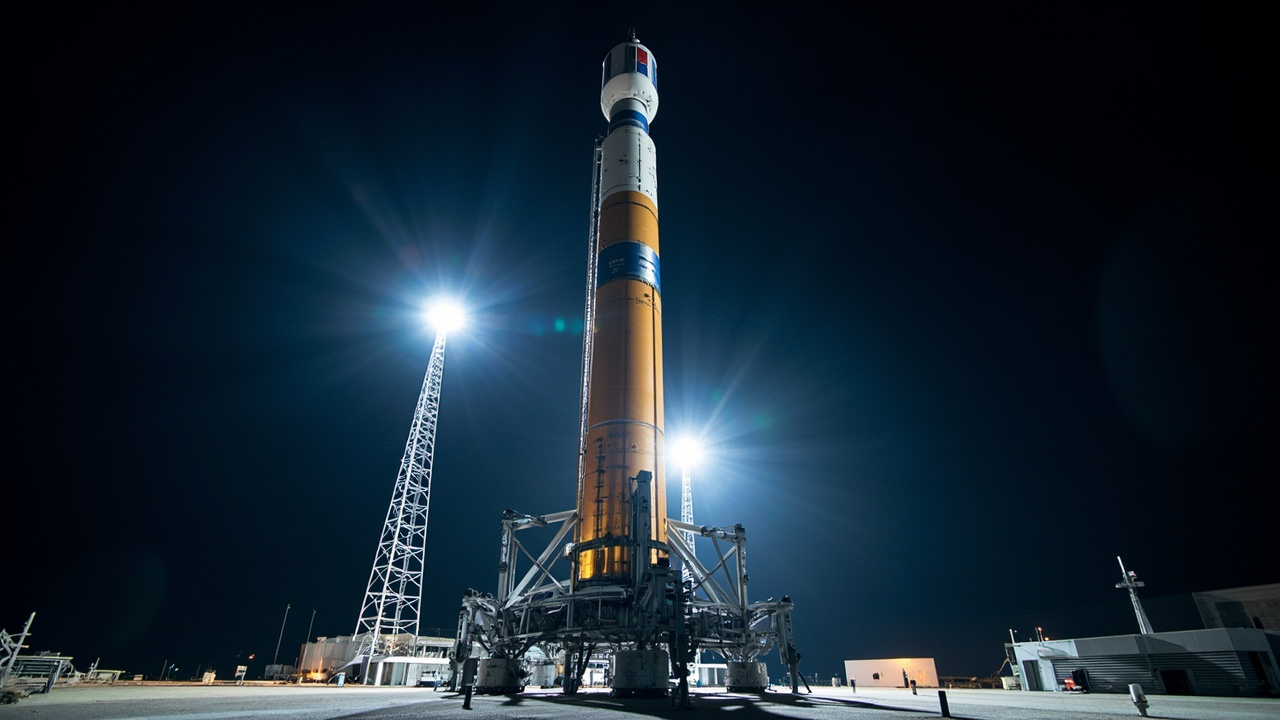
TL;DR: SpaceX moved Super Heavy booster B21 to Pad 2 at Starbase late Sept. 20 to prepare Starship Flight 14, the first planned orbital Starship mission carrying 26 Starlink V3 satellites, targeted no earlier than Sept. 28 at 7:15 a.m. CDT pending FAA license approval.
SpaceX placed a Super Heavy booster onto the launch mount at its Starbase facility in Texas as work advances toward the first planned orbital flight of Starship, according to Spaceflight Now. The vehicle, identified by tail number B21, was positioned at Pad 2 after a late-night transfer on Sunday, Sept. 20. The mission, designated Starship Flight 14 and also listed as Starlink 31-1, is scheduled for launch as soon as Sept. 28, subject to final authorization from the Federal Aviation Administration.
Booster B21 reaches Pad 2
The booster left its assembly building shortly before midnight local time and was secured on the launch mount about two hours later, according to Spaceflight Now. The report described the move as part of testing and preparations for the coming flight test.
Spaceflight Now reported that, as of Monday morning, the City of Starbase had not published road closures associated with a further vehicle movement. The absence of published closures indicated that the Starship upper stage, tail number S41, was likely at least a day or two from rolling to the pad to join B21.
SpaceX had not said whether it would conduct a fully integrated wet dress rehearsal tanking test after assembling the vehicle before the launch attempt, according to Spaceflight Now. A wet dress rehearsal would involve loading propellant and exercising countdown procedures without launching.
The Sept. 28 target was announced Sept. 17 and replaced an earlier no-earlier-than Sept. 22 window, according to TeslaNorth.com. The FAA’s airspace advisory had identified Sept. 22 as the primary date and Sept. 23 as a backup date for Starbase operations. TeslaNorth.com reported that those airspace notices coordinate use of national airspace around a possible attempt and do not by themselves establish a final countdown.
How large the flight hardware is
B21 is constructed from stainless steel and measures 236 feet tall, or 72 meters, with a diameter of 9 meters, or 29.5 feet, according to Spaceflight Now. A Falcon 9 rocket has a diameter of 3.7 meters, or 12 feet.
The internal downcomer pipe that transports methane fuel through the center of the booster’s liquid oxygen tank to the Raptor engines at the base is approximately the size of an entire Falcon 9 rocket, according to Spaceflight Now. The size comparison illustrates the difference in propellant-feed and thrust scale between the Super Heavy first stage and SpaceX’s operational Falcon vehicle.
The Starship upper stage assigned to the mission is 171 feet tall, or 52 meters, according to Spaceflight Now. SpaceX completed related upper-stage ground testing before the booster rollout, including a full-duration, 60-second static fire with all six Raptor engines, as reported by SpaceX in an Aug. 21 post described by Spaceflight Now.
First planned orbital Starship flight
Flight 14 is planned as Starship’s first orbital mission following 13 suborbital flight tests, according to Starpath Global. Earlier flights used intentionally suborbital trajectories, while the new mission is designed to place the Ship into orbit for an extended period.
SpaceX is targeting liftoff during a 75-minute window opening at 7:15 a.m. Central Time, or 1215 UTC, according to TeslaNorth.com. Starpath Global reported that the mission is expected to last nearly 10 hours and include about six revolutions around Earth.
The flight profile calls for Ship 41 to operate near 275 kilometers above Earth, according to TeslaNorth.com. Spaceflight Now reported the planned deployment orbit as 171 miles, or 275 kilometers, with an estimated orbital inclination of 30 degrees to the equator.
After completing orbital operations, the Ship is expected to perform a controlled deorbit, reenter over the Pacific Ocean and splash down west of Chile, according to Starpath Global. The extended time in orbit and subsequent deorbit burn are central to demonstrating orbital insertion, long-duration operations and a planned return from orbit.
FAA approval still required
The Sept. 28 launch opportunity can proceed only after the FAA approves a license modification covering SpaceX’s orbital flight plan, according to Spaceflight Now. The agency has not yet granted that authorization.
The application would be the first time the FAA grants an orbital license for an object the size of a Starship upper stage, according to Spaceflight Now. Agency review therefore includes the consequences of a missed or unsuccessful planned deorbit burn.
If Starship did not complete the planned deorbit maneuver, an uncontrolled reentry could create a hazard on the ground, according to Spaceflight Now. The vehicle’s heat shield and overall bulk mean that large pieces could survive and reach Earth.
“In addition to completing the environmental review, license applications must also meet FAA safety, policy/payload, and financial responsibility requirements to receive authorization for flight,” the FAA said in a statement reported by Spaceflight Now. The statement identifies the separate safety, policy, payload and financial conditions that must be satisfied in addition to environmental review.
26 Starlink V3 satellites on board
Depending on its timing, Flight 14 may serve as SpaceX’s next Starlink mission and carries the additional designation Starlink 31-1, according to Spaceflight Now. The company recently stopped launches of V2 mini broadband satellites from Florida but continues to build and replenish the constellation with missions from Vandenberg Space Force Base in California.
SpaceX needs Starship to begin launching larger and more capable Starlink V3 satellites, according to Spaceflight Now. On Flight 14, the company aims to deploy 26 Starlink V3 spacecraft into orbit.
Each V3 satellite is expected to add 1 terabit per second of capacity, producing 26 terabits per second from this mission alone, according to SpaceX’s prelaunch mission writeup described by Spaceflight Now. That amount represents about 10 times the capacity added by one Falcon 9 launch carrying V2 mini satellites.
After separation from Starship, the satellites are expected to unfold antennas, deploy solar arrays and establish initial contact with ground stations and the existing constellation through radio-frequency and laser links, according to Spaceflight Now. The spacecraft will then use onboard thrusters to raise their orbits. Following on-orbit checkouts, the satellites could begin serving customers within a few weeks after launch.
A July test flight provided a partial preview of V3 operations. SpaceX deployed several V3 satellites along the same suborbital trajectory used by the Ship 40 upper stage, according to Spaceflight Now. Those satellites deployed solar arrays, captured imagery of Starship’s heat shield and briefly connected with the broader constellation using laser links before their planned demise.
Booster recovery plan for Flight 14
Super Heavy Booster 21 is not scheduled to return to the Starbase launch tower for a catch on this mission, according to Starpath Global. Instead, the booster is expected to perform a boostback maneuver, conduct a landing burn and make a controlled splashdown in the Gulf.
SpaceX incorporated hardware and software changes intended to improve engine-data filtering and relight reliability following Flight 13, according to Starpath Global. Those changes are relevant to engine performance during return maneuvers.
If Flight 14 demonstrates reliable orbital flight, payload deployment and controlled reentry, Flight 15 could become the first realistic opportunity to attempt a Starship catch, according to Starpath Global. Under the most ambitious scenario described in that report, SpaceX could attempt to recover both the Super Heavy booster and the upper-stage Ship with the launch tower’s mechanical arms.
Any recovery attempt would depend on guidance, propulsion and vehicle-control data collected during Flight 14, according to Starpath Global. SpaceX must show sufficiently precise performance before directing a returning Ship toward infrastructure at the launch site.
Sources referenced
- SpaceX’s Super Heavy booster arrives at pad ahead of first orbital Starship launch – Spaceflight Now (https://spaceflightnow.com/2026/09/21/spacexs-super-heavy-booster-arrives-at-pad-ahead-of-first-orbital-starship-launch/)
- SpaceX Targets September 28 for Starship’s First Orbital Flight as Florida Pad Nears Readiness – Starpath Global (https://starpath.global/news/spacex-targets-september-28-for-starships-first-orbital-flight-as-florida-pad-nears-readiness/)