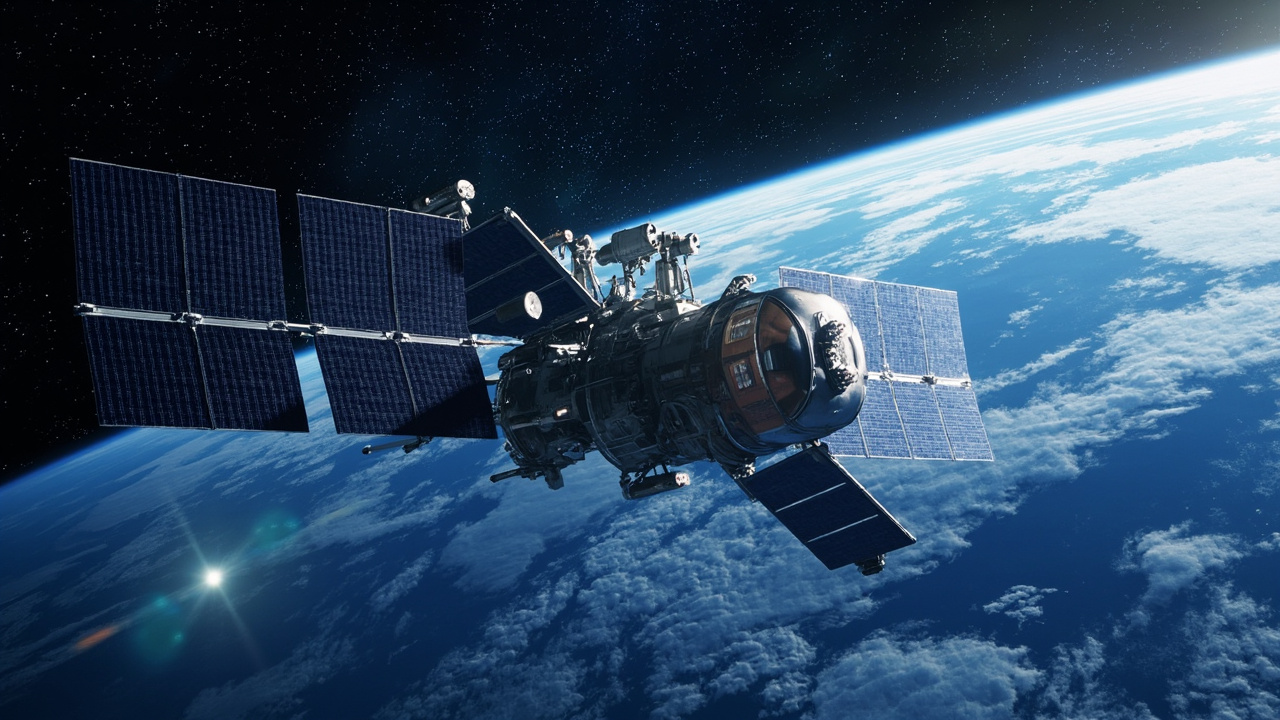
NASA's Neil Gehrels Swift Observatory re-entered Earth's atmosphere on November 4, 2026, at 7:39 a.m. EST, ending a 22-year mission that transformed understanding of the universe's most violent explosions — and concluding with a failed last-minute rescue attempt that offers hard lessons for the next generation of satellite servicing.
Re-Entry Confirmed Over North Sumatra
The U.S. Space Force tracked and confirmed the precise time and location of Swift's atmospheric descent, which occurred over the North Sumatra region of Indonesia, according to NASA's Swift mission blog. Most of the 3,200-pound (1,450-kilogram) observatory was expected to burn up during re-entry, though NASA acknowledged some fragments could potentially reach the surface.
NASA placed the odds of any surviving debris injuring someone on the ground at roughly 1 in 2,100 — a figure that, while low in absolute terms, exceeded thresholds set by current orbital debris guidelines. The agency had been monitoring Swift's orbit throughout 2026 as it descended. Swift ceased science observations on October 20, 2026, just two weeks before its final plunge, with its last operational altitude hovering around 171 miles (275 kilometers).
Heightened solar activity played a direct role in accelerating the timeline. Increased solar output expanded Earth's upper atmosphere, intensifying the drag forces acting on Swift's already-low orbit and shortening any intervention window.
Twenty-Two Years of Cosmic Discovery
Launched in November 2004, Swift was originally designed for a two-year mission. It far exceeded that mandate, logging more than two decades of continuous science operations. Over that span, the observatory catalogued more than 2,000 gamma-ray bursts and detected upward of 1,400 supernovae, according to reporting by the Associated Press.
Gamma-ray bursts — the most energetic explosions in the observable universe — were Swift's primary quarry. The spacecraft's hallmark capability was speed: it could autonomously detect a burst, calculate its position, and swivel its X-ray and ultraviolet telescopes onto the target within roughly 90 seconds, then broadcast coordinates to ground-based observatories worldwide. That rapid-response architecture made Swift an indispensable hub for multi-wavelength follow-up campaigns.
Shawn Domagal-Goldman, director of NASA's Astrophysics Division, was quoted in AP coverage stating that Swift "delivered an incredible, lasting return on investment for the nation." The observatory was renamed in 2017 to honor Neil Gehrels, its first principal investigator, who died that year after leading the mission from conception through its most productive years.
Beyond gamma-ray bursts, Swift studied active galactic nuclei, tidal disruption events where stars are shredded by supermassive black holes, comets, and exoplanet atmospheres — a scientific breadth that far outlasted the original mission concept.
The LINK Rescue Mission and Its Failure
In September 2025, NASA announced a novel plan to extend Swift's life: a small robotic spacecraft called LINK, designed to rendezvous with the observatory and boost it to a higher, safer orbit where it could continue operating for additional years. The concept drew attention as a proof-of-concept for autonomous satellite servicing.
LINK launched on July 3, 2026, according to Science magazine's coverage of Swift's end. The mission ran into trouble almost immediately. Two of LINK's three reaction wheels — gyroscopic devices critical for precise attitude control — failed shortly after launch, leaving the spacecraft unable to maneuver with the accuracy required to safely approach and dock with Swift.
NASA abandoned the rescue effort in August 2026 after engineers determined the wheel failures could not be overcome. Science magazine reported that LINK's compressed development schedule, driven by the urgency of Swift's accelerating descent, left limited time for the extended testing that might have caught those hardware vulnerabilities earlier. The tight turnaround between mission announcement and launch underscored the difficulty of building reliable servicing spacecraft under time pressure.
What the LINK Failure Means for Satellite Servicing
The LINK setback arrives at a moment when NASA and commercial partners are investing heavily in on-orbit servicing as a strategy for extending aging spacecraft lifetimes and reducing orbital debris. Swift's experience illustrates the gap between concept and execution: even a well-motivated servicing attempt can be undone by component failures that only manifest in the actual space environment.
Future servicing candidates — including, potentially, the Hubble Space Telescope — will need to account for the propulsion and attitude-control redundancies that LINK lacked. The lessons apply equally to commercial operators planning refueling or life-extension services for telecommunications satellites in geostationary orbit.
Swift's uncontrolled re-entry also renews focus on end-of-life disposal planning. Current U.S. and international debris-mitigation guidelines call for spacecraft in low Earth orbit to re-enter within 25 years of mission end. Swift was within that window, but its trajectory was shaped more by solar activity than deliberate deorbit maneuvering. As orbital congestion grows, mission planners face increasing pressure to build in dedicated deorbit propellant reserves from the outset.
A Lasting Mark on Astrophysics
Despite the uncontrolled finale, Swift's scientific legacy is unambiguous. The observatory produced a population-level census of gamma-ray bursts that underpins current models of neutron star mergers, black hole formation, and the chemical enrichment of galaxies. Its ultraviolet telescope contributed calibration data used by researchers across dozens of unrelated programs.
NASA's Swift mission blog confirmed the November 4 re-entry and noted that the agency was awaiting ground reports of any surviving debris. No confirmed fragment recoveries had been announced at the time of that reporting.
For a mission originally scoped for two years, Swift's 22-year run — punctuated by a daring, ultimately unsuccessful rescue bid — stands as one of the more remarkable chapters in NASA's astrophysics portfolio. The spacecraft's data archive will continue to yield discoveries for researchers long after the hardware itself has burned away.
Sources referenced
- NASA's Swift Observatory to Re-Enter Atmosphere (https://science.nasa.gov/blogs/swift/2026/11/02/nasas-swift-observatory-to-re-enter-atmosphere/)
- NASA space telescope plunges to Earth after failed rescue mission (https://apnews.com/article/swift-observatory-telescope-hubble-5c19afdd7867dc88d68ea61dba1fbaee)