TL;DR: NASA's James Webb Space Telescope has identified the host galaxy of the most distant fast radio burst on record, while NASA has ordered a new test telescope for the LISA gravitational-wave mission and NASA's Chandra observatory has cataloged a new class of X-ray sources.
NASA's astrophysics program published a series of results in early to mid-October 2026, led by the Webb measurement reported on Oct. 8, 2026, according to NASA Science in "Webb Measures Distance to Farthest Fast Radio Burst, Suggesting Origin."
Webb pins down record-distant fast radio burst
Fast radio bursts were first discovered in 2007, described by NASA Science as enigmatic, millisecond-long flashes of radio emission from the distant universe. Their origin remains uncertain, particularly since most are seen once and never again.
The new record-holder is designated FRB 20240304B. The MeerTRAP team used the MeerKAT telescope to detect the burst on March 4, 2024. Radio data suggested it was extremely distant, possibly the most distant one seen to date.
To confirm that distance, astronomers needed to study its host galaxy. Although they knew the location very precisely, the world's largest ground-based telescopes could not see any galaxy at that spot in the sky. The team turned to Webb, according to NASA Science.
Webb's NIRCam instrument detected a galaxy in the right location. Its NIRSpec instrument provided a precise measurement of the galaxy's redshift: 2.148, corresponding to a time just 3 billion years after the big bang. The vast majority of FRBs detected to date occurred billions of years later in cosmic history.
A NASA Webb asset page lists the distance as 10.63 billion light-years at z=2.148. It places the object in the constellation Virgo at right ascension 12:11:59.294 and declination +11:48:46.830. Webb data came from proposal 6779 led by M. Caleb, with exposures on Dec. 26, 2024, in filters F200W and F322W.
NIRCam detected the host at the position marked by a white cross in released imagery. The galaxy was identified as a small dwarf galaxy actively forming stars. Image credits list NASA, ESA, CSA, STScI, Themiya Nanayakkara of the University of Sydney, with processing by Joseph DePasquale of STScI.
The host galaxy was not typical of other galaxies with FRBs. Most FRB galaxies are massive star-forming galaxies, but the galaxy found for FRB 20240304B was 1,000 times less massive than expected.
"We thought it would be a big, nicely formed galaxy with lots of stars, and instead it was a little dwarf galaxy, although it was actively forming stars," said Manisha Caleb of the University of Sydney, lead author on the study published Thursday in the journal Science, according to NASA Science.
"The host sticks out in the whole galaxy sample that we have. And it definitely was not what we were expecting," said Ben Stappers of the University of Manchester, United Kingdom, a co-author on the paper.
The galaxy existed at the height of cosmic noon, a period in the history of the universe when star formation was at its peak. The galaxy's rate of star formation suggested that the majority of its stars may have formed within just 30 million years.
Why the dwarf host points to a magnetar
One theory suggests FRBs may originate from the merger of two neutron stars. The process of orbiting neutron stars gradually approaching closer until they collide is expected to take billions of years. As a result, FRBs from mergers would be expected to be associated with older galaxies containing more evolved stellar populations.
A second theory proposes an FRB can originate from a single, young, highly magnetic neutron star known as a magnetar through a mechanism like starquakes. In that case, once a massive star explodes as a supernova and leaves behind a magnetar, an FRB might occur relatively quickly with no large time delay. FRBs of that type would also be expected in younger galaxies like the host of FRB 20240304B.
"Our work suggests that it's very unlikely that this FRB was produced by a merger," said Caleb, according to NASA Science.
The University of California, Santa Cruz, reporting on the same Oct. 8 study in Science, said UC Santa Cruz researchers planned, organized, executed and analyzed observations from the W. M. Keck Observatory in Hawaii that proved the home galaxy is too faint to be seen by any ground-based telescope. That null result was needed to justify and plan the request for observation time on Webb.
J. Xavier Prochaska of the University of California, Santa Cruz, a co-author, described a fast radio burst as almost like a cosmic flashlight that lights up everything along its path and carries an imprint of everything it travels through. The team said that imprint can be used to trace the cosmic web, the otherwise invisible matter and structures encountered along the way.
The team found the imprint of two cosmic structures on the FRB signal. One was a previously unknown galaxy cluster at redshift 0.3, about 3.5 billion light-years from Earth. The other was the nearby Virgo Cluster, located about 54 million light-years from Earth.
"Our results further show the amazing capability of Webb where we can push boundaries beyond what was previously possible," said co-author Themiya Nanayakkara of the University of Sydney, Australia, according to NASA Science.
The MeerTRAP discovery and Webb host study combination was described by Stappers as very exciting for studying distant bursts and their hosts. UC Santa Cruz summarized the implication as favoring young magnetars over colliding stellar remnants.
NASA advances LISA with all-glass test telescope
On Oct. 8, 2026, NASA announced it has taken the next step in developing a new all-glass telescope for LISA, the Laser Interferometer Space Antenna mission, according to NASA Science in "NASA Advances LISA Mission Contributions With New Test Telescope."
LISA is a space observatory designed to detect ripples in space-time called gravitational waves. It is led by ESA, the European Space Agency, and is slated for launch in the mid-2030s. As a collaborative partner, NASA is contributing the telescopes, other critical hardware, and engineering and scientific support.
L3Harris Technologies will design, assemble, and integrate the new telescope for NASA. Called the Engineering Test Unit, this contribution represents a final step toward the future production of flight hardware.
L3Harris said on Oct. 8, 2026, from Rochester, New York, that it was selected to design, assemble, integrate and test the telescope. The company said work on its portion would take place in Rochester.
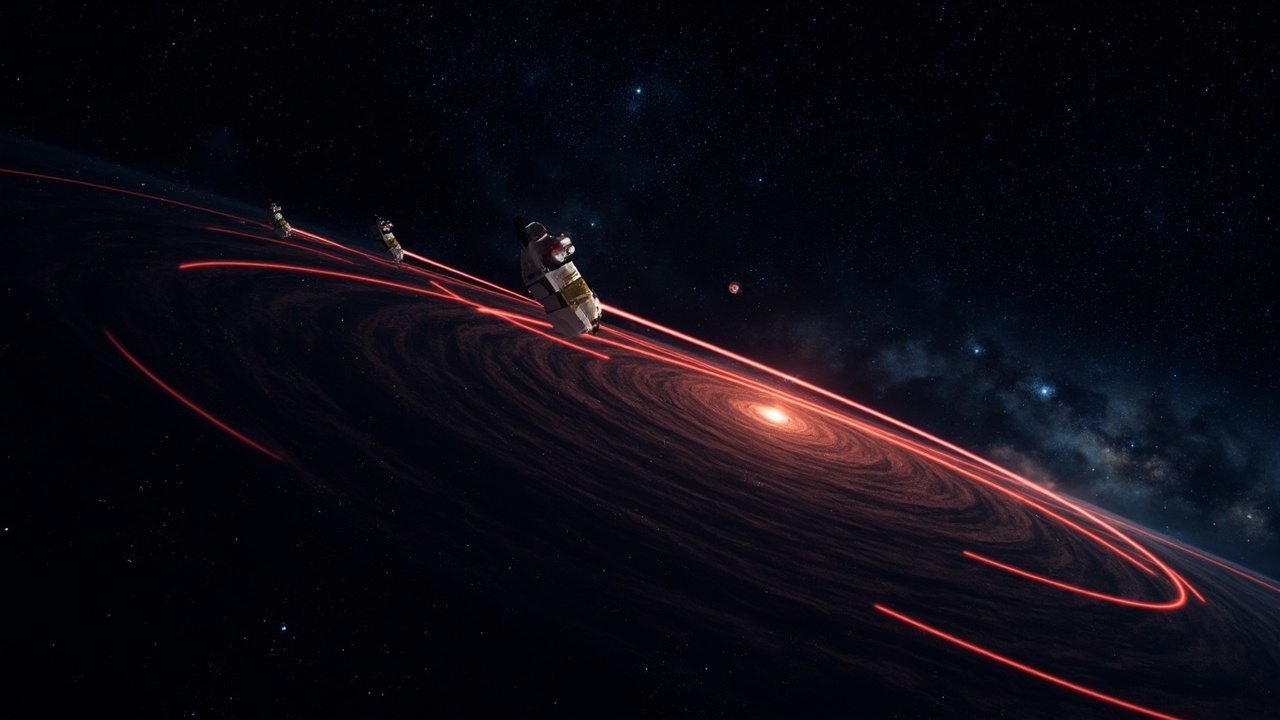
The mission will deploy a trio of satellites into an Earth-following orbit, creating a vast triangular array stretching 1.6 million miles, or 2.5 million kilometers, on each side. L3Harris described the orbit as heliocentric, forming a triangular constellation spanning 2.5 million kilometers.
Each satellite will include two telescopes that will use infrared laser beams to simultaneously transmit and receive signals between adjacent spacecraft. Through these telescopes, the spacecraft will measure minuscule changes in their relative distances, the signals of passing gravitational waves.
"These changes are tiny, smaller than the width of a helium atom, but through them LISA will reveal a sea of low-frequency gravitational waves that we cannot currently detect through facilities on Earth," said Ira Thorpe, the NASA project scientist for the mission at the agency's Goddard Space Flight Center in Greenbelt, Maryland.
Thorpe said LISA will be able to detect mergers of monster black holes billions of light-years away, map compact pairs of white dwarfs, neutron stars and stellar-mass black holes, and perhaps provide new insights into gravity itself.
Each telescope will be entirely made of an amber-colored ceramic-glass composite called Zerodur. NASA Science describes Zerodur as widely used in high-precision applications because it resists changes in shape across a wide range of temperatures.
In 2024, L3Harris delivered a prototype telescope to NASA that served as an engineering development unit for this next step. NASA imaged a technician inspecting that prototype in a clean room at NASA Goddard, with the mirror surface coated in gold. NASA credits that image to Dennis Henry.
"We've put the prototype through rigorous testing, and we're bringing everything we've learned into this new telescope," said Ritva Keski-Kuha, lead for the LISA Telescope program at NASA Goddard. Keski-Kuha described the Engineering Test Unit as the last pre-flight unit and the first optical telescope delivery to ESA.
Earlier this year, in June, the team delivered a structural model of the telescope made from metal instead of glass. NASA reported the prototype had been delivered in May 2024 in one account and October 2024 in a company account, reflecting separate reporting of the hardware handover.
Gravitational waves were predicted by Albert Einstein's 1916 general theory of relativity and first detected by ground-based observatories in 2015. The waves form whenever massive objects accelerate, such as two stars in orbit around each other. They flow across space-time, moving at the speed of light, and are unaffected by objects they encounter along the way.
Each of the three LISA spacecraft contains a free-floating gold-platinum cube called a proof mass. The spacecraft will fly around the cube and manage its environment so the cube falls through space only under the influence of gravity. In 2016, ESA's LISA Pathfinder mission showed it was possible to reduce non-gravitational forces on the proof masses to the level needed for detection.
Additional NASA contributions include the laser system, devices to manage the buildup of electric charge on the proof masses, data analysis for identifying and characterizing individual gravitational wave sources, and additional scientific and engineering expertise.
Chandra finds 84 hypersoft X-ray sources
Using NASA's Chandra X-ray Observatory, scientists discovered a new class of objects behaving unlike any they had seen before, according to NASA Science in "NASA's Chandra Unveils Mysterious X-Ray Objects," published Sept. 9, 2026.
The researchers found 84 hypersoft X-ray sources in six galaxies searched, using data openly available in the Chandra archive. Two galaxies are spirals, M31, the Andromeda galaxy, and M101, the Pinwheel galaxy, while the other four are ellipticals.
The objects give off unusually low-energy X-rays but intense levels of ultraviolet radiation. The team spotted them by finding objects that appeared in Chandra images at the lowest X-ray energies but vanished in higher-energy images. Because low-energy X-rays border energetic ultraviolet radiation on the electromagnetic spectrum, the researchers determined the sources are producing large amounts of energetic ultraviolet radiation as well.
The discovery was featured in a paper published Wednesday in Nature Astronomy. Mustafa Muhibullah of the University of Alabama led the study, with Jimmy Irwin, also of the University of Alabama, as co-author.
It is unclear what types of objects are responsible. The team thinks they most likely involve a black hole, neutron star or white dwarf pulling material from a companion star. Material pulled from the companion is heated to produce X-rays before falling onto the white dwarf or neutron star or into the black hole.
The discovery suggests there may be large populations of binary systems with energetic ultraviolet radiation that have been undetected until now. The sources were found both in regions of active star formation and areas with older stars.
Scientists think some white dwarf systems pulling material from companion stars may eventually explode as Type Ia supernovae critical for measuring the expansion of the universe. Those supernovae played a key role in discovering that expansion is accelerating. Astronomers have sought the stars that turn into Type Ia supernovae for many years.
October astrophysics snapshots from Hubble and Webb
The Goddard Astrophysics Science Division press list records additional October releases that frame the month's observing activity.
On Oct. 16, 2026, NASA's Hubble Space Telescope featured the edge-on, intermediate spiral galaxy NGC 1827, located roughly 37 million light-years away in the constellation Columba, the Dove.
On Oct. 6, 2026, Webb unveiled numerous stars formerly hidden by dust in stellar nursery NGC 7129, which resides about 3,300 light-years from Earth. NASA described the region as a cauldron of cosmic creation where stars show life cycles beginning in dust clouds.
On Oct. 5, 2026, new analysis of archival Hubble data pointed to the possibility of dead white dwarf stars hosting second-generation planetary systems.
On Oct. 1, 2026, Webb provided a study of planet-shattering collisions tied to early solar system history, when scientists theorize a Mars-sized object called Theia smashed into the infant Earth and some material coalesced into the Moon.
Together, the October set links Webb's distant-universe reach, Hubble's nearby-galaxy imaging and archival exoplanet work, Chandra's X-ray survey science, and LISA's mid-2030s hardware path. For U.S. readers, the practical thread is mission continuity: operating Great Observatories delivering peer-reviewed results while NASA builds the next gravitational-wave and far-infrared infrastructure with ESA, JAXA and industry partners.
Sources referenced
- Webb Measures Distance to Farthest Fast Radio Burst, Suggesting Origin - NASA Science (https://science.nasa.gov/missions/webb/webb-measures-distance-to-farthest-fast-radio-burst-suggesting-origin/)
- NASA Advances LISA Mission Contributions With New Test Telescope - NASA Science (https://science.nasa.gov/missions/lisa/nasa-advances-lisa-mission-contributions-with-new-test-telescope/)