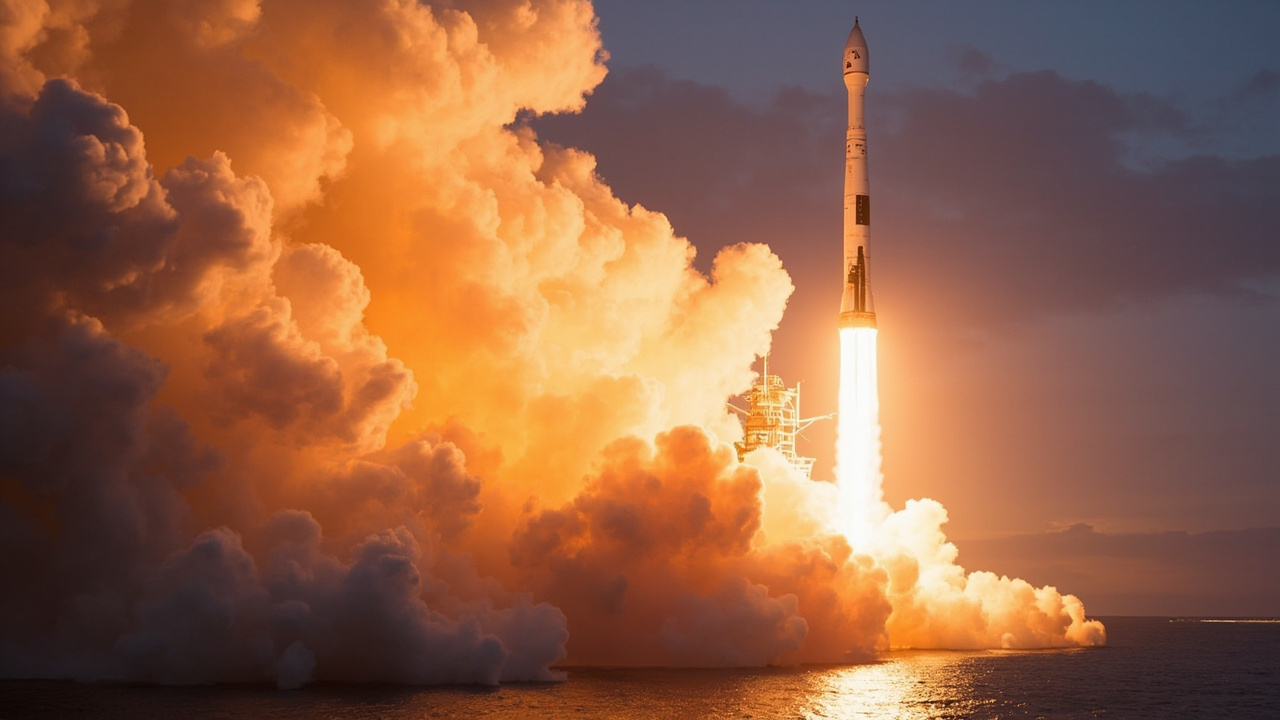
TL;DR: SpaceX is targeting Monday, October 19, for a Falcon 9 launch of the Bandwagon-5 rideshare mission from SLC-40 in Florida, with 31 separation events planned and booster B1085 flying a 19th time.
SpaceX is targeting Monday, October 19, for liftoff of the Falcon 9 Bandwagon-5 rideshare mission from Space Launch Complex 40 (SLC-40) at Cape Canaveral Space Force Station in Florida, according to SpaceX - Bandwagon-5 Mission. The one-hour window opens at 6:30 a.m. ET. A backup opportunity is available Tuesday, October 20, with the same window. A live webcast will begin about 15 minutes prior to liftoff and can be viewed on the SpaceX site and on X @SpaceX.
Launch window and viewing details
The planned liftoff time corresponds to 10:30 UTC, with the window extending to 11:30 UTC, according to Bandwagon-5 | Falcon 9 Block 5 | Next Spaceflight. Spaceflight Now lists the same opening as 6:30 a.m. EDT, or 1030 UTC, from SLC-40 at Cape Canaveral Space Force Station in Florida, according to Falcon 9 • Bandwagon-5 – Spaceflight Now. The schedule entry was updated October 13 and identifies Will Robinson-Smith as author. The launch is aimed at mid-inclination low Earth orbit.
SpaceX describes Bandwagon-5 as a dedicated rideshare mission, according to SpaceX - Bandwagon-5 Mission. Next Spaceflight describes the flight as part of SpaceX's SmallSat Rideshare Program for ESPA class payloads to mid-inclination orbits, with pricing as low as $300,000 per mission including up to 50kg of payload mass. The mission is listed with 31 payloads to low Earth orbit. Spaceflight Now reports 31 separation events, per the SpaceX launch timeline.
Booster B1085 on 19th flight
The first-stage booster supporting the mission is making its 19th flight, according to SpaceX - Bandwagon-5 Mission. Spaceflight Now identifies the booster tail number as B1085, launching for a 19th time. Next Spaceflight also lists B1085 as Flight #19, with a 69 day turnaround.
Prior missions for the booster included Crew-9, RRT-1, Firefly Blue Ghost Mission 1, Fram2, SXM-10, MTG-S1, EchoStar XXV, SXM-11, and 10 Starlink missions, according to SpaceX - Bandwagon-5 Mission. Following stage separation, the first stage will land on the A Shortfall of Gravitas droneship stationed in the Atlantic Ocean. Spaceflight Now similarly reports a targeted landing on the droneship A Shortfall of Gravitas. Next Spaceflight lists the same recovery ship and characterizes the attempt as the 690th Falcon recovery attempt.
Falcon 9 vehicle configuration
Falcon 9 Block 5 has been active since 2018, according to Bandwagon-5 | Falcon 9 Block 5 | Next Spaceflight. The listed price is $74.00 million. Diameter is 3.7m and height is 70m. Payload capability to orbit is listed as 22,800 kg to LEO and 8,300 kg to GTO. Liftoff thrust is 7,607 kilonewtons.
The fairing diameter is 5.2m and height is 13m, with two stages, according to Bandwagon-5 | Falcon 9 Block 5 | Next Spaceflight. General trajectory from SLC-40 is southeast. Next Spaceflight lists the flight as the 698th Falcon 9 mission and 115th Falcon 9 mission of 2026, alongside the 731st SpaceX mission and 121st SpaceX mission of 2026.
Countdown and early flight timeline
SpaceX Launch Director verifies go for propellant load at 00:38:00, according to SpaceX - Bandwagon-5 Mission. RP-1 loading and first-stage liquid oxygen loading begin at 00:35:00. Second-stage liquid oxygen loading begins at 00:16:00. Falcon 9 begins engine chill prior to launch at 00:07:00.
Command flight computer begins final prelaunch checks at 00:01:00, with propellant tank pressurization to flight pressure beginning at the same mark, according to SpaceX - Bandwagon-5 Mission. SpaceX Launch Director verifies go for launch at 00:00:45. Engine controller commands engine ignition sequence to start at 00:00:03. Falcon 9 liftoff is at 00:00:00.
Max Q occurs at 00:01:09, according to SpaceX - Bandwagon-5 Mission. First-stage main engine cutoff is at 00:02:26. First and second stages separate at 00:02:29. Second-stage engine start, SES-1, is at 00:02:37. Fairing separation is at 00:03:00.
First-stage entry burn starts at 00:06:36 and ends at 00:07:03, according to SpaceX - Bandwagon-5 Mission. Second-stage engine cutoff, SECO-1, is at 00:08:17. First-stage landing burn starts at 00:08:33. First-stage landing is at 00:08:58. Second-stage engine restart, SES-2, is at 00:53:48, with SECO-2 at 00:53:52. All times are described as approximate.
Payload deployment sequence: first groups
Deployments begin at 00:57:18 with T.MicroSat-3 via Tron Future Tech, manifested by Exolaunch, according to SpaceX - Bandwagon-5 Mission. T.MicroSat-4 via Tron Future Tech, manifested by Exolaunch, follows at 00:57:35. FOSSASAT-2E27, manifested by Exolaunch, separates at 00:57:58. Tomorrow-S15, manifested by Tomorrow.io, deploys at 00:58:01. Tomorrow-S14, manifested by Tomorrow.io, deploys at 00:58:15.
LEO Express 4, manifested by Exolaunch, deploys at 00:58:22, according to SpaceX - Bandwagon-5 Mission. Hawk-15C, manifested by Exolaunch, deploys at 00:58:32. SIRIUS-B, manifested by Exolaunch, deploys at 00:59:08. SIRIUS-A, manifested by Exolaunch, deploys at 00:59:39. Hawk-15A, manifested by Exolaunch, is listed at 00:59:54.
A second entry labeled Hawk-15A, manifested by Exolaunch, is listed at 01:00:16, according to SpaceX - Bandwagon-5 Mission. Hawk-15B, manifested by Exolaunch, is listed at 01:00:19. ICEYE-4, manifested by Exolaunch, deploys at 01:00:56. ICEYE-2, manifested by Exolaunch, deploys at 01:01:09. Pulsar-02, manifested by Exolaunch, deploys at 01:01:24.
Payload deployment sequence: middle groups
Pulsar-04, manifested by Exolaunch, deploys at 01:01:39, according to SpaceX - Bandwagon-5 Mission. ICEYE-1, manifested by Exolaunch, deploys at 01:01:48. Pulsar-03, manifested by Exolaunch, deploys at 01:01:53. ICEYE-3, manifested by Exolaunch, deploys at 01:01:58. PTS-1 via Xona Space Systems, manifested by Exolaunch, deploys at 01:02:29.
Acadia-11, manifested by Capella Space Corp, deploys at 01:02:31, according to SpaceX - Bandwagon-5 Mission. Pulsar-01, manifested by Exolaunch, deploys at 01:02:43. FRG-100D4, manifested by Fergani, deploys at 01:02:48. Starburst-1, manifested by Portal Space Systems, deploys at 01:03:00. PTS-2 via Xona Space Systems, manifested by Exolaunch, deploys at 01:03:30.
Pelican-12, manifested by Planet Labs, deploys at 01:03:33, according to SpaceX - Bandwagon-5 Mission. Acadia-12, manifested by Capella Space Corp, deploys at 01:03:35. GNOMES-11, manifested by PlanetiQ, deploys at 01:04:14. MAXWELL, manifested by Viasat, deploys at 01:05:37. W-Series 7, manifested by Varda Space Industries, deploys at 01:05:58.
Final deployments and manifest context
Umbra-14, manifested by Umbra Lab, Inc, deploys at 01:07:10, according to SpaceX - Bandwagon-5 Mission. Umbra-13, manifested by Umbra Lab, Inc, deploys at 01:09:30. Those two events close the deployment list published in the SpaceX timeline.
The payload set includes Tomorrow-S14 and Tomorrow-S15, the ICEYE cluster from ICEYE-1 through ICEYE-4, Acadia-11 and Acadia-12, the Hawk-15 cluster, Umbra-13 and Umbra-14, PTS-1 and PTS-2, the Pulsar cluster from Pulsar-01 through Pulsar-04, W-Series 7, Starburst-1, T.MicroSat-3 and T.MicroSat-4, SIRIUS-A and SIRIUS-B, and Pelican-12, according to Bandwagon-5. The same overview also lists LEO Express 4, GNOMES-11, MAXWELL, FRG-100D4, and FOSSASAT-2E27. SLC-40 is one of two launch sites leased by SpaceX at Cape Canaveral Space Force Station in Florida for preparing and launching Falcon 9 rockets, according to the same overview.