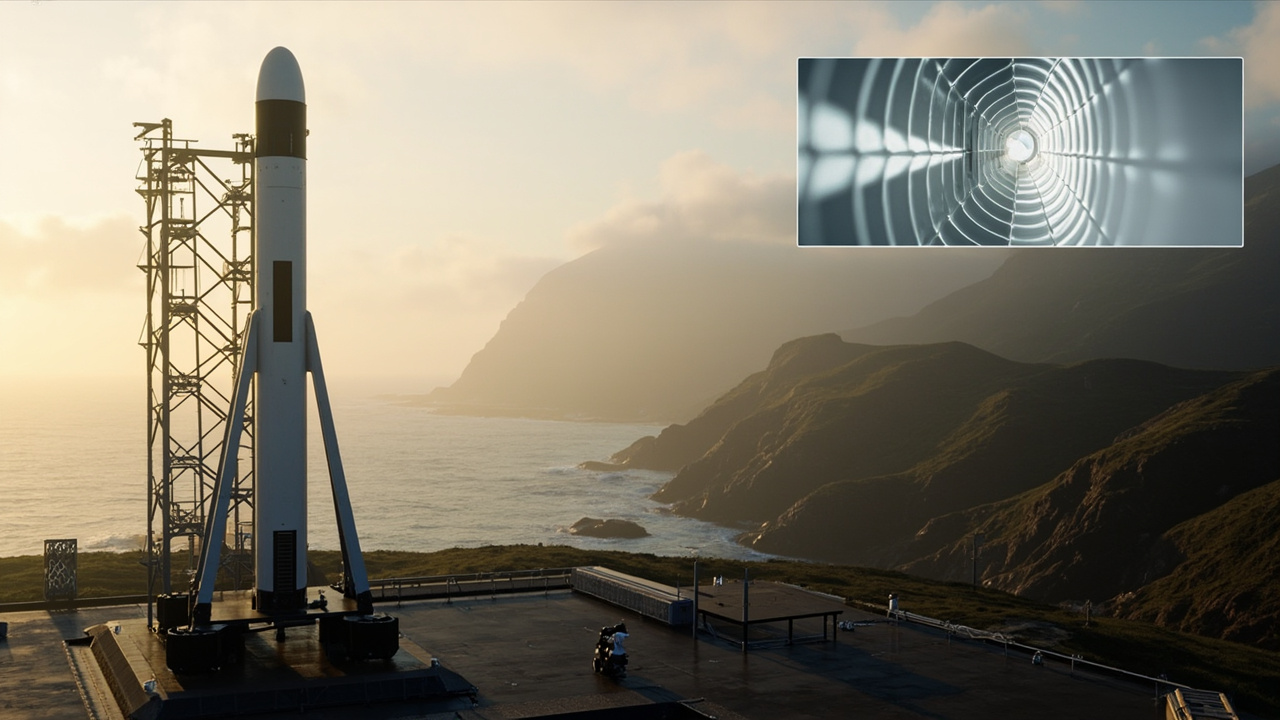
TL;DR: Synspective's 12th StriX synthetic aperture radar satellite is scheduled to launch on Rocket Lab's Electron as mission "Owl By The Dozen" on September 19 at 03:22 UTC from Launch Complex 1 on New Zealand's Mahia Peninsula.
Scheduled launch date and time
Synspective Inc. announced on September 16, 2026, the official launch schedule for its 12th StriX synthetic aperture radar satellite, according to Synspective Inc.
The 12th StriX mission is scheduled for September 19 at 03:22 UTC, according to Synspective Inc.
The company stated that the launch may be postponed or canceled due to unforeseen weather conditions or complications, according to Synspective Inc.
Synspective listed the same time as September 19 at 12:22 Japan Standard Time, according to the company's mission update shared on LinkedIn.
The company directed readers to Rocket Lab's Upcoming Missions page for the latest information, according to Synspective Inc.
The Upcoming Missions page URL provided by Synspective is https://rocketlabcorp.com/missions/launches/, according to Synspective Inc.
Launch schedules can change due to weather or technical factors, according to the company's LinkedIn mission update.
Synspective described itself as a Synthetic Aperture Radar satellite data and analytic solutions provider in the September 16 announcement, according to Synspective Inc.
The September 16 announcement identified the spacecraft as the company's 12th StriX SAR satellite, according to Synspective Inc.
Rocket and launch site
The mission will launch on Rocket Lab's Electron vehicle from Launch Complex 1 on the Mahia Peninsula in New Zealand, according to Synspective Inc.
The LinkedIn mission update identified the launch vehicle as Rocket Lab's Electron and the location as Launch Complex 1, Mahia Peninsula, New Zealand, according to the Synspective LinkedIn post.
The mission name is "Owl By The Dozen" and it is designated StriX Launch 12, according to launch tracking data compiled by Launch Library 2 and reported by Orbiter Forum.
The mission type is listed as Earth Science with a target of low Earth orbit, according to the same Launch Library 2 tracking summary.
The mission is described as a synthetic aperture radar satellite for Japanese Earth imaging company Synspective, according to the Launch Library 2 mission description.
Rocket Lab Launch Complex 1 is located at Mahia Peninsula, New Zealand, according to the Launch Library 2 launch-site listing.
The target date was listed as no earlier than September 19 at 03:15 UTC in early tracking data, according to the Launch Library 2 summary.
Synspective's later September 16 announcement specified 03:22 UTC as the scheduled time, according to Synspective Inc.
Another mission preview reported that the September 19 launch window opens at 3:15 p.m. New Zealand Standard Time, equivalent to 03:15 UTC and 11:15 p.m. EDT on September 18, according to TheCanadian.space.
Planned orbit and dedicated flight
For "Owl By The Dozen," Electron is planned to transport a single StriX spacecraft toward low Earth orbit at about 572 kilometers with an inclination of 38 degrees, according to Economiadellospazio.it.
Spaceflight Now's mission preview also lists a StriX synthetic aperture radar spacecraft bound for 572-kilometer low Earth orbit at an inclination of 38 degrees, according to Spaceflight Now.
The mission is dedicated exclusively to the Japanese operator's satellite, according to Economiadellospazio.it.
Rocket Lab has described the flight as its 12th launch on behalf of Japan-based Earth observation company Synspective, according to Spaceflight Now.
Why SAR matters for Synspective customers
Synthetic Aperture Radar observes Earth's surface using radar signals and can therefore acquire information at night and in weather conditions that can limit optical systems, according to Economiadellospazio.it.
Synspective directs that capability toward applications including disaster response, environmental monitoring, security-related activity, and infrastructure observation, according to Economiadellospazio.it.
The company is a SAR satellite data and analytic-solutions provider developing and operating small SAR satellites and selling SAR data and analysis solutions, according to Synspective Inc. and its Japanese announcement.
Its headquarters is listed as Koto-ku, Tokyo, and its chief executive is named as Motoyuki Arai in the Japanese version of the announcement, according to Synspective Inc.
The 12th satellite was developed with support from Japan's Space Strategy Fund program for acceleration of commercial satellite constellation construction, according to Synspective Inc.
A 30-satellite constellation goal
Synspective aims to build a constellation of 30 SAR satellites by the end of the 2020s to provide continuous Earth-observation capacity, according to Economiadellospazio.it.
Increasing operating assets in orbit is intended to support more frequent observations and more continuous delivery of data for the company's downstream services, according to Economiadellospazio.it.
The shift from individual satellites to a larger constellation is described as industrially relevant because more assets enable the revisit frequency needed for ongoing data supply, according to Economiadellospazio.it.
Rocket Lab has said it is the exclusive launch provider for the Synspective constellation since 2020, according to Economiadellospazio.it.
The launch provider has said it has 15 additional missions booked to support completion of the constellation before 2030, according to Economiadellospazio.it.
A separate September 16 mission roundup reported that Synspective has 16 additional missions scheduled before 2030 after the September 3 flight, according to TheCanadian.space.
Seventeen days after the previous StriX launch
The September 19 target comes 17 days after the previous StriX launch on September 2, according to Economiadellospazio.it.
The prior mission, named "Owl Around The World," launched the 11th satellite on September 2 at 12:01 UTC and reached its planned orbit, according to Economiadellospazio.it.
Synspective then started testing and commissioning before entry into service for that spacecraft, according to Economiadellospazio.it.
The ninth StriX was launched on May 22 and the 10th StriX was launched on June 26, according to Economiadellospazio.it.
If the 12th mission proceeds as announced, it would bring the number of new StriX satellites launched in about four months to four, according to Economiadellospazio.it.
A September 11 industry roundup listed the September 3 "Owl Around The World" flight as Electron's 94th overall flight and its 15th launch of 2026, according to New Space Economy.
That roundup said the September 3 mission deployed a StriX synthetic-aperture-radar satellite for Synspective, according to New Space Economy.
Factory capacity behind the flight rate
In 2024 Synspective started full-scale operations at the Yamato Technology Center, a facility dedicated to production of small SAR satellites, according to Economiadellospazio.it.
The plant was designed to reach production capacity of 12 satellites per year, a step described as necessary to support expansion toward 30 units, according to Economiadellospazio.it.
Ground production and orbital deployment are therefore presented as two parts of the same constellation-industrialization process, according to Economiadellospazio.it.
Rocket Lab's September cadence
On August 21, the "Lightning God Defends" mission deployed the ninth QPS-SAR satellite for the Institute for Q-shu Pioneers of Space Inc. to a 575-kilometer orbit, according to TheCanadian.space.
That August 21 flight was Rocket Lab's 93rd launch overall and 14th of 2026, according to TheCanadian.space.
Two weeks later, on September 3, "Owl Around The World" lifted Synspective's StriX satellite to a 575-kilometer low Earth orbit, according to TheCanadian.space.
That September 3 flight was the 94th Electron flight and 15th launch of the year, according to TheCanadian.space.
On September 11, Rocket Lab achieved its 95th overall launch with "Happily Ever Faster," deploying a single Earth-observation satellite to 500-kilometer orbit for a confidential customer, according to TheCanadian.space.
That September 11 mission was the company's 16th launch of 2026, according to TheCanadian.space.
Rocket Lab completed two Electron missions within little more than a week with the September 3 Synspective flight and the September 11 confidential-customer flight, according to New Space Economy.
The September 11 "Happily Ever Faster" mission lifted off from Rocket Lab Launch Complex 1 in New Zealand at 3:28 p.m. New Zealand Standard Time, according to New Space Economy.
Electron successfully deployed a single Earth-observation satellite for a confidential commercial customer into a 500-kilometer circular low Earth orbit on that flight, according to New Space Economy.
What dedicated small launch provides
Electron is an 18-meter-tall, two-stage launch vehicle designed primarily for dedicated and rideshare small-satellite missions, according to New Space Economy.
Rocket Lab lists its maximum payload capability at approximately 300 kilograms to low Earth orbit, according to New Space Economy.
The vehicle uses nine Rutherford engines on its first stage and a single vacuum-optimized Rutherford engine on the second stage, according to New Space Economy.
The Rutherford engine is noted for its electric-pump-fed architecture and extensive use of additive manufacturing, according to New Space Economy.
The vehicle can also use Rocket Lab's Kick Stage, which provides additional orbital maneuvering and enables placement of spacecraft into different orbital planes, altitudes or inclinations, according to New Space Economy.
Its value proposition centers on dedicated access to orbit, schedule control and precise orbital placement for smaller spacecraft rather than direct competition with vehicles such as Falcon 9, Vulcan, New Glenn or emerging medium-lift systems, according to New Space Economy.
What to watch before liftoff
As of September 16, "Owl By The Dozen" remained a mission yet to be performed, with the September 19 date subject to normal operational and meteorological launch variables, according to Economiadellospazio.it.
The operational liftoff time should be rechecked with official sources near liftoff because Synspective listed 03:22 UTC while Rocket Lab's listing showed a no-earlier-than time of 03:15 UTC, according to Economiadellospazio.it.
Rocket Lab had already announced another commercial Electron mission before the end of September beyond the Synspective flight, according to New Space Economy.
The company also confirmed that another Electron mission for a commercial constellation operator was scheduled to launch from Launch Complex 1 before the end of September 2026, according to New Space Economy.
Sources referenced
- Announcement of the Launch Schedule for Synspective's 12th StriX Satellite — Synspective Inc. (https://www.synspective.com/news/launch_window_12/)
- Electron • ‘Owl By The Dozen’ – Spaceflight Now (https://spaceflightnow.com/launch/electron-owl-by-the-dozen/)