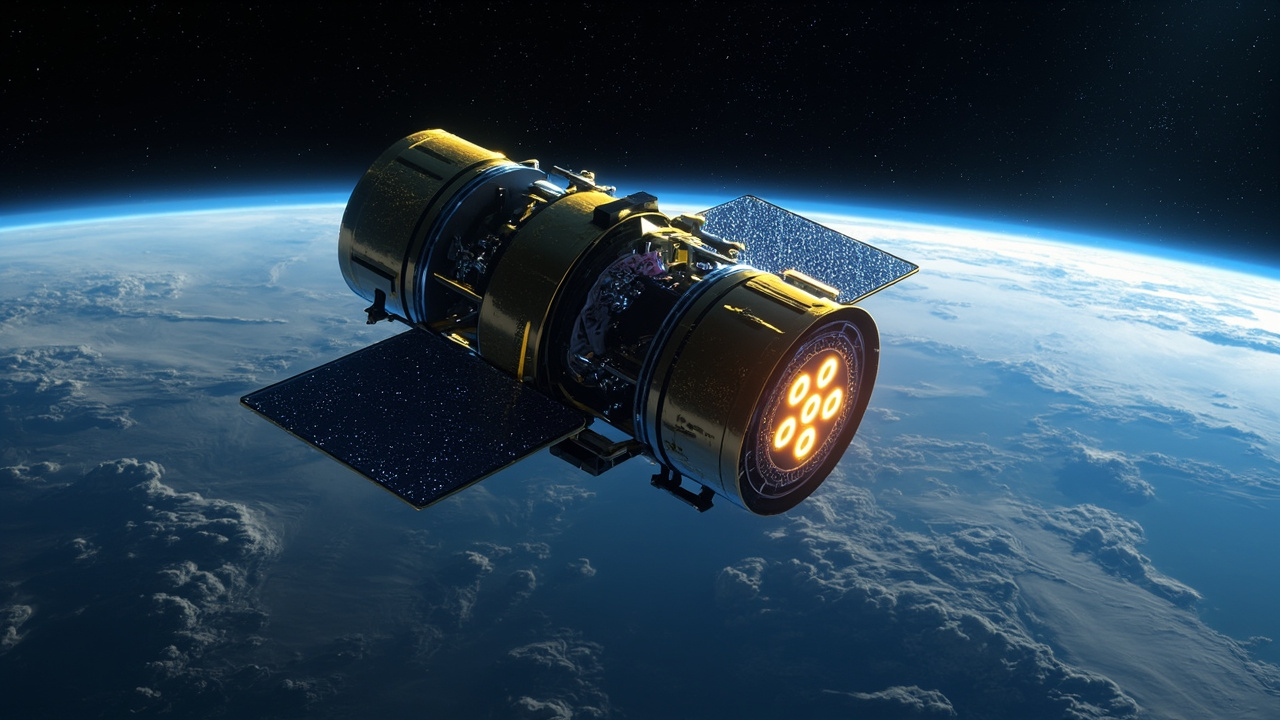
TL;DR: Google will fly four Trillium TPUs aboard a Planet-built prototype called MVP on SpaceX's Transporter-18 rideshare around October 1 to measure AI-chip survival in orbit under Project Suncatcher.
Google is about to learn whether the processors that train its models on the ground can also think in orbit.
The company said on Sept. 24, 2026, that its first Project Suncatcher test satellite will ride to low Earth orbit next week to gather direct data on how Tensor Processing Units respond to launch stress, radiation and vacuum heat. The flight is framed as a research step, not a working data center, aimed at deciding if constellations of solar-powered machines could one day support large machine-learning workloads away from terrestrial power limits, according to the Google Research blog post “Behind Project Suncatcher, our moonshot to put AI in space.”
That announcement places Google alongside other U.S. ventures studying orbital computing, at a moment when power demand for artificial intelligence is reshaping infrastructure debates on Earth. The test itself is deliberately small, short-lived and instrumented to fail informatively.
What is launching, and when?
The spacecraft, nicknamed MVP, is described as roughly refrigerator-sized and built around a satellite bus supplied by Planet Labs, the San Francisco Earth-imaging company. Google integrated its own AI hardware inside rather than developing an entirely new bus for this first flight, a choice that allowed engineers to move faster toward orbit, according to reporting by Ars Technica in “Google's first Suncatcher orbital data center test launches October 1.”
Inside MVP are four Google TPUs. Power comes from solar panels rated at about one kilowatt, enough for a household microwave or hair dryer. Operations are expected to last only a few months, and active computing will occur in brief intervals rather than continuously.
The ride to orbit is SpaceX’s Transporter-18 rideshare mission aboard a Falcon 9, now targeted for Oct. 1. Rideshare flights carry multiple small payloads for different customers to low Earth orbit, which keeps cost down for an experimental mission. Google characterized the payload as a prototype intended to collect in-orbit measurements on physical stress, thermal extremes and radiation effects, as detailed in the Google Research blog post.
Reuters summarized the same plan on Sept. 24 in “Google plans first test of AI chips in space under Project Suncatcher,” noting that the company positioned the mission as its first in-orbit evaluation of whether space could host large-scale AI infrastructure in the future.
The schedule matters because the team has set 2027 as its next milestone, when it intends to place two satellites in orbit to examine satellite-to-satellite links. That later flight is still a research objective, not a commercial deployment.
Why space looks attractive for AI power
Project Suncatcher was first outlined last year as a long-term research moonshot led within Google by Senior Director of Paradigms of Intelligence Travis Beals. The central premise is energy availability: satellites in low Earth orbit can see near-constant sunlight and, according to Google, may generate up to eight times more solar power than comparable panels on Earth.
That abundance is relevant because modern AI accelerators consume large amounts of electricity and produce concentrated heat. On Earth, expanding data-center capacity can run into grid, permitting and community constraints. In orbit, sunlight is plentiful, but every other part of operating computers becomes harder.
Google’s longer-range concept envisions groups of satellites, each eventually carrying dozens of TPUs, flying in clusters and coordinating work across the formation. Data Centre Dynamics, in “Project Suncatcher: Google to launch first space data center test in orbit next week,” noted Google has previously described visions involving 81-satellite compute clusters arranged in arrays about one kilometer across. Those figures describe a direction of study, not hardware now built or funded for launch.
Before any such scaling, the team says it must answer a narrower question: can standard AI silicon, designed for air-cooled halls on Earth, function reliably above the atmosphere?
Can TPUs survive launch and radiation?
The roughly 10-minute climb to low Earth orbit subjects payloads to shaking and sustained acceleration. Google said spacecraft structures can see loads near 10 times gravity, while individual parts such as chips may experience brief forces estimated at 50 to 100 g because of how vibration moves through assemblies.
To mimic that environment, engineers shook the assembled satellite along all three axes across launch-like frequencies. Beals said the group was pleasantly surprised that the hardware held up, in comments recounted in the Google Research blog post and in Data Centre Dynamics coverage.
Radiation is the second gate. Outside much of the atmosphere, solar outbursts and cosmic rays can damage circuits or alter values mid-calculation, including single-bit errors known as bitflips. Space programs often use hardened parts or heavy shielding; Google instead flew production-style Trillium TPUs and tested them while running AI workloads inside a proton-beam facility at the Crocker Nuclear Laboratory at UC Davis.
During those runs, engineers watched for errors and their effect on model work. Initial findings indicated the Trillium devices tolerated a total ionizing dose larger than expected during a five-year mission, suggesting the silicon itself may not fail quickly in orbit. That ground result does not prove reliable operation in space, where combined heat, vacuum and actual cosmic particles interact, which is why the company says some questions can only be settled by flight.
MVP will therefore log how the four accelerators behave after real launch vibration and during exposure to the orbital radiation environment. The goal for this first trip is comparative learning to guide later designs.
Cooling may be the hardest problem
If survival is the first question, heat rejection may be the defining engineering challenge.
TPUs concentrate large thermal output in a small footprint. In a terrestrial hall, fans and liquid loops move that energy into air or water. In vacuum there is no air to carry heat away, so the only path is conduction into structures that radiate infrared energy to space.
Google said it is pursuing heat pipes paired with radiator panels. A malleable thermal interface layer couples the chips to aluminum and copper heat conduits, which spread energy across a radiator that emits it outward, as described in Ars Technica’s technical breakdown of the mission.
The team validated the approach in a thermal vacuum chamber that reproduces orbital pressure and temperature swings. Even so, capacity is limited. Ars Technica reported the cooling assembly can sustain operation for roughly 15 minutes at a time; the TPUs must then pause while radiators catch up. Google plans to run Gemini models during those windows to see how inference behaves under such duty cycling.
That stop-start rhythm underscores how early the effort remains. A future orbital facility would require far larger radiators, more efficient heat spreading, and power systems orders of magnitude beyond MVP’s one-kilowatt array to support continuous training or high-volume serving.
Lasers, clusters and the 2027 step
Long-term usefulness would also depend on networking. A single satellite cannot match a data-center hall with thousands of accelerators. Google’s concept therefore relies on clusters whose members exchange data at very high rates over short orbital distances.
Existing space laser communications often prioritize modest rates across thousands of kilometers, such as links between distant relay or broadband satellites. Suncatcher needs the opposite: very high throughput between neighbors flying in close formation. That demands precise pointing, tracking and acquisition while both ends move at orbital velocity, which Beals likened to striking a coin-sized target from miles away while both points are in motion, as quoted in the Google Research blog post and Data Centre Dynamics.
The company does not intend to demonstrate that link on MVP. Instead, engineers plan to place two satellites in orbit in 2027 to test the approach. Future designs would each host dozens of accelerators, with position knowledge shared continuously so workloads can move across the cluster.
Beals framed the sequence as methodical: fly once, understand thermal, radiation and mechanical realities, revise the design, then attempt networking. The program remains classified internally as research rather than product development.
A crowded orbital-compute field
Google is not alone in exploring the idea. Reuters noted that SpaceX and Starcloud are among companies pursuing low-Earth-orbit computing concepts that would use steady sunlight to ease terrestrial electricity pressures. Blue Origin has also discussed orbital compute possibilities this year as part of broader regulatory filings for future systems, according to Data Centre Dynamics.
The attractions cited across the industry are similar: abundant solar input, potential relief for land and grid constraints, and proximity to space-collected data. The obstacles are also shared — launch cost, debris management, heat rejection, radiation reliability and the difficulty of servicing hardware once deployed.
By starting with a Planet bus and four chips for a months-long flight, Google has chosen a lower-cost way to sample those obstacles before committing to custom spacecraft or expensive dedicated launches that a full cluster would require. Whether steady sunlight can outweigh thermal and networking penalties will depend on data MVP now begins to collect after Oct. 1.