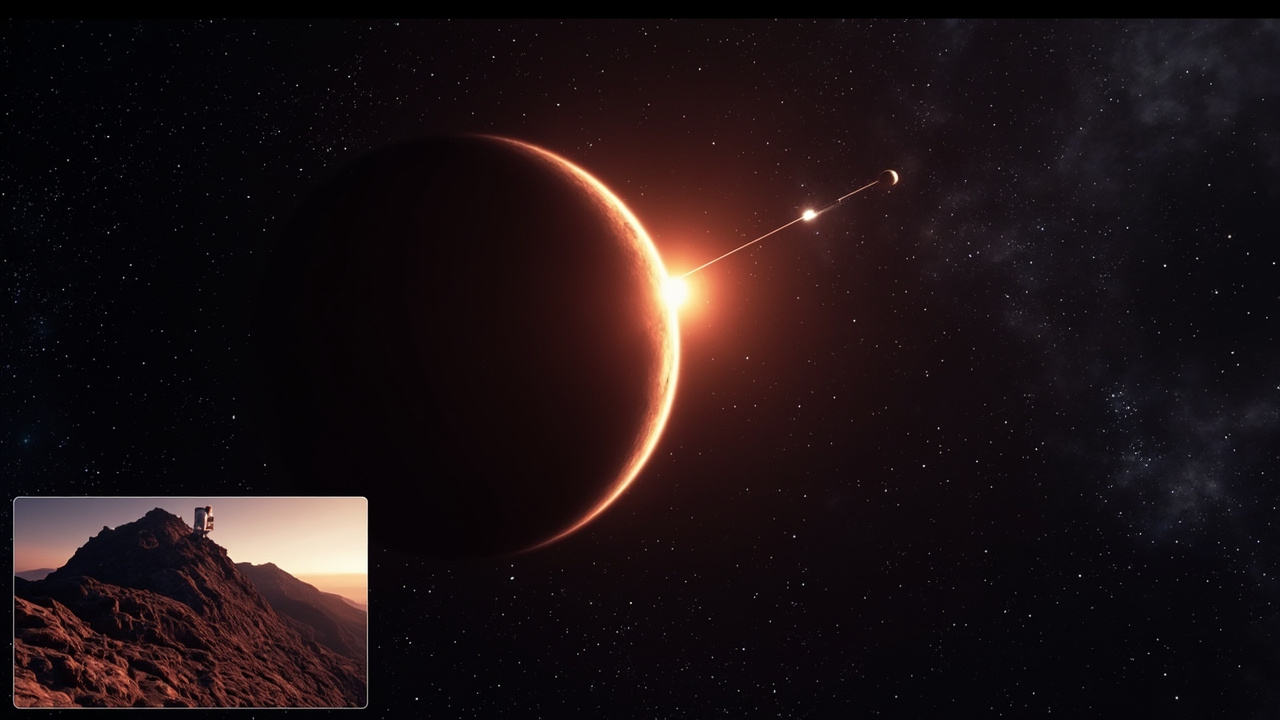
TL;DR: First Backward World Around a Cool Small Star
TL;DR: Astronomers measured exoplanet GJ 3090 b orbiting opposite its small star's spin with a 3D angle near 136 degrees.
The result, reported September 21, 2026, identifies GJ 3090 b as the first known retrograde planet around a small, cool M-dwarf star, according to Queen Mary University of London.
The planet is a sub-Neptune in a confirmed multi-planet system and the inner planet of that system, according to the University of Geneva-led team abstract posted to arXiv.
Researchers derived a three-dimensional obliquity of 136 degrees, with an uncertainty range extending 18 degrees lower and 24 degrees higher, through analysis of the Rossiter-McLaughlin effect, according to that team abstract.
The team found no evidence of a massive outer planet or wide stellar companion that could readily explain the extreme tilt, according to Queen Mary University of London.
Instead, the authors propose primordial misalignment of planet-forming material, including possible late accretion of a second misaligned disk followed by disk-driven migration, according to that team abstract.
A Neptune-Class Planet Moving the Wrong Way
GJ 3090 b is described as a small Neptune-sized planet orbiting the red dwarf GJ 3090, according to Queen Mary University of London.
The Instituto de Astrofísica de Canarias reports the planet has a radius 2.2 times that of Earth and a mass 4.5 times that of Earth.
That combination places GJ 3090 b in the sub-Neptune category, described by the Instituto de Astrofísica de Canarias as the most abundant class of exoplanets in the Galaxy.
GJ 3090 itself is a red dwarf that is cooler and smaller than the Sun, according to the Instituto de Astrofísica de Canarias.
The host is further classified as an M dwarf of subtype M2 in the University of Geneva-led team abstract posted to arXiv.
GJ 3090 b was first detected by NASA's TESS space telescope, which searches for small periodic dips in stellar brightness caused when a planet passes in front of its star, according to the Instituto de Astrofísica de Canarias.
NIRPS observations later confirmed the presence of GJ 3090 b, measured its mass, and detected two other planets in the system, according to the Instituto de Astrofísica de Canarias.
The published research appears in Astronomy & Astrophysics, with Queen Mary University of London specifying Astronomy & Astrophysics Letters as the venue.
The study was led by the University of Geneva and included researchers from Queen Mary University of London and the Instituto de Astrofísica de Canarias, according to those institutions.
Queen Mary participant Andrew Winter is identified as a lead author, while Geneva doctoral student Yann Carteret is identified as first author, according to Queen Mary University of London and the Instituto de Astrofísica de Canarias.
Why Astronomers Expected Alignment
Stars and planets form when a cloud of gas and dust collapses and creates a disk around the nascent star, according to the Instituto de Astrofísica de Canarias.
That protostar and its disk then rotate in the same direction, according to the Instituto de Astrofísica de Canarias.
Planets forming in the disk are therefore expected in the ideal case to orbit in the same direction as stellar rotation and near the stellar equatorial plane, a configuration astronomers call aligned, according to the Instituto de Astrofísica de Canarias.
Queen Mary University of London gives the same basic expectation, stating that planets should initially inherit the rotation direction of their birth disk.
In the Solar System, the eight planets orbit in the same direction as the Sun, with angles between their orbital planes and the solar equatorial plane ranging from approximately 3 to 7 degrees depending on the planet, according to the Instituto de Astrofísica de Canarias.
For Earth, that angle is just over 7 degrees, according to the Instituto de Astrofísica de Canarias.
That small Solar System deviation may reflect perturbations during formation, such as an encounter with another star or asymmetric collapse of the initial cloud, according to the Instituto de Astrofísica de Canarias.
Against that background, an angle near 136 degrees is not a modest tilt, but motion in the opposite direction to stellar rotation, according to Queen Mary University of London.
Carteret said the team found not only a highly misaligned orbit but also retrograde motion opposite stellar rotation, according to the Instituto de Astrofísica de Canarias.
Winter said the planet is not simply tilted relative to its star but is orbiting in the opposite direction, according to Queen Mary University of London.
How the Backward Orbit Was Measured
The team used six transit observations obtained with NIRPS and HARPS, according to the University of Geneva-led team abstract posted to arXiv.
NIRPS, the Near-Infrared Planet Searcher, is an ultra-stable spectrograph installed on the ESO 3.6-metre telescope at La Silla Observatory in Chile, according to the Instituto de Astrofísica de Canarias.
Spain's involvement in NIRPS development was coordinated by the Instituto de Astrofísica de Canarias, which contributed to design, development and commissioning of the instrument's fibre bundle, according to that institute.
Using high spectral resolution and high temporal cadence spectroscopic observations, the researchers analyzed the Rossiter-McLaughlin effect induced by GJ 3090 b to determine orbital obliquity, according to the University of Geneva-led team abstract posted to arXiv.
The Rossiter-McLaughlin measurement was performed with the RM Revolutions technique, according to that team abstract.
The analysis yielded a three-dimensional obliquity of 136 degrees, lower bound 118 degrees and upper bound 160 degrees based on the stated uncertainties, according to that team abstract.
Queen Mary University of London separately reports an orbital obliquity of approximately 136 degrees and states that the value confirms retrograde motion.
IAC researcher Jonay González said NIRPS performance in the infrared provided the precision needed to measure the angle between the orbital plane of such a small planet and the stellar equatorial plane, according to the Instituto de Astrofísica de Canarias.
González leads the Spanish contribution to the project and is a co-author of the study, according to the Instituto de Astrofísica de Canarias.
Other IAC participants listed are Vera M. Passegger, Rafael Rebolo, Alejandro Suárez Mascareño and Atanas Stefanov, according to the Instituto de Astrofísica de Canarias.
No Giant Companion Found
Retrograde orbits are often thought to result from dramatic gravitational interactions, in which a massive planet or companion star disturbs a planet's orbit and tilts it over time, according to Queen Mary University of London.
The researchers therefore searched for evidence of another massive object in the GJ 3090 system, according to Queen Mary University of London.
Their observations found no evidence for a wide stellar companion or a sufficiently massive outer planet that could readily explain the extreme misalignment, according to Queen Mary University of London.
The University of Geneva-led team abstract posted to arXiv similarly states that the team found no evidence of massive outer planetary or wide stellar binary companions.
That absence disfavors scenarios involving gravitational perturbations from a massive body and instead points toward primordial misalignment of the protoplanetary disk, according to that team abstract.
Carteret said the team looked for the kind of massive companion that could have forced the planet into such an extreme orbit but did not find evidence for one, according to Queen Mary University of London.
That outcome makes the system particularly intriguing because a familiar dynamical explanation is unavailable, according to Queen Mary University of London.
The result establishes GJ 3090 b as the first planet on a retrograde orbit discovered around an M dwarf, according to that team abstract.
It is also described as the first highly misaligned confirmed multi-planet system without a known massive companion, according to that team abstract.
One of Few Extreme Multi-Planet Tilts
The angle Psi for GJ 3090 b is approximately 136 degrees, according to the Instituto de Astrofísica de Canarias.
Only five other multiplanetary systems are known to host a misaligned planet with an angle greater than 70 degrees, according to the Instituto de Astrofísica de Canarias.
Unlike those other systems, there is no evidence of a massive object orbiting GJ 3090 that could be responsible for the configuration, according to the Instituto de Astrofísica de Canarias.
Measuring Psi provides clues about formation and evolution of planetary systems, which is why researchers try to measure it for other systems, according to Carteret as quoted by the Instituto de Astrofísica de Canarias.
GJ 3090 b is the smallest planet around an M dwarf for which a three-dimensional orbital obliquity has been measured, according to Queen Mary University of London.
That measurement provides an important new target for understanding the diversity of planetary systems, according to Queen Mary University of London.
The work also illustrates the capability of the RM Revolutions technique applied to near-infrared data to probe orbital architectures of the smallest planets around M dwarfs that had remained mostly inaccessible, according to the University of Geneva-led team abstract posted to arXiv.
The study demonstrates the growing importance of near-infrared observations for studying planets around M dwarfs, described as the small, cool stars that make up the majority of stars in the Galaxy, according to Queen Mary University of London.
A Second Disk May Explain the Flip
Vincent Bourrier, lecturer and researcher in astronomy at the University of Geneva, said the absence of a massive companion will lead the team to explore other hypotheses, according to the Instituto de Astrofísica de Canarias.
Bourrier proposed that GJ 3090 could have accreted a misaligned, retrograde secondary disk in which the system's planets then formed, according to the Instituto de Astrofísica de Canarias.
Queen Mary University of London describes the same possibility: the star may have acquired a second, misaligned disk of gas and dust from its surroundings.
Planets forming from that later material would inherit its unusual orientation, according to Queen Mary University of London.
If that explanation is correct, the backward orbit would not necessarily result from a later violent encounter, according to Queen Mary University of London.
Instead, it could preserve evidence of unusual conditions present while the planetary system formed, according to Queen Mary University of London.
The University of Geneva-led team abstract posted to arXiv proposes late secondary disk accretion around GJ 3090, in which the disk is not expected to be aligned with stellar spin, followed by disk-driven migration as the most likely mechanisms for the observed architecture.
Bourrier added that the idea of a planetary system being rebuilt from a second, differently oriented disk is particularly exciting, according to Queen Mary University of London.
He said it suggests the environment around a young star can play a much larger role in determining planetary architecture than might have been expected, according to Queen Mary University of London.
The researchers say further observations will be needed to test the proposed formation scenario and determine whether other systems contain similarly extreme configurations, according to Queen Mary University of London.
The full study is listed as Yann Carteret et al., “Upside down: GJ 3090 b the first retrograde exoplanet around an M dwarf detected with NIRPS,” Astronomy & Astrophysics, Volume 713, September 2026, according to the Instituto de Astrofísica de Canarias.
Sources referenced
- First 'backwards' planet discovered around a small star challenges ideas about how planets form - Queen Mary University of London (https://www.seresearch.qmul.ac.uk/news/5719/first-backwards-planet-discovered-around-a-small-star-challenges-ideas-about-how-planets-form/)
- A rebellious exoplanet orbits in the opposite direction of its star - Instituto de Astrofísica de Canarias (https://www.iac.es/en/outreach/news/rebellious-exoplanet-orbits-opposite-direction-its-star)