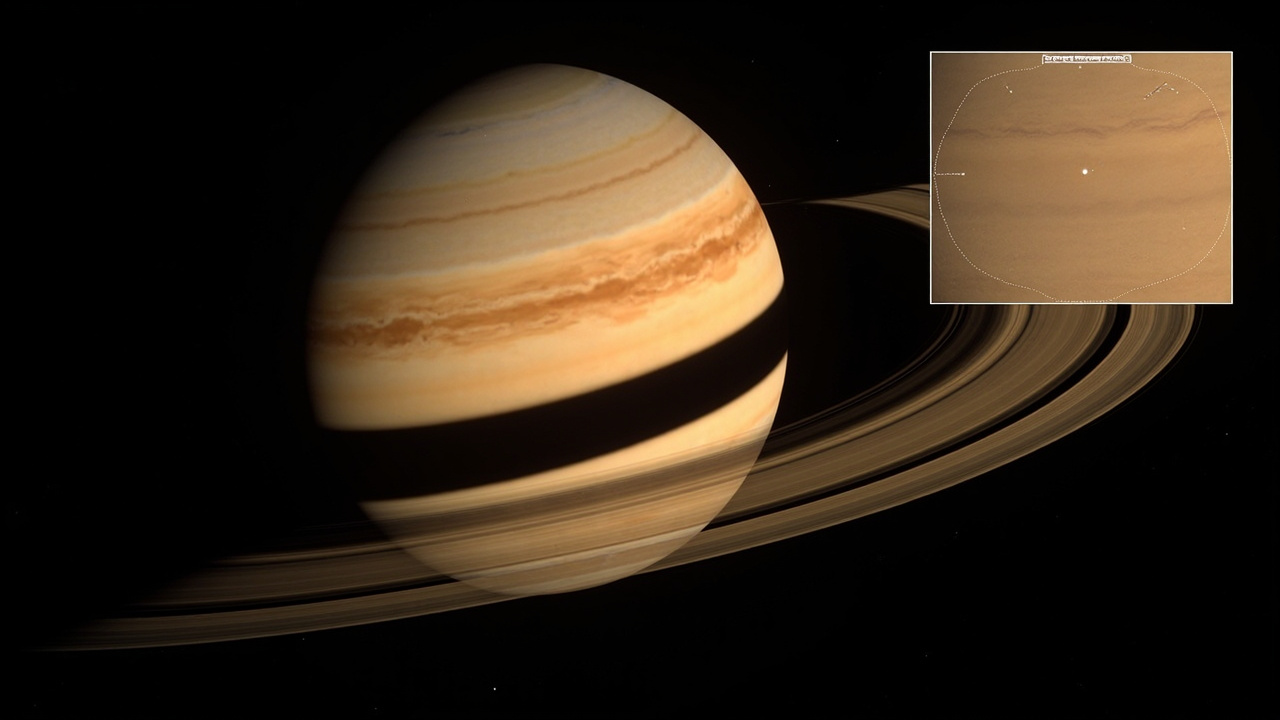
TL;DR: Hubble and ground telescopes caught a giant 10-sided jet wave circling Saturn's south pole that was faint in 2023 and sharply defined by 2025.
Astronomers have found a huge, evolving decagon encircling Saturn's south pole, the first large, regular-sided jet pattern ever seen in the planet's southern hemisphere.
The result was published in the journal Science Advances in the paper titled "A decagon wave around Saturn's south pole," according to the ESA/Hubble release titled "Hubble tracks new decagon encircling Saturn's south pole." By assembling Hubble Space Telescope images from 2023 through 2025, the team traced the feature from faint hints to a clearly outlined 10-sided loop. Those images came from Hubble's Outer Planet Atmospheres Legacy (OPAL) program, which has photographed the outer planets annually for more than a decade.
Study co-author Amy Simon, OPAL principal investigator at NASA's Goddard Space Flight Center in Greenbelt, Maryland, said the northern hexagon has appeared on every suitable look for more than 40 years, while the southern feature appears to be strengthening. That contrast gives researchers a rare chance to watch a planet-scale polygonal pattern develop rather than studying one that was already stable.
Why the south pole just came back into view
Saturn's seasons control what Earth can see. Because of the planet's axial tilt, the southern hemisphere faded from Earth view in mid-2012 and only became observable again in 2023, the Science Advances paper reports.
That returning view mattered. In October 2023, Hubble red-filter images at wavelengths longer than 600 nanometers showed a 10-sided structure near planetographic latitude 63°S. In August 2024, with a better viewing angle, sides and vertices were easier to recognize, although contrast varied around the circle.
Ground observers played a central role. Agustín Sánchez-Lavega, lead author and researcher at the University of the Basque Country in Spain, works with the university's Planetary Virtual Observatory Laboratory, a site that collects ground-based planet images contributed worldwide. According to the ESA/Hubble release, Sánchez-Lavega and amateur astronomers Trevor Barry and Jean-Paul Oger first noticed a subtle undulating band near the south pole in 2024 images. Additional ground-based imagery in 2025 strengthened the case for a decagonal shape.
Hubble then supplied the sharper test. From orbit, the telescope avoids blurring by Earth's atmosphere and can follow Saturn through full rotations with consistent sharpness and spatial resolution. The Hubble data confirmed the feature's presence back to 2023 and documented its year-to-year growth.
Where the decagon sits and how big it is
The decagon occupies planetographic latitudes about 58°S to 63°S, the paper's abstract states. In red continuum filters at 631, 727, 763 and 937 nanometers, the wave center was 63°S plus or minus 0.4 degrees. In the strong 889-nanometer methane band, which samples higher aerosols, the center appeared displaced equatorward to 60.5°S plus or minus 0.4 degrees.
That wavelength dependence is scientifically important. Different Hubble wavelengths probe different altitudes, so the small shift in apparent position indicates a structure that extends through multiple atmospheric layers rather than a marking confined to one cloud deck. The ESA/Hubble release describes it as a vertically extended atmospheric structure seated within one of Saturn's powerful jet streams.
The paper gives a wave number of 10 and a mean zonal wavelength of 16,782 kilometers plus or minus 1,100 kilometers. Edges of crests and troughs trace a sinusoidal oscillation with a peak-to-peak latitudinal amplitude of 2.7 degrees plus or minus 0.3 degrees, equivalent to 2,645 kilometers.
A related banded structure appears outside the main decagon. At 763 nanometers, the authors describe a less-defined decagonal undulation in a dark belt centered at 53°S in 2023 and 2024 and at 58°S in 2025. In 2025, the undulation also appeared as a white band at 889 nanometers near 58.8°S. The bands are about 2 to 3 degrees wide in latitude, or roughly 2,000 to 3,000 kilometers, with meridional brightness profiles indicating that the pattern reaches from deeper clouds into upper-tropospheric aerosols.
How fast it moves
The decagon does not simply ride the local wind at full speed. The abstract reports eastward motion at 2.5 meters per second, much slower than the zonal jet at 60.5°S, which flows at 116 meters per second.
The vertices also wobble. Their longitudes oscillate with a period of 32 days and amplitudes of 4.6 to 8.4 degrees. That combination — slow bulk drift plus month-scale longitudinal oscillation — helps distinguish a wave from a passively carried cloud marking.
By August and September 2025, Hubble showed all 10 vertices, but not with equal strength. Three vertices and adjoining sides were very prominent, four were less prominent, and three were less defined. In 2023 and 2024, the vertices had weaker albedo contrasts, although linear sides were already visible, supporting the interpretation of an evolving phenomenon rather than a sudden instrumental artifact.
A southern counterpart — but not a twin — to the hexagon
Saturn's north polar hexagon is the obvious comparison. It was found in Voyager flyby images in 1980-1981 and has since been recorded by ground telescopes, Hubble and the Cassini spacecraft, implying a lifetime exceeding 44 years, the paper states. The northern wave is centered near 78.5°N planetographic latitude, sits on an eastward jet with peak speed near 100 meters per second, and remains nearly stationary in longitude relative to Saturn's System III radio-rotation period.
Researchers long suspected that southern subpolar jets near 60°S and 73.6°S might host an analogous wave because Saturn's zonal jet system is broadly symmetric and long-term stable. No durable southern polygon had been reported, although Cassini saw an ephemeral partial polygonal feature in 2004.
Sánchez-Lavega said the team has searched Hubble images since 1990 for a southern counterpart to the northern hexagon, according to the ESA/Hubble release. Images from NASA's Cassini spacecraft, which orbited Saturn from 2004 to 2017, also showed no sign of a long-lived southern formation. Against that long non-detection, the emergence of a strengthening decagon after 2023 stands out.
The shapes also differ. Six sides versus 10 sides implies a different dominant wave number, and the southern feature is currently changing while the northern hexagon has been persistent. That difference is why the authors describe the decagon as similar in family yet distinctly different.
What may be driving it
From its scale and setting, the authors interpret the decagon as potentially a large-scale meandering wave trapped vertically and confined meridionally by the curvature of the dominant jet, the abstract states.
Numerical experiments point to two possibilities. Shallow-water model simulations suggest the decagon may have grown from a spatially periodic disturbance at the jet peak, or it may have been driven by a dark anticyclonic vortex immediately to the north. The paper does not claim a settled cause; both remain modeled explanations to test against further observations.
The vortex idea has context in giant-planet meteorology, where nearby eddies can perturb jets and excite stable wave numbers. The jet-peak disturbance idea instead places the origin within the jet itself. Distinguishing them will require tracking how vertex spacing, drift and amplitude evolve alongside neighboring winds and vortices.
Why Hubble, OPAL and amateurs all mattered
The discovery depended on time coverage rather than a single portrait. OPAL's annual outer-planet imaging supplied comparable Hubble views across 2023, 2024 and 2025. Ground-based patrol images supplied frequent coverage and first drew attention to the waviness.
Mike Wong, study co-author at the University of California, Berkeley, said many OPAL findings rest on years of data rather than one observation, with regular long-term monitoring enabling new results, according to the ESA/Hubble release. Simon said further study with Hubble and the NASA/ESA/CSA James Webb Space Telescope, plus computer models, is needed to establish how the decagon formed, how long it may last and how closely it compares with the northern hexagon.
The team plans continued Saturn monitoring to determine whether the decagon settles into a durable configuration resembling the northern hexagon or keeps evolving. Future work may also clarify what the wave reveals about atmospheric dynamics on giant planets and their possible analogies to circulation patterns on Earth, questions the researchers list as open rather than answered.
For now, the verified picture by Sept. 1, 2026 is narrow and striking: a 10-sided wave near 58°S to 63°S, faint in 2023, clearer in 2024, fully outlined but uneven in 2025, drifting slowly eastward while its corners oscillate on a 32-day rhythm inside a far faster jet.
Sources referenced
- Hubble tracks new decagon encircling Saturn’s south pole | ESA/Hubble (https://esahubble.org/news/heic2612/)
- A decagon wave around Saturn’s south pole | Science Advances (https://www.science.org/doi/10.1126/sciadv.aee4251)